For most of my life, understanding the who’s who of elections has been fairly simple. Republicans and Democrats were all we had. Now and then someone would call himself or herself an independent.
In the the national elections, an occasional misfit with no chance of winning would claim to be a member of the Prohibition Party, the Green Party, the Communist Party USA or the like. Mainly, however, with just good old vanilla Democrats and Republicans, we knew who to vote for — because our family political label had been passed down generation to generation.
Today the task is not so easy. Vanilla has been replaced by the entire inventory of the Ben & Jerry’s ice cream company.
So, to help you figure out the labels being tossed about by candidates running in the November election, I offer the following summaries of definitions I have either read online or just made up:
Conservative: Someone who will throw a 10-foot long rope to a man drowning 50 feet out in the river, so the man can improve his character by swimming to the end.
Liberal: Someone who will throw a 50-foot rope to the same drowning man, but will lose interest and walk away about the time the man grabs the end.
Social conservative: Someone who believes laws are needed to make everyone go to his or her church.
Fiscal conservative: Someone who wants to balance the federal budget and pay off the national debt without having to go to someone else’s church.
Libertarian: A candidate who believes the office he or she is running for should be eliminated.
Anarchist: A libertarian with bombs.
Conservative Libertarian: A person who wants government to stay out of his or her life, unless the intrusion is for the purpose of straightening out the moral shortcomings of liberals.
Liberal Libertarian: A person who wants government to stay out of his or her life, unless the intrusion is for the purpose of straightening out the moral shortcomings of conservatives.
Populist: Someone in pain who votes for the candidate with the most simplistic solutions and the loudest mouth.
Of course, even if you are informed on the labels, you can’t just go ahead and vote on the basis of what a candidate claims to be or claims his or her opponent to be. Politics, to a degree, has always been about lies — from the tiny shading of truth to attract “the uncommitted” to the complete whopper to energize “the base.”
About 150 years ago, Mark Twain offered some good advice about lying that many politicians have adhered to ever since. He said a good lie contains no truth at all. He believed if you offer even a fragment of truth in the midst of a lie, the listener could use that piece of truth to research the entire statement and find out you are lying. With no truth at all, you can’t be checked.
Of course, those were the days before cable TV “news” channels and the vast wasteland of conspiracy theories, vile manipulation and ignorance on the internet. In those arenas, political “truth” is found in whatever supports what a voter already believes.
Along that line, a newspaper reader once called me to object to an opinion column I had written, saying, “This is America and everyone has an equal opinion.”
I told him everyone should have an equal right to an opinion, but that all opinions were not equal. If they were, “the inmates would run the asylum.”
In the campaign wars building toward November, we might all try to be a bit more skeptical about both the labels and the so-called “gospel truth” we are fed from the stump speeches.
If Lincoln were alive today, his famous quote about lies might be changed to note: “You can fool some of the people some of the time and all of the people some of the time, and that is sometimes enough to get elected.”
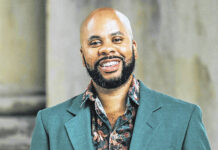
Bud Herron is a retired editor and newspaper publisher who lives in Columbus. He served as publisher of The Republic from 1998 to 2007. His weekly column appears on the Opinion page each Sunday. Contact him at editorial@therepublic.com