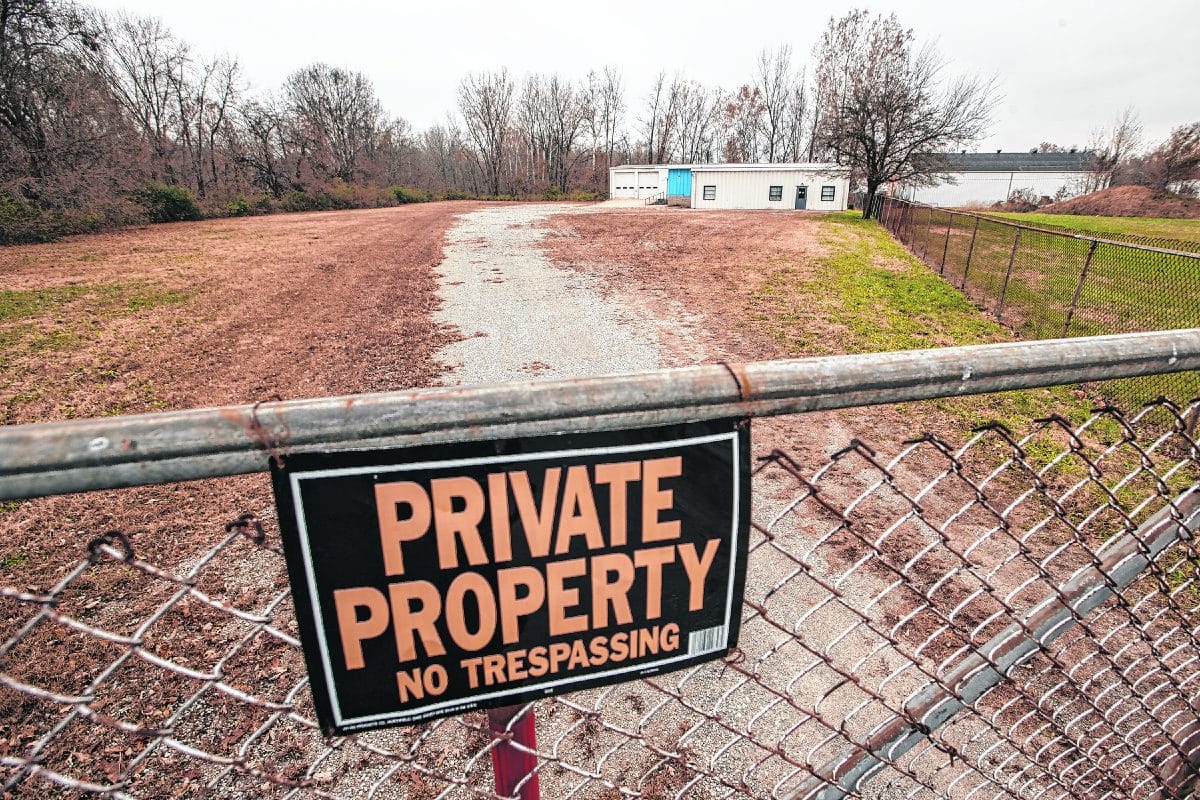
State officials have determined that an environmentally-contaminated property that the Columbus Parks Board purchased from Mayor Jim Lienhoop’s aunt is eligible for remediation funding.
The funding will come from the Indiana Brownfields Program’s Petroleum Orphan Sites Initiative, or POSI, and potentially cover the costs of remediating the former Machinery Moving Inc. site at 1360 Jackson St.
Columbus Parks and Recreation plans to use the facility as a storage facility for parks equipment.
The brownfields initiative seeks to help communities across the state address petroleum contamination caused by leaking underground storage tanks, or USTs, that “cannot be addressed by the party responsible for cleanup as a result of an inability-to-pay, bankruptcy or other factors,” according to the program’s website.
[sc:text-divider text-divider-title=”Story continues below gallery” ]
Brownfields program representatives have not responded to inquiries about who was determined to be the party responsible for cleanup on the Jackson Street property and what criteria was used to determine the property’s eligibility.
Lienhoop has recused himself from all negotiations or decisions about the building.
Columbus Parks Director Mark Jones said Norma Lienhoop, the property’s former owner, did not receive any special treatment from the city at any point during the negotiations for the sale of the property.
“After evaluating all the facts pertaining to ownership and operational history and potential liability under applicable UST laws/regulations, (Indiana Department of Environmental Management’s) UST Section and the (Indiana Finance Authority’s) Brownfields program have concluded that the site is eligible for financial assistance through POSI,” said Stephanie McFarland, spokeswoman for the Indiana Finance Authority’s Brownfields Program, in a statement to The Republic. “At this time, the program is prepared to proceed with developing a scope of work and putting the project out to bid to its pool of qualified consultants.”
The city formally acquired the Jackson Street property on Aug. 1, two days after the Columbus Board of Public Works approved the transfer of the property to the city, according to public records. On July 24, the city’s park board approved an agreement at a special meeting to purchase the property for $205,000. The purchase amount will be paid in annual installments of $34,166.67, according to the purchase agreement.
Earlier this year, Ark Engineering, an outside contractor hired by the city, determined that soil and groundwater on the property were above state thresholds for several environmental contaminants, including benzene, ethylbenzene, 1,2,4-trimethylbenzene, 1,3,5-trimethylbenzene, xylenes, 1-methylnaphthalene, 2-methylnaphthalene and naphthalene.
The contractor said the contaminants were likely due to three underground fuel storage tanks that were used on the property in the 1970s.
Machinery Moving officials notified IDEM on April 25, 1990 that the three tanks had been removed in November 1989, according to records obtained from the Indiana Department of Environmental Management.
However, it is unclear from the records if Machinery Moving conducted a site inspection to check if the tanks were leaking when they were removed, which IDEM officials instructed the company to do in 1989.
In a letter dated Oct. 16, 1989, an IDEM official told Machinery Moving that “a site assessment (soil borings or soil samples) must be performed… to assess whether a release has occurred.”
IDEM does not have any report of Machinery Moving conducting a site inspection when the tanks were removed, and the company did not notify IDEM that it was aware of any contaminants being released from the tanks, said Barry Sneed, IDEM spokesman.
Owners and operators of the USTs are required to report contamination at regulated UST facilities if they learn that contaminants have been released, but IDEM is not sure if Machinery Moving was aware of any contamination when the company removed the tanks, Sneed said.
“While Machinery Moving has not formally reported a release to the IDEM Leaking UST Section, IDEM has received a Phase II Investigation Report prepared for the city of Columbus by Ark Engineering dated January 2019 and is aware of the contamination discovered,” Sneed said. “Owners and operators of underground storage tanks are required to report contamination from UST systems within 24 hours of discovery, assuming they are aware of a release. IDEM does not know whether Machinery Moving knew of a release when it removed the tanks. The Phase II investigation was prepared for the city of Columbus, and IDEM has no knowledge of when, or if, this information was shared with the property owner, Machinery Moving Inc.”
The funds used by the city to purchase the property will come from unspent money in the Columbus Parks and Recreation’s allotment of the city’s capital fund, city officials said. The city expects the Indiana Brownfields Program’s Petroleum Orphan Sites Initiative to pay for the environmental remediation of the site.
The U.S. Environmental Protection Agency defines a brownfield as a “property, the expansion, redevelopment or reuse of which may be complicated by the presence or potential presence of a hazardous substance, pollutant or contaminant.”
The Brownsfield initiative receives funding from the Indiana Department of Environmental Management’s Excess Liability Trust Fund, which is funded by an “inspection fee” that the Indiana Department of Revenue levies on every barrel of fuel, Sneed said.
“That tax is then passed down to the consumer in the form of a $0.01 per gallon gas tax,” he said.
[sc:pullout-title pullout-title=”About the Indiana Brownfields Program” ][sc:pullout-text-begin]
Visit www.in.gov/ifa/brownfields to learn more about the Indiana Finance Authority’s Brownfields Program.
The U.S. Environmental Protection Agency defines a brownfield as a "property, the expansion, redevelopment or reuse of which may be complicated by the presence or potential presence of a hazardous substance, pollutant or contaminant."
[sc:pullout-text-end]