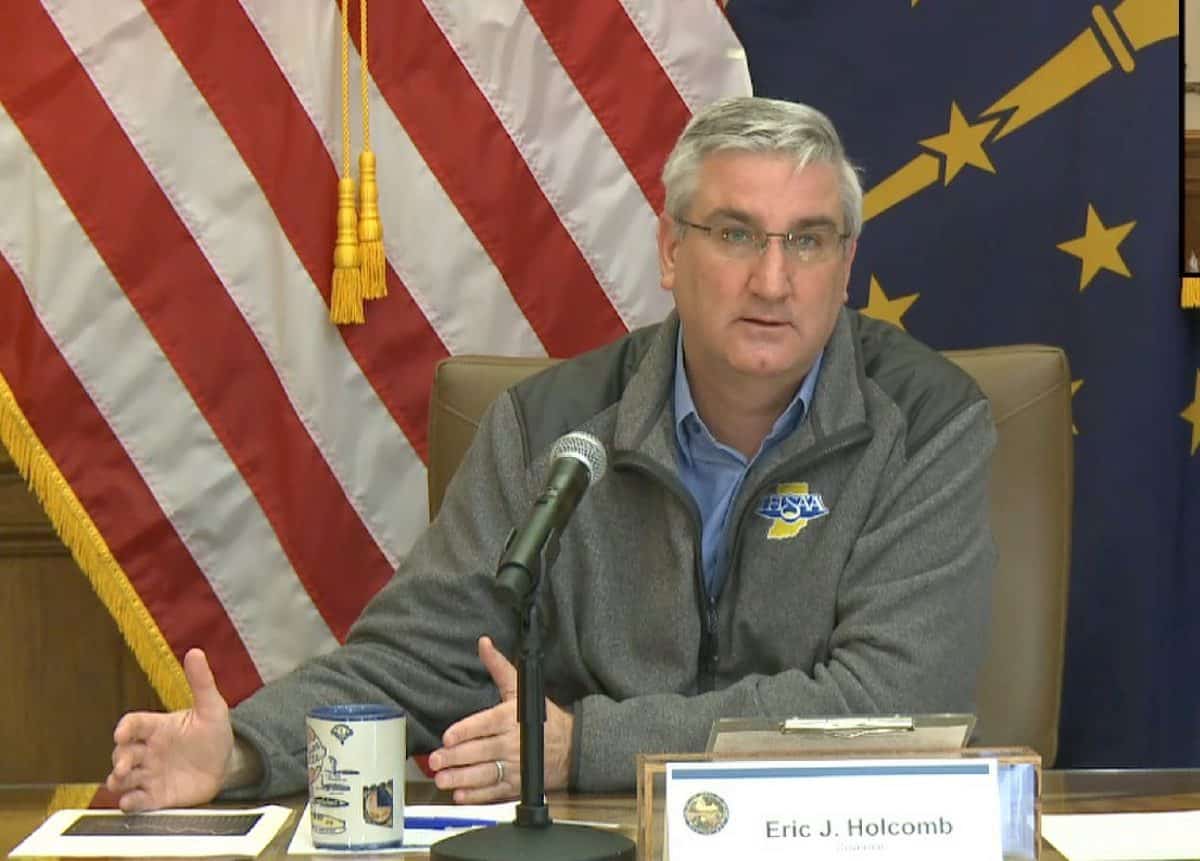
INDIANAPOLIS — Gov. Eric Holcomb and state health officials on Monday said they have ramped up the number of ICU beds, ventilators and testing capacity across the state as hospitals scramble to prepare to handle an expected wave of COVID-19 patients in the coming weeks.
State officials project that Indiana is at “the very beginning” of a surge in COVID-19 patients, with nearly 1,000 people currently hospitalized across Indiana with symptoms consistent with COVID-19 using roughly 31% of the state’s ICU beds and 19% of the state’s supply of ventilators, according to figures provided by Indiana State Health Commissioner Dr. Kris Box on Monday.
Over the past few weeks, however, Indiana has roughly doubled the number of ventilators available at hospitals, and will increase the number of ICU beds and the number of tests that can be processed daily from 3,700 to 6,300 in the coming weeks, Box said.
As of Saturday, there were a total of 2,964 ICU beds across the state, compared to 1,132 on March 1, according to state figures. The number of ventilators at Indiana hospitals has jumped from 1,377 on March 30 to 2,642 as of Sunday, with another 455 that could potentially be used, Box said.
As of Sunday, there were 1,243 available ICU beds in the state and 1,839 ventilators, according to state figures.
In addition, Indiana has received personal protective equipment from what could be the state’s final shipment from the Strategic National Stockpile, including 113,308 surgical gowns, 186,060 N95 masks, 186,060 surgical masks, 85,920 face shields, 295,150 gloves and 2,313 coveralls, Box said.
The equipment would last an estimated 12.7 days at peak patient capacity, though hospitals are still receiving personal protective equipment through their normal supply chains, Box said.
“We’re not sure if we’ll be receiving any additional supplies from the National Strategic Stockpile at this time,” Box said. “We are continuing to make requests through FEMA and will work to buy personal protective equipment anywhere we can. But until I actually have those supplies in my hand, I cannot promise that we can replenish anyone’s (personal protective equipment).”
“That is the reality that every state across the United States is facing at this time,” she added.
The updates from state officials came one day after the U.S. Surgeon General Jerome Adams warned Americans to brace for the “the hardest and saddest week” of their lives as the number of cases and deaths from COVID-19 are expected to rise.
On Sunday, Adams characterized the upcoming week as a “Pearl Harbor” and “9/11” moment for the country.
“This is going to be our Pearl Harbor moment, our 9/11 moment, only it’s not going to be localized, it’s going to be happening all over the country and I want America to understand that,” Adams said.
The dire warning from Adams reflects worries among local healthcare workers about a potential surge in deaths from COVID-19, especially with a project surge in cases in Bartholomew County over the next two to six weeks, said Dr. Brian Niedbalski, county health officer.
“I am certain all in health care are worried about the potential for a spike in deaths nationwide,” Niedbalski said. “My belief is that the largest number of deaths will be occurring in metropolitan areas because of their population size. We are still expecting a rise in cases locally at some point in the next two to six weeks. I just don’t know exactly when that will take place. Furthermore, we will hopefully experience a small number of people dying from COVID-19 in Bartholomew County.”
So far, there have been 54 cases of COVID-19 reported in Bartholomew County and at least two Bartholomew County residents with the illness have died since Friday.
As of Monday, eight patients with COVID-19 were in isolation at Columbus Regional Hospital, with three listed in “stable critical” condition and five in stable condition, CRH officials said.
A total of 26 patients with COVID-19 have been hospitalized at Columbus Regional Hospital since the outbreak started.
There have been at least 356,000 confirmed cases of COVID-19 in the United States and at least 10,500 deaths, according to Johns Hopkins University.
New York state has become the epicenter of the outbreak in the United States, with at least 130,600 cases and 4,700 deaths.
But the number of cases in the country has yet to peak, according to public health experts, prompting pleas for the public to practice social distancing, proper hygiene and wear some type of mask or facial covering if out in a store among other people to reduce the spread of the virus.
“More people in New York were admitted to a hospital with the coronavirus last week than admitted for the flu in its worst week by a factor of five. That’s what we’re trying to prevent here,” Holcomb said on Monday.
[sc:pullout-title pullout-title=”Local COVID-19 cases” ][sc:pullout-text-begin]
Bartholomew County: 55, 2 deaths, 597 tests administered.
Totals listed for surrounding counties included:
Jackson County: 37 positive, 0 deaths, 141 tests administered.
Jennings County: 37 positive, 0 deaths, 76 tests administered.
Decatur County: 90 positive, 5 deaths, 131 tests administered.
[sc:pullout-text-end][sc:pullout-title pullout-title=”Where to learn more” ][sc:pullout-text-begin]
Visit the Community COVID-19 Task Force’s website at covid19communitytaskforce.org for local information.
[sc:pullout-text-end][sc:pullout-title pullout-title=”Where to call” ][sc:pullout-text-begin]
Local residents with concerns are urged to call the health system’s Triage Resource Call Center, a phone resource line launched by CRH to handle calls from residents with questions and concerns about exposure or symptoms associated with COVID-19, CRH officials said.
The phone resource line can be contacted at 812-379-4449 available seven days a week, and is staffed by registered nurses who will offer screening questions and potentially recommend a course of action for patients.
Visit crh.org/news/2020/03/16/coronavirus-update-what-you-need-to-know for more information.
[sc:pullout-text-end][sc:pullout-title pullout-title=”For more information” ][sc:pullout-text-begin]
For more information about COVID-19, including a list of frequently asked questions, visit in.gov/coronavirus.
Visit the Indiana State Department of Health in.gov/isdh/ or follow us on Twitter at @StateHealthIN and on Facebook at facebook.com/StateHealthIN.
[sc:pullout-text-end][sc:pullout-title pullout-title=”Closings and cancellations” ][sc:pullout-text-begin]
For a list of closing and cancellations, see Page A3.
[sc:pullout-text-end]