It turns out that the story of diesel engine cars at Indianapolis actually starts with the first Indianapolis 500 in 1911.
Clessie Cummins, who started the Cummins Engine Company, had crewed for Ray Harroun, who won the first Indianapolis 500 in 1911. In 1919, he started the Cummins Engine Company in Columbus. Over the years Cummins entered cars in the Indianapolis 500 in 1931, 1934 and 1950, in addition to the 1952 Indianapolis 500.
In 1952, Cummins made a profoundly serious attempt to win the Indianapolis 500. At that time, the rules allowed diesel engines to be 6.6 litres (400 cubic inches) in size, compared to 4.5 litres for normally-aspirated engines and 3.0 litres for supercharged engines. As a result, Cummins prepared a 400 cubic inch, 6-cylinder, turbocharged diesel engine that produced 380 horsepower.
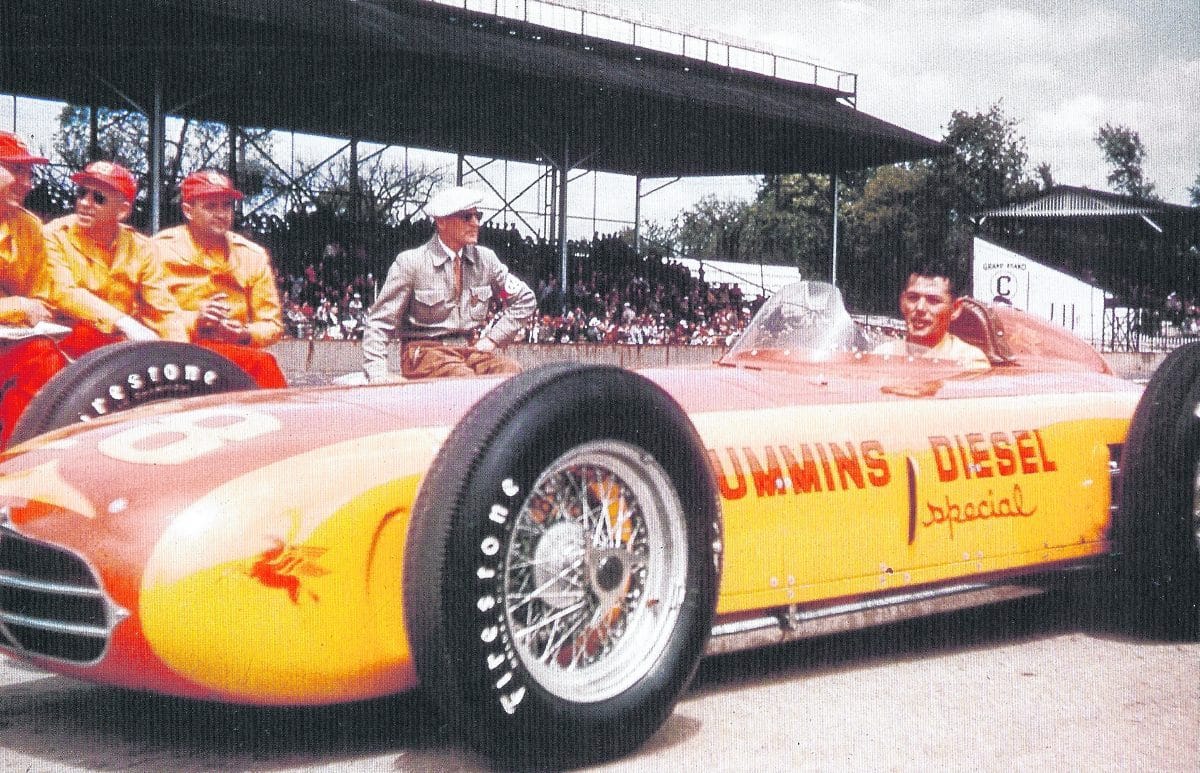
Cummins also worked very closely with Kurtis Kraft to produce a sleek design for the Cummins Diesel Special. To that time, the engines in the race cars at Indianapolis had been in an upright position.
However, with an engine that was much bigger than the other cars, this would result in a noticeably big car. To overcome some of these size problems, the motor featured an aluminum block and head with a magnesium crank case. The engine was also lain 5 degrees off flat, which provided three advantages:
- Reduced center of gravity
- Reduced the frontal area
- An offset eng
ine p
- rovided more weight on the left (inside) wheels.
The design of the Cummins Diesel Special was definitely longer and lower than the rest of the cars in the field. But it was heavier due to the larger engine.
Cummins hired Freddie Agabashian to drive the Cummins Diesel Special. After the car was tested for the first time, everyone who was involved knew that they had an extremely fast car. So the Cummins team became very secretive about the car. They said nothing.
Agabashian held back for much of the month of May while at the Indianapolis 500 preparations until Pole Day by lifting off on the back straight one lap or by cruising through a turn on another lap. He never completed a whole lap under full power so as not to draw attention to the capability of the car and risk having the rules changed.
Then at 5:45 p.m. on Pole Day, 15 minutes before the end of qualifying, Agabashian and the heavy, 3,100-pound, Cummins Diesel Special fitted with a fresh engine won the pole position for the Indianapolis 500 by setting an individual lap record of 139 mph and a record four-lap average of 138 mph. This qualifying speed was over 1 mph faster than the runner-up car. During Indianapolis’ remaining qualifying days that year, other cars went faster, but the Cummins Diesel was on the pole.
The race did not go well for the Cummins Diesel Special. The turbocharger inlet was clogged with rubber and other debris. The car had to retire after 70 laps or 180 miles as the clogging became too bad. The car is listed as finishing 27th.
Soon after, the rules were changed by taking away the possibility of large diesel engines. A diesel engine has never powered a race car in the Indianapolis 500 since that spectacular year of 1952 when the Cummins Diesel Special won the pole at the Indianapolis 500.
Agabashian was respected as a test driver. He was nicknamed “Doc” for his uncanny ability to diagnose what was wrong with a sick car. Only a regular in the AAA National Championship (now IndyCar) for two seasons, he earned a comfortable living racing midgets instead.
The eldest son of Armenian immigrants, Agabashian started racing those small cars during the mid-1930s and won the 1937 Northern California Racing Association title. He was the class of the field in BCRA midgets after World War II, winning the 1946 championship for Jack London and repeating that success for the next two years, having switched to George Bignotti’s stable.
That prompted Agabashian to make his IndyCar debut in the 1947 Indianapolis 500 when he finished ninth with a Ross Page Kurtis-Duray. He retired from the race for the next two years, but scored his only IndyCar victory in what was only his fourth start in the National Championship. His J.C. Agajanian Kurtis-Offenhauser started from pole position on Sacramento’s California State Fair dirt oval in October 1949, and Agabashian led all but two laps that day to win at an average speed of 84.486 mph.
He was a fulltime Indycar driver in 1950, qualifying the Wynn’s Friction Proofing Kurtis-Offy on the front row at Indy and scoring two top-five finishes. Although he reduced his commitments in the National Championship from 1952, he qualified Andy Granatelli’s Elgin Piston Pin Kurtis KK500B-Offy on the front row again in 1953 and finished fourth in the hottest race in history with Paul Russo driving as his relief from Lap 105. Sixth at the finish in 1954, fourth on the grid in 1955 and 1957, Agabashian retired from the sport after failing to qualify for the 1958 Indy 500.
He then joined the Champion Spark Plug company and worked as an analyst on radio broadcasts of the Indianapolis 500, serving from 1959 to 1965 and again from 1973 to 1977. He is a member of both the National Midget Hall of Fame and the Indianapolis Motor Speedway Hall of Fame.
Brownstown opens tonight without fans
Brownstown Speedway will finally open it’s 2020 racing season tonight with full racing program consisting of pro late models, super stocks, pure stocks, modifieds and hornets. Due to the state and CDC guidelines, there will be no spectators allowed in the grandstand seating area. For more information, visit brownstownspeedway.com.
This week in
racing history
From 50 years ago in 1970 at Brownstown, Jack Owens won the late model feature over Paul Crockett, Teako Ray, Dennis Boknecht and Junior Pace.
From 40 years ago this weekend in 1980 at Brownstown, Ray Godsey won the late model feature race over Paul Crockett, Ira Bastin, Buck Ridenour and Roger Absher. Tony Moore won the hobby stock feature over John Mull, jack Taylor, Cooley Singer and Tony Godsey.
This weekend in 1980 at Twin Cities, Russ Petro won the late model feature over Dee Kramer, Tom Wieck, Jay Wilkens and Gary Herbert. Russ Smiley won the street stock feature over Bob Johnson, Dan Sallee and Don Walp.
Also from 1980 at Haubstadt, Larry Gates won the sprint car feature race over Cliff Cockrum, Rick Ungar, Chuck Amati and Rickey Hood. Paul Crockett won the late model feature over Tom Helfrich, Fred Gerteisen, Mike Wallace and Dusty Chapman.
In 1980 at Putnamville, Roger Absher won the late model feature race over Larry Taylor, Terrence Johnson, Steve Barnett and Charlie Reed.
From 30 years ago in 1990 at Bloomington Speedway, Chuck Amati won the sprint car feature over Gary Hayhurst Jr., Bob Kinser, Tray House and Gary Trammell.
From 20 years ago in 2000 at Brownstown, Scott James won the Kenny Simpson Memorial Race over Jim Curry, Don O’Neal, C.J. Rayburn and Mark Barber. Todd Gilpin took the modified feature race over Darren Davis, John DeMoss, Matt Boknecht and Clint DeMoss. Robert Green grabbed the bomber feature over Josh Hayes, Greg hicks, Ben Baker and Jennifer Johnson.
From 10 years ago in 2010 at Brownstown, Mark Barber won the pro late model feature over Steven Godsey, Zak Blackwood, Scott Graham and Alan Magner. John DeMoss won the modified feature over Devin Gilpin, Richie Lex, Clint DeMoss and Ryan Thomas. Cody Vanosdol won the pure stock main event over Jeremy Owens, Danny Hupp, Brent Howard and Mickey Hines. Bubba Woods took the bomber feature over Keaton Streeval, Aaron Fields, Josh Turner and Kelly Lee.