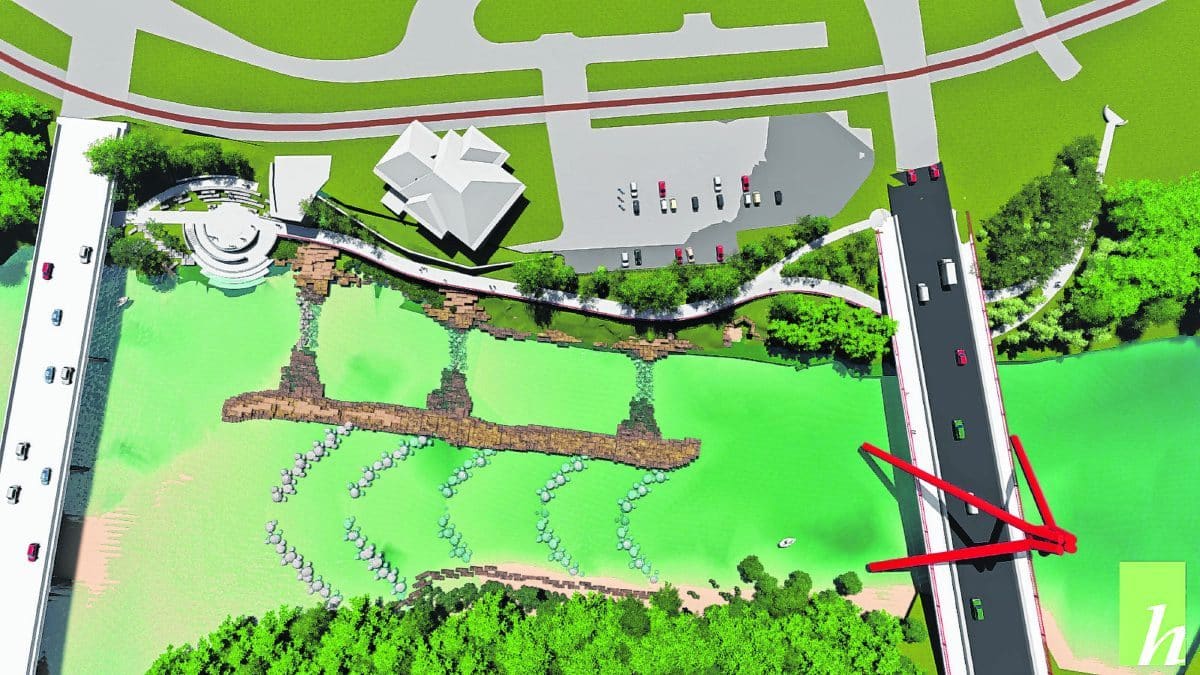
The Indiana Department of Natural Resources and the city of Columbus are continuing to hash out details of a proposed $8.6 million riverfront redevelopment between the Second and Third Street bridges downtown.
The project, which calls for overlooks of the East Fork White River, the removal of the low-head dam, connections to the People Trail system and an in-water recreation area, has gone through several rounds of discussions with state environmental officials over the past few years.
The most recent round of feedback from DNR, filed in February, identified some concerns with proposed lighting that environmental officials say could impact the “sleep and circadian rhythm” of wildlife, the type of native species that should be planted near the river and the presence of grout in proposed whitewater park structures, according to a copy of the agency’s recommendations based on a permit application the city filed in October.
DNR also has recommended a mussel and fish passage study in the river, but no determination has been made on when the study would take place or how long it would be, DNR officials said.
[sc:text-divider text-divider-title=”Story continues below gallery” ]
Overall, the agency expressed some concern that certain aspects of the project, as proposed in October, could have “detrimental effects upon fish, wildlife and botanical resources,” but has not denied the city’s application and is attempting to “work out those impacts” with the city, said Sam Whiteleather, assistant division director of DNR’s Office of Private Lands.
However, the permit review process has taken more time than usual largely because DNR does not typically look at installing recreational features in rivers as part of a dam removal project and is attempting to proceed with caution before granting the city any permits, Whiteleather said.
“In general, environmental permit reviews take time,” he said. “We’ve got to fully analyze all the fish and wildlife impacts of proposed activities, and then once those impacts are identified, we then come up with recommendations and then work those out and discuss them with the permit applicant. We definitely want to be thorough on all our permits to make sure that we can get maximum benefit for the fish and wildlife resource. The other thing, on this one, there’s some newness to the approach that the city has taken with the dam removal. They’re including a recreational feature within the river, and that’s not something that we typically deal with, and so that’s required some extra time on our end to fully process the impacts of that.”
City officials met with four DNR staff member in Indianapolis this past Tuesday to address some of the agency’s comments and gave them a 2D model of the proposed whitewater park structures, said Heather Pope, redevelopment director for the city of Columbus.
Pope said grout is necessary in those structures to prevent them from shifting during a flood or high-water event.
“We gave them a presentation and told them we were going to provide them what we addressed in the presentation in writing, and we are putting all that together,” Pope said. “We are to give that material to them on Monday, and then they told us that we would get a response in two weeks after that,” Pope said.
In addition, the city, along with consultants Hitchcock Design Group, are looking at how to best adjust the type of lighting they would install along the riverfront to minimize any potential impact on wildlife and are currently “leaning towards” dimmers or motion-sensitive lighting, Pope said.
Pope added that while the city proposed native species of vegetation to be planted as part of the project in October, “(DNR) had a preference on the type of native species.”
“We’ve had conversations about the types of planting, and we believe that we’re in agreement on the types of planting now that we will be able to utilize on our riverbank,” she said.
In October, the city filed a more than 300-page application that includes a narrative project description that summarizes the project scope, need for the project, and the project’s major components, maps and aerial photographs showing the proposed project location and a quantification of permanent and temporary disturbances and hydraulic modeling information.
The project design incorporates a fish passage channel and a rock arch ramp structure using natural materials, which reduces the amount of grout required in the structure, accommodates boat passage and maintains the river’s water level.
It features many design drivers, including the removal of the lowhead dam, access for safety personnel, maintenance and repair of the river banks, economic and workforce development, ecology, connections, compelling attractions and captivating appearance.
In January, Columbus City Council approved allocating $567,300 in funds for a contract with Hitchcock Design Group that extends through the end of the proposed riverfront redevelopment project.
The contract had received a favorable recommendation from the Columbus Redevelopment Commission.
The city has spent $1.17 million on the project since June 2016, Pope said.
Typically, there is some level of back and forth with all permit applications filed with DNR, but the complexity of the proposed riverfront development has prompted the agency to proceed more cautiously, Whiteleather said.
“I would say that projects that we’ve handled a lot in the past, there was probably less back and forth, but, again, this is something that’s fairly new for us,” Whiteleather said. “A lot of it is, ‘Hey, tell us more about what this piece looks like, or what does this piece looks like?’ And that’s been a lot of the back and forth.”
“DNR strives to work with applicants to try to make proposed projects as beneficial as possible to the fish and wildlife resource,” Whiteleather added. “Sometimes, on a more complex project like this, that takes some time.”
[sc:pullout-title pullout-title=”Where to learn more” ][sc:pullout-text-begin]
Visit www.columbusriverfront.org for more information about the project.
[sc:pullout-text-end]