British period dramas have been a mainstay of public television. One of the most successful series in this idiom has been “Downton Abbey.” This PBS series chronicles the lives of the British aristocratic Crawley family and their servants in the early 20th century. On Saturday night in the spacious sanctuary of First Christian Church, the Columbus Indiana Philharmonic musically transported their audience to England and the elegant mansion and countryside that are the setting for this series.
With Maestro David Bowden as emcee, the Philharmonic introduced to us the music of the time as the string chamber ensemble performed works of the early 1900s. It was a delightful mixture of stately grand musical masterpieces and virtuosic show pieces for three of the orchestra’s most talented young artists.
The concert began with the theme from the television series which filled the concert space with the full bodied and sonorous string sound that has become a trademark of the ensemble. With most of players standing for the entire hour and a half concert, the physical demands of the concert were equally matched by the outstanding abilities of the performers.
Their strong playing enhanced by the superb acoustics of the FCC sanctuary created an almost surround sound experience which actually inspired a woman in the audience behind me to whisper “it’s so beautiful” as the first selection came to its conclusion.
Two compositions by Edward Elgar, Serenade for Strings and the ever popular graduation march Pomp and Circumstance March No. 1 followed, leading to the first major solo of the evening, “Variations on the Last Rose of Summer” by Henrich Wilhelm Ernst featuring violinist and concertmaster Daniel Aizenshtadt. A piece of great technical difficulty and extreme virtuosity, Aizenshtadt performed brilliantly and astonished the audience with his skill. Using all the techniques possible in playing violin, he was always in control, never rushed or tense and flawless in performing incredible leaps of pitch, rapid and intricate fingering and inspiring musicianship. At the conclusion of his performance the concert came to a halt as many in the audience stood and acknowledged the high caliber of artistic expression they had just witnessed.
The musicians changed position for the piece “Fantasia on a Theme” by Thomas Tallis by Ralph Vaughan Williams which Bowden described as one of his favorites. His conducting of the piece made this quite evident as he displayed great passion and intensity with his conducting. With the orchestra physically separated into three smaller ensembles, with one group actually facing away from the audience, the talent within the entire ensemble was highlighted as each group was equally strong and musically solid in their individual parts. The theme/hymn originally composed in the mid 1500s and used by Vaughan Williams in this setting from 1910 fit in beautifully in the cathedral like setting and acoustic of First Christian Church.
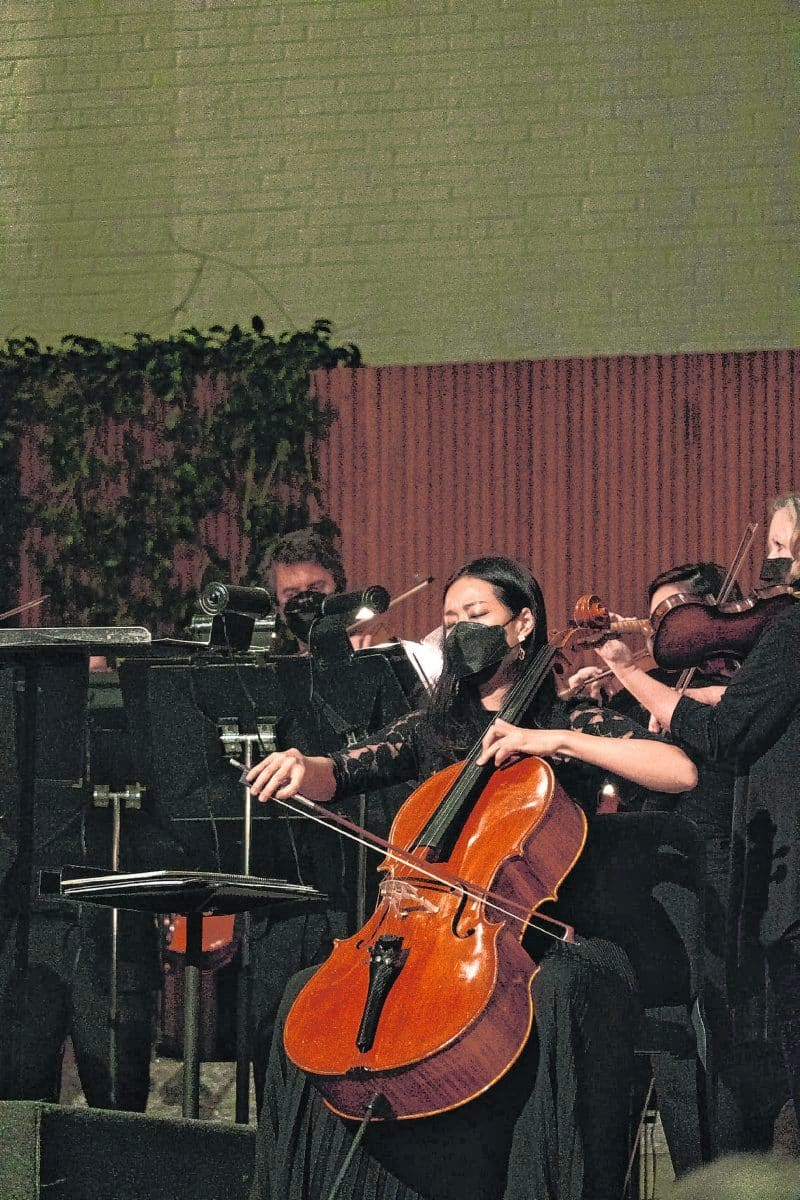
Again Bowden wisely programmed a couple of vigorous dances “Jig and Finale” from St Paul’s Suite by Gustav Holst to keep the audience on the edge of its seats and set up beautifully the final major soloist of the evening cellist SeungAh Hong with the beautiful Catalan carol “Song of the Birds” by Pablo Casals. As a vocalist I can only express my deepest appreciation for the work of Hong as I feel she makes the cello sing. Her technique is so self assured and her musicianship so delicate yet passionate, that both I and the audience wished her performance had gone on much longer.
The final selection appropriately tugged on the strings of the audience’s heart with Percy Grainger’s “Irish Tune from County Derry (Danny Boy).” This familiar tune had many in the audience humming along and shedding a few tears in a reflection on these troubled times. The feelings of the audience about this final selection in a well done and well-received concert were best summed up by Bowden himself as he exclaimed at the end of the evening “Live music is back!”