Polling reveals that party identification divides us more than any other factor, including the major factor of geography. I maintain that party labels are very often misleading and that each side misinterprets the other’s viewpoints.
I am convinced that the American people have far more in common than what divides us. I mentioned to a former Republican county chairman that he and I agreed on more things than on which we disagreed. Without ascertaining what those areas of agreement might be, he simply rebutted my premise. Apparently, he automatically assumed the divide among Democrats and Republicans is insurmountable.
Likewise, on two occasions while speaking to male Republican voters about the issues, both agreed with me. But in both cases, their wives jumped in, saying “but he’s a Democrat.” Even with their husbands and I finding common ground, these ladies viewed the divide as an unbridgeable chasm.
I readily admit that bridging the divide will not be easy. It will require people on both sides to actually chip away at their set-in-stone views and preconceptions. It will demand that each of us take seriously the other’s fears and concerns. Then, a civil national discourse can begin in which we can ascertain how warranted are those fears and on what concerns we can find compromise.
I ask that the reader take note of one such difference. I believe the single greatest fear Republicans have of Democrats is the issue of socialism. This was recently reinforced when I received a late-night call from an old friend seeking my reassurance that President Biden would not turn the country into a nation ruled by socialism. After a lengthy yet civil discussion, he claimed I was the first Democrat he’d spoken with who did not make him angry. He said he appreciated my views,
He wasn’t totally convinced but hoped I was right. This was exactly the kind of conversation Republicans and Democrats need to begin if we are ever to eventually unite the nation.
I basically told my friend that his fears were unfounded. First, I noted, there is virtually no chance of large-scale policy changes. I reminded him that Biden has always been and remains a centrist, citing the complaints among left-leaning members of the Democratic Party about Biden. As for his concerns about Sen. Bernie Sanders and the small congressional faction led by Rep. Alexandra Ocasio Cortez, I stated that Sanders managed but one primary victory and Ocasio Cortez represents a tiny part of the Democratic congressional contingent. In fact, Speaker Nancy Pelosi calls that contingent “the Four.” I mentioned that Ocasio Cortez has publicly aired her frustrations with centrist congressional Democrats and has said that she is considering not running for reelection.
Americans have a right to fear socialism in its purest form. I advised my friend that while Republicans warn against Venezuela’s pure socialism, there is nothing about Democratic policies that resemble Nicolas Maduo’s government. Rather, those Democratic policies Republicans call socialism resemble what is known in Europe as Christian socialism. Here is one example of where both sides must carefully parse the language. Just as there are multiple forms of capitalism, so, too, are there multiple forms of socialism, and they are not equivalent. Based on a comment my friend made, it occurred to me that his fear may be more about authoritarianism than socialism. These are not synonymous terms. The opposite of authoritarianism is democracy, and the nations practicing Christian socialism are democratic.
The point is that understanding each other and knowing the facts will serve to unite this nation. Let us listen to one another with open minds, tossing out preconceptions, and search for commonality.
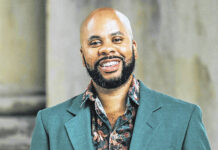
Michael Adkins formerly was chair of the Hancock County Democratic Party. This column originally appeared in the (Greenfield) Daily Reporter. Send comments to editorial@therepublic.com.