5:18 P.M. UPDATE
MINNEAPOLIS (AP) — Former Minneapolis Officer Derek Chauvin was convicted Tuesday of murder and manslaughter for pinning George Floyd to the pavement with his knee on the Black man’s neck in a case that touched off worldwide protests, violence and a furious reexamination of racism and policing in the U.S.
Chauvin, 45, could be sent to prison for decades.
The jury of six white people and six Black or multiracial ones came back with its verdict after about 10 hours of deliberations over two days. Chauvin was found guilty on all charges: second-degree unintentional murder, third-degree murder and second-degree manslaughter.
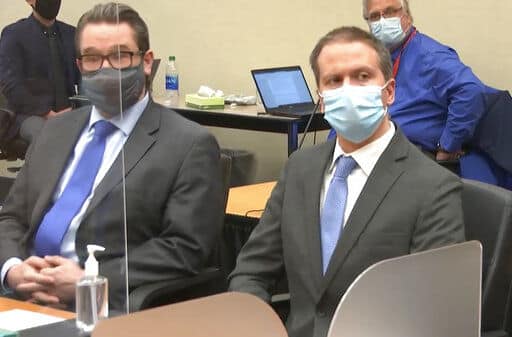
His face was obscured by a COVID-19 mask, and little reaction could be seen beyond his eyes darting around the courtroom.
His bail was immediately revoked and he was led away with his hands cuffed behind his back.
The verdict was read in a courthouse ringed with concrete barriers and razor wire and patrolled by National Guard troops, in a city on edge against another round of unrest — not just because of the Chauvin case but because of the deadly police shooting of a young Black man, Daunte Wright, in a Minneapolis suburb April 11.
The jurors identities were kept secret and will not be released until the judge decides it is safe to do so.
Three other former Minneapolis officers charged with aiding and abetting murder in Floyd’s death will stand trial in August.
Floyd, 46, died May 25 after being arrested on suspicion of passing a counterfeit $20 bill for a pack of cigarettes at a corner market. He panicked, pleaded that he was claustrophobic and struggled with police when they tried to put him in a squad car. They put him on the ground instead.
The centerpiece of the case was the excruciating bystander video of Floyd gasping repeatedly, “I can’t breathe” and onlookers yelling at Chauvin to stop as the officer pressed his knee on or close to Floyd’s neck for what authorities say was 9 1/2 minutes. Floyd slowly went silent and limp.
Prosecutors played the footage at the earliest opportunity, during opening statements, with Jerry Blackwell telling the jury: “Believe your eyes.” And it was shown over and over, analyzed one frame at a time by witnesses on both sides.
In the wake of Floyd’s death, demonstrations and scattered violence broke out in Minneapolis, around the country and beyond. The furor also led to the removal of Confederate statues and other offensive symbols such as Aunt Jemima.
In the months that followed, numerous states and cities restricted the use of force by police, revamped disciplinary systems or subjected police departments to closer oversight.
The “Blue Wall of Silence” that often protects police accused of wrongdoing crumbled after Floyd’s death: The Minneapolis police chief quickly called it “murder” and fired all four officers, and the city reached a staggering $27 million settlement with Floyd’s family as jury selection was underway.
Police-procedure experts and law enforcement veterans inside and outside the Minneapolis department, including the chief, testified for the prosecution that Chauvin used excessive force and went against his training.
Medical experts for the prosecution said Floyd died of asphyxia, or lack of oxygen, because his breathing was constricted by the way he was held down on his stomach, his hands cuffed behind him, a knee on his neck and his face jammed against the ground.
Chauvin attorney Eric Nelson called a police use-of-force expert and a forensic pathologist to help make the case that Chauvin acted reasonably against a struggling suspect and that Floyd died because of an underlying heart condition and his illegal drug use.
Floyd had high blood pressure, an enlarged heart and narrowed arteries, and fentanyl and methamphetamine were found in his system.
Under the law, police have certain leeway to use force and are judged according to whether their actions were “reasonable” under the circumstances.
The defense also tried to make the case that Chauvin and the other officers were hindered in their duties by what they perceived as a growing, hostile crowd.
Chauvin did not testify, and all that the jury or the public ever heard by way of an explanation from him came from a police body-camera video after an ambulance had taken the 6-foot-4, 223-pound Floyd away. Chauvin told a bystander: “We gotta control this guy ’cause he’s a sizable guy … and it looks like he’s probably on something.”
The prosecution’s case also included tearful testimony from onlookers who said the police kept them back when they protested what was happening. Eighteen-year-old Darnella Frazier, who shot the crucial video, said Chauvin just gave the bystanders a “cold” and “heartless” stare.
She and others said they felt a sense of helplessness and lingering guilt from witnessing Floyd’s slow-motion death.
“It’s been nights I stayed up, apologizing and apologizing to George Floyd for not doing more, and not physically interacting and not saving his life,” Frazier testified, while the 19-year-old cashier at the neighborhood market, Christopher Martin, lamented that “this could have been avoided” if only he had rejected the suspect $20 bill.
To make Floyd more than a crime statistic in the eyes of the jury, the prosecution called to the stand his girlfriend, who told the story of how they met and how they struggled with addiction to opioids, and his younger brother Philonise. He recalled how Floyd helped teach him to catch a football and made “the best banana mayonnaise sandwiches.”
5:14 p.m. UPDATE
MINNEAPOLIS (AP) — Former Minneapolis police Officer Derek Chauvin has been convicted of murder and manslaughter in the death of George Floyd, the explosive case that triggered worldwide protests, violence and a furious reexamination of racism and policing in the U.S.
The jury reached its verdict Tuesday after deliberating about 10 hours over two days in a city on edge against another outbreak of unrest.
Bail is revoked, and Chauvin has been sent to jail while awaiting sentencing. He was placed in handcuffs before being led from the courtroom.
Floyd died last May after Chauvin, a white officer, pinned his knee on or close to the 46-year-old Black man’s neck for about 9 1/2 minutes.
5:05 p.m. UPDATE
MINNEAPOLIS (AP) — Ex-cop Derek Chauvin convicted of murder and manslaughter in George Floyd death that stirred worldwide protests. Sentencing is scheduled for eight weeks from today.
Bail is revoked, and Chauvin has been sent to jail while awaiting sentencing. He was placed in handcuffs before being led from the courtroom.
- The verdict is Count 1, guilty.
- The verdict is Count 2, guilty
- The verdict is Count 3, guilty
3:50 P.M. UPDATE
The jury has reached a verdict at the murder trial of former Minneapolis police Officer Derek Chauvin in the death of George Floyd. The verdict is to be read between 4:30 and 5 p.m. Eastern.
WHAT ARE THE CHARGES
By The Associated Press
MINNEAPOLIS (AP) — The 12 jurors who reached a verdict Tuesday in the case against Derek Chauvin had three counts to consider as they weighed whether he is responsible for the death of George Floyd.
Chauvin is charged with second-degree unintentional murder, third-degree murder and second-degree manslaughter. He could be convicted on all of the charges, some or none. The decision was expected to be announced Tuesday afternoon.
The case comes down to two key questions — whether Chauvin caused Floyd’s death and whether his actions were reasonable — and each charge requires a different element of proof as to Chauvin’s state of mind.
Here’s an explanation of the charges:
HOW DO THE CHARGES AGAINST CHAUVIN COMPARE?
For all three charges, prosecutors had to prove that Chauvin caused Floyd’s death and that his use of force was unreasonable.
Prosecutors didn’t have to prove Chauvin’s restraint was the sole cause of Floyd’s death, but only that his conduct was a “substantial causal factor.” Chauvin is authorized to use force as a police officer, as long as that force is reasonable.
To convict on any of these counts, jurors must find that Chauvin used a level of force that would be considered unreasonable to an objective officer in his position. Hindsight can’t be a factor.
The charges differ when it comes to Chauvin’s state of mind — with second-degree murder requiring some level of intent — not an intent to kill but that Chauvin intended to apply unlawful force to Floyd — all the way down to manslaughter, which requires proof of culpable negligence.
WHAT’S SECOND-DEGREE UNINTENTIONAL MURDER?
It’s also called felony murder. To prove this count, prosecutors had to show that Chauvin killed Floyd while committing or trying to commit a felony — in this case, third-degree assault. They didn’t have to prove Chauvin intended to kill Floyd, only that he intended to apply unlawful force that caused bodily harm.
Prosecutors called several medical experts who testified that Floyd died from a lack of oxygen because of the way he was restrained. A use of force expert said it was unreasonable to hold Floyd in the prone position for 9 minutes, 29 seconds, handcuffed and face-down on the pavement.
“No reasonable officer would have believed that that was an appropriate, acceptable or reasonable use of force,” prosecution witness Seth Stoughton testified.
Defense attorney Eric Nelson tried to raise doubts about Floyd’s cause of death — saying underlying heart issues and drug use were to blame. He also argued that Chauvin’s actions were reasonable, saying Floyd was big, under the influence of something, could start fighting and that nearby bystanders presented a threat.
“It’s easy to sit and judge … an officer’s conduct,” defense witness Barry Brodd testified. “It’s more of a challenge to, again, put yourself in the officer’s shoes to try to make an evaluation through what they’re feeling, what they’re sensing, the fear they have, and then make a determination.”
WHAT ABOUT THIRD-DEGREE MURDER?
For this count, jurors must find Chauvin caused Floyd’s death through an action that was “eminently dangerous” and carried out with a reckless disregard for and conscious indifference to the loss of life.
Mark Osler, a professor at University of St. Thomas School of Law, said prosecutors tried to prove the elements of this count through testimony about the dangers of subduing a handcuffed person in the prone position.
Dr. Martin Tobin, a lung and critical care specialist, testified for the prosecution that any healthy person subjected to this restraint would have died. Minneapolis Police Lt. Johnny Mercil, a use-of-force instructor, testified that officers are trained to “stay away from the neck when possible.” Osler said Police Chief Medaria Arradondo was also effective in showing that Chauvin was not trained to use such a hold.
“They wanted to have a lot of evidence showing that what Chauvin did is not what he was trained to do and that the reason they don’t train people to do that is because it’s eminently dangerous,” Osler said.
AND SECOND-DEGREE MANSLAUGHTER?
Prosecutors had to show that Chauvin caused Floyd’s death through culpable negligence that created an unreasonable risk, and that he consciously took the chance of causing severe injury or death.
Testimony that revealed Chauvin should have known to put Floyd in a side recovery position, that he should have provided medical care before paramedics arrived and that he stayed in his position after he was told Floyd didn’t have a pulse could all point to negligence, said former U.S. Attorney Tom Heffelfinger.
WHAT DOES CHAUVIN FACE IF CONVICTED?
Each count carries a different maximum sentence: 40 years for second-degree unintentional murder, 25 years for third-degree murder, and 10 years for second-degree manslaughter.
But under Minnesota sentencing guidelines, for a person with no criminal history, each murder charge carries a presumptive sentence of 12 1/2 years in prison, while manslaughter has a presumptive sentence of four years.
Prosecutors are seeking a sentence that goes above the guideline range. They cited several aggravating factors, including that Floyd was particularly vulnerable, that Chauvin was a uniformed police officer acting in a position of authority, and his alleged crime was witnessed by multiple children — including a 9-year-old girl who testified that watching the restraint made her “sad and kind of mad.”
Chauvin has waived his right to have a jury decide if aggravating factors exist. So if he is convicted, Judge Peter Cahill will make that decision and would sentence Chauvin at a later date. In Minnesota, defendants typically serve two-thirds of their penalty in prison, with the rest on parole.
ORIGINAL STORY
MINNEAPOLIS — Jurors remained in deliberations into the afternoon Tuesday in the Derek Chauvin murder trial, after being given the case late Monday.
The jury heard nearly six hours of closing arguments from opposing attorneys Monday in Hennepin County District Court about whether the former Minneapolis police officer should be convicted or acquitted of killing George Floyd May 25, 2020, at 38th and Chicago by pinning him to the pavement until he died.
Deliberations began late Monday afternoon and wrapped up about 8 p.m. They resumed at 8 a.m. Tuesday. As of early Tuesday afternoon, the jurors have been out more than eight hours.
They are being sequestered throughout their deliberations and until the verdicts are read in court and livestreamed before a worldwide audience.
Chauvin, 45, is free on bond while the jury works toward unanimous verdicts on second-degree unintentional murder, third-degree murder and second-degree manslaughter.
The 12-person jury has six people who are white, four who are Black and two who are multiracial. Two are in their 20s, three in their 30s, three in their 40s, three in their 50s and one in their 60s. Seven are woman, and five are men.
For more on this story. see Wednesday’s Republic.