It’s time to let the old ways die.
That’s part of the chorus of a song from the 2018 remake of “A Star Is Born” — but on Tuesday, it was the song sung by Bartholomew Circuit Court Judge Kelly Benjamin and Jess Powell during the first-ever Bartholomew County Adult Drug Recovery Court graduation ceremony.
The lyrics are indeed appropriate for graduating adults with substance abuse disorders who have, to date, remained sober for 15 to 24 months, Benjamin said.
“We asked them to change their entire life,” the judge told an audience of more than 100 people at the Commons. Benjamin then brought up examples of progress among the graduates that include:
A 75% program retention rate. The goal was to keep it above 70%.
Under 5% of participants have tested positive for drug use while in the program. The goal is to keep it below 10%.
62% of participants are currently employed. That’s up from 44% last year.
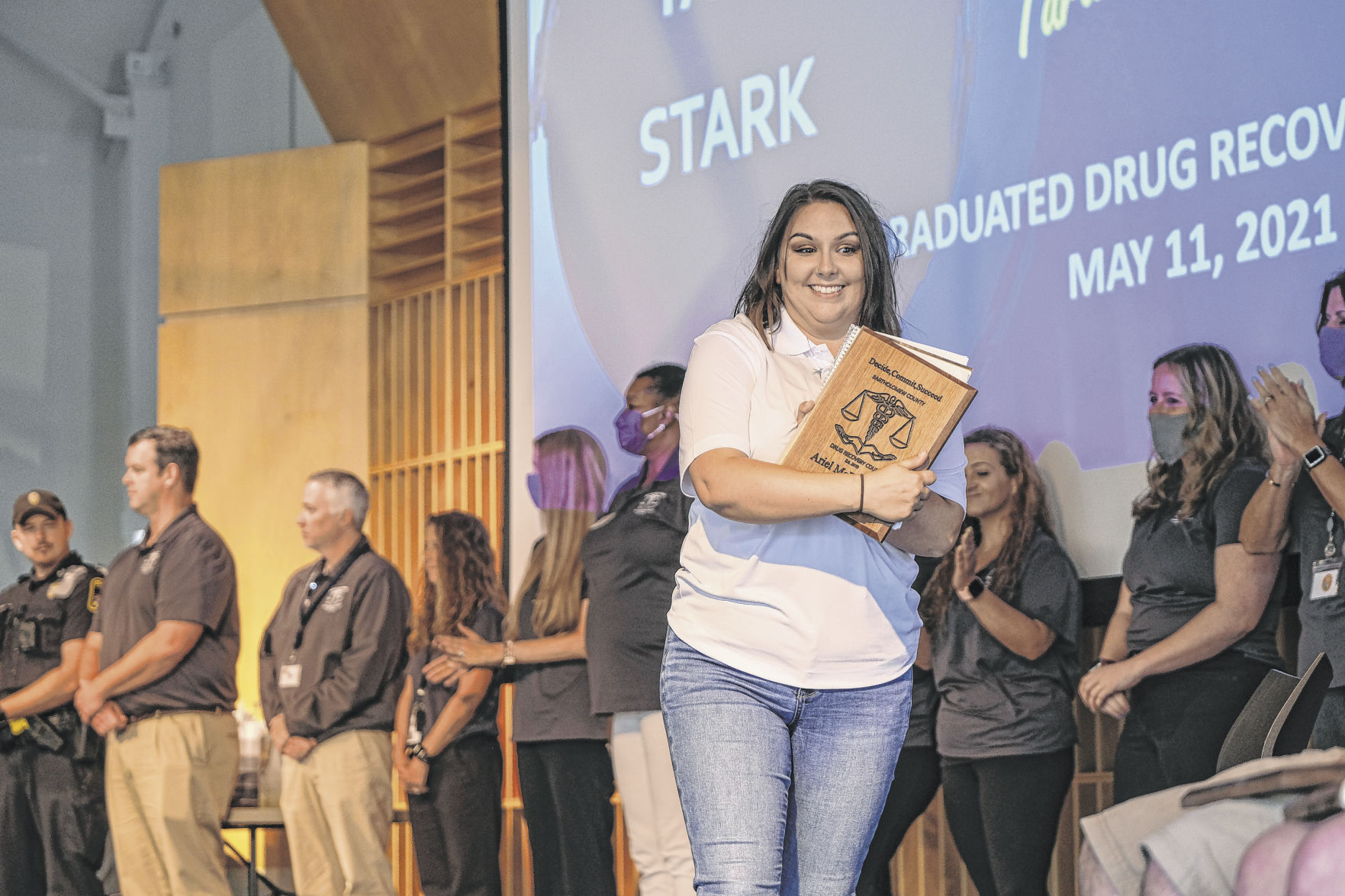
Much of that success comes from the efforts of counselors, case managers, attorneys, law enforcement officers, personnel from the Alliance for Substance Abuse Progress (ASAP) and treatment providers, Benjamin said. Many team members were brought up on the stage Tuesday to not only be recognized, but to form a line in order to congratulate each graduate.
When the judge asked the outgoing participants to name the four main principles of Drug Court, they answered in unison: Honesty, Showing Up, Accountability and Being Respectful.
Although a number of graduates did not attend the public ceremony, those who did get on the stage each received an enthusiastic round of applause.
Ariel McFarland recalled being homeless for almost two years and pregnant before being arrested in July 2019. While McFarland said the conditions of the program were challenging, her perspective changed when she realized all the things she was ordered to do were to help her, not punish her.
“It set up a support system and taught me how to cope with things without turning to drugs,” said McFarland, who has been sober since her arrest. “I just want everybody to know that recovery is possible, and it’s never too late to choose sobriety.”
There were some tears among support staff members as participant Greg Hill thanked them for helping to change his life around.
“You guys are awesome,” Hill said. “Each one of you have a very special place in my heart, and I will never forget the patience, kindness, respect and love that you have shown me through this whole program.”
The final speaker, Alison Grimes, said her addiction made her hit rock-bottom multiple times before she finally made up her mind to turn her life around. It was a difficult task she had unsuccessfully attempted earlier that involved rebuilding her life, facing her demons, and confronting trauma from her past.
“The reason this time was different — the reason I’m 23 months sober today — is because I wasn’t doing it alone this time,” Grimes said. “The Drug Recovery team gave me support, guidance encouragement — and most of all, believed in me when I didn’t believe in myself.”
The job of those teams are to work together to find underlying problems that contribute to criminal behavior, Benjamin said. Assistance and encouragement is then provided with a goal of reuniting families and repairing lives, she said.