Editor’s note: This is the fifth story in a series highlighting the five J. Irwin and Xenia Miller Prize winners for the Exhibit Columbus architectural exhibition opening to the general public Saturday and running through Nov. 28.
Call it a discovery of the cities across the globe named for the Discoverer.
Therein lies the proud and towering installation of design firm Dream the Combine’s “Columbus Columbia Colombo Colón” nestled against the Mill Race Park amphitheatre in downtown Columbus.
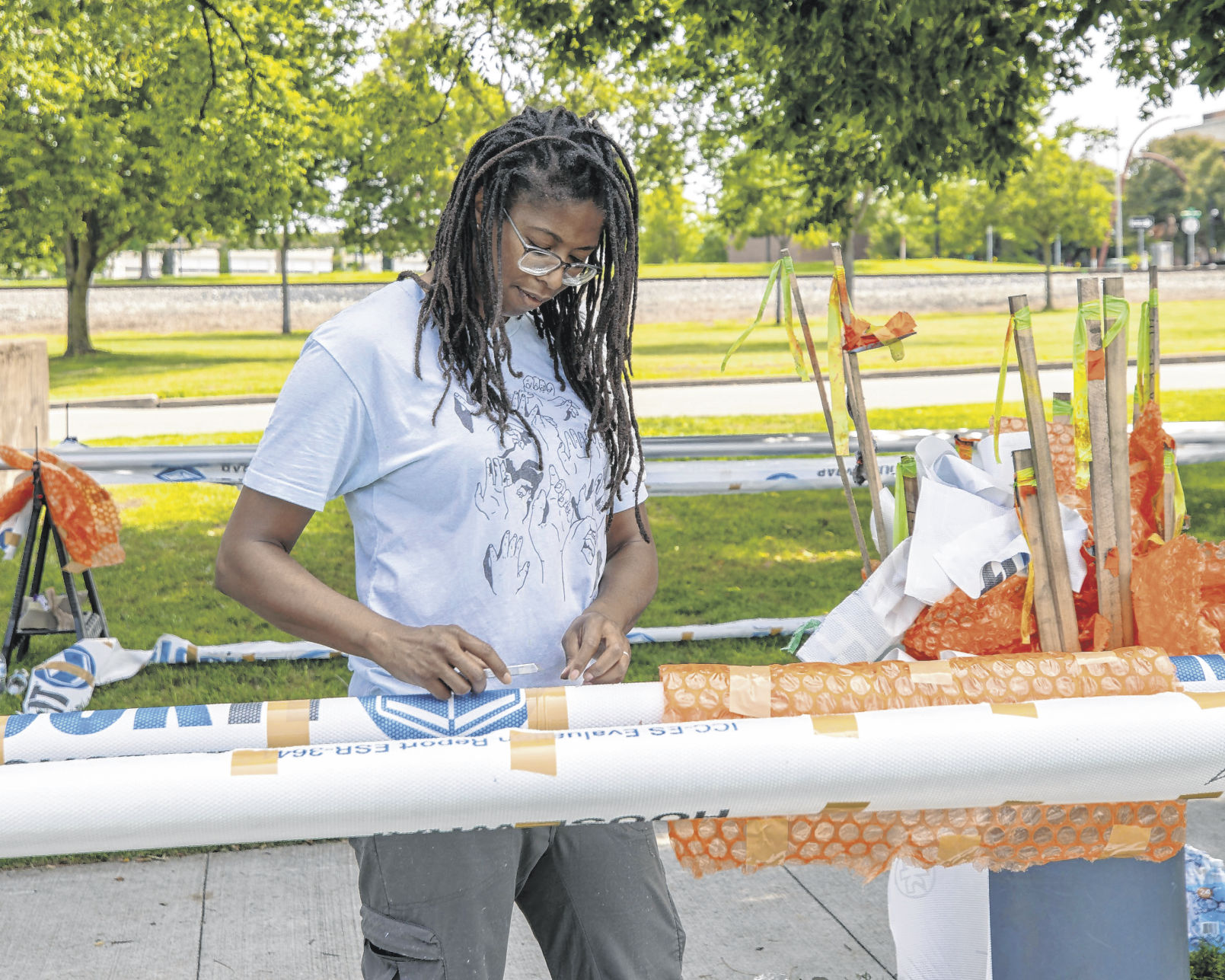
Embossed text spirals around the shaft of each of 58 gleaming 20-foot aluminum poles, all arranged in the proper spacing as the cities would be on a world map if it were viewed from the height of the nearby park tower.
Tom Carruthers with Dream the Combine refers to the different locales within the installation in the plural term of Columbi. He says the poles are laid out in a precise pattern.
“As you drive through the park on Carl Miske drive, and you’re looking north, the points start to suggest the curve of South America, then the curve of the Gulf of Mexico, and then the outbound curve of North America.
“There are a lot of metaphors here — a lot of metaphors. It’s like a story on top of a story.”
Jennifer Newsom of the firm mentioned that reading the information on each pole becomes something of an active task for visitors.
“On each pole, as you read it (the text), you have to move around it,” Newsom said. “There is a kind of choreography.”
Most messages are fewer than 150 words.
“We hope that the text will draw you in,” Carruthers said, “and then it will send you off.”
The married design duo, based in Minneapolis, write this as part of their summary of their pop-up architecture: “Columbus, Indiana is not just a city. It is part of a larger complex of meaning and signification—the persistence of its continuing legacy is one that we all must grapple with.”
The work is just one among 13 total installations spread across the community amid an exhibition with the theme “New Middles: From Main Street to Megalopolis, What is the Future of the Middle City?”
Organizers say this programming explores the future of the center of the United States and the regions connected by the Mississippi Watershed. New Middles speculates on the heartland, an ecology stretching beyond political borders—from North to South—from the Canadian Border to the Gulf, and from East to West—from Appalachia to the plains.
The Dream duo was among the the first architectural teams to finish their work, partly because of meticulously detailed planning and a concern about supplies amid a continuing COVID-19 economic impact. Plus, they pass ample credit to the Columbus Department of Public Works for superb help and guidance.
“We tried to effectively harness some of the prior knowledge we’ve gained from previous installations,” Newsom said. “We just kept in the forefront that awareness that things can get kind of backed up due to forces beyond your control.”
The biggest challenge?
“I think one was the physical reality of manipulating the material and getting it engineered,” Newsom said. “And there’s also been a deep dive into each of the histories of these places, and that has posed its own challenge. And it has provoked within us a lot of considerations such as ‘How do we effectively construct memory about a place? What are the histories that are recorded and can be found by us while searching?
“So, there have been two construction projects going simultaneously. And obviously, they’re intertwined. That research piece has to be included and underscored as another form of building.”