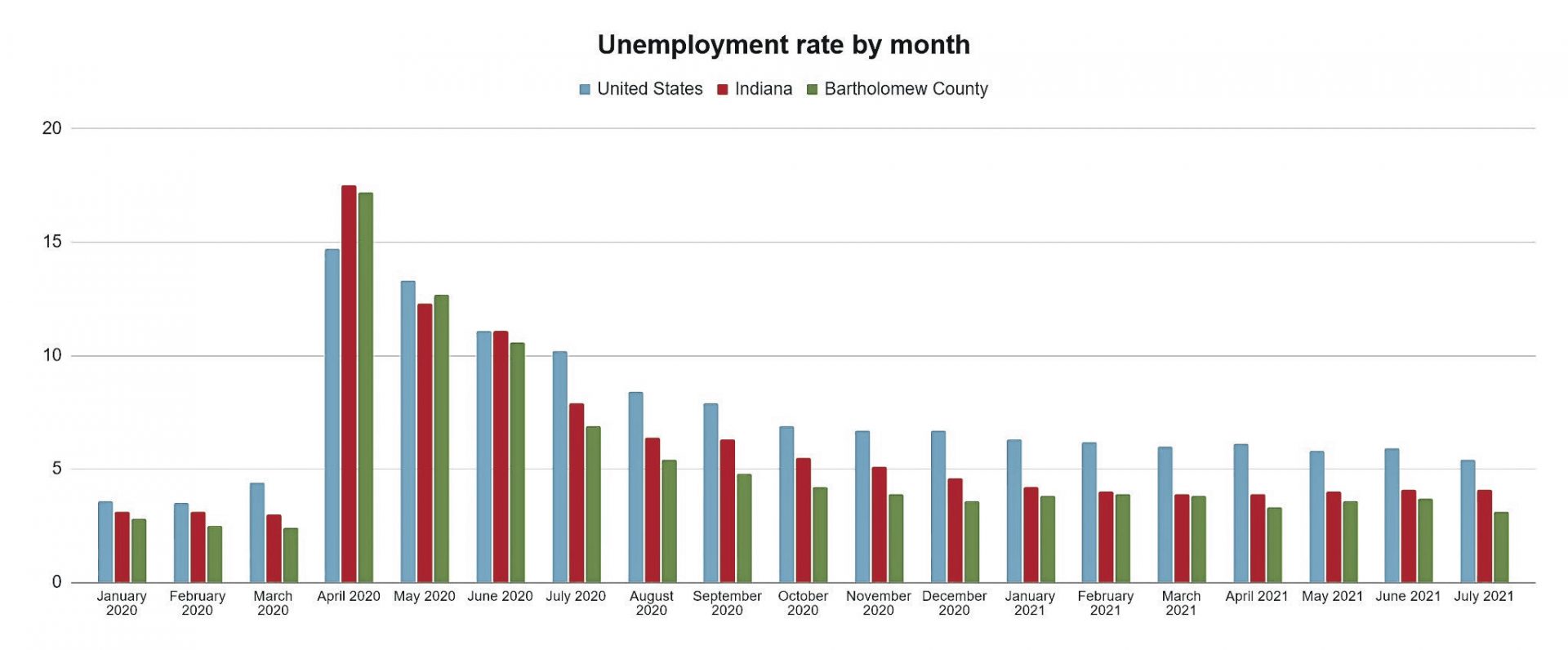
Bartholomew County’s unemployment rate ticked down last month to its lowest level since the COVID-19 pandemic forced businesses in spring 2020 to temporarily close and lay off workers at levels not seen in generations.
In July, Bartholomew County’s jobless rate was 3.1%, down from 3.7% the month before and the lowest since March 2020, when unemployment was 2.4%, according to figures released Monday by the Indiana Department of Workforce Development.
By comparison, the local jobless rate was 17.2% in May 2020.
Similar trends were seen last month in neighboring counties.
In Jackson County, the jobless rate dropped to 3.4% last month, down from 4.1% in June, state records show. Unemployment in Jennings County was 4.1% in July, down from 4.8% the month before.
Decatur County’s rate fell from 3.9% in June to 3.3% last month, and the jobless rate dropped from 4.2% to 3.7%.
However, the statewide unemployment rate remained unchanged at 4.1% last month. The national rate was 5.4% in July, down from 5.9% the month before.
The local update came days after the federal government reported that the number of people seeking unemployment benefits in the United States fell for a fourth straight time to a pandemic low, the latest sign that America’s job market is rebounding from the pandemic recession as employers boost hiring to meet a surge in consumer demand, according to The Associated Press.
The Labor Department reported this past Thursday that jobless claims fell by 29,000 to 348,000. The four-week average of claims, which smooths out week-to-week volatility, also fell — by 19,000, to just below 378,000, also a pandemic low.
The weekly pace of applications for unemployment aid has fallen more or less steadily since topping 900,000 in early January, according to wire reports. The dwindling number of first-time jobless claims has coincided with the widespread administering of vaccines, which has led businesses to reopen or expand their hours and drawn consumers back to shops, restaurants, airports and entertainment venues.
Still, the number of applications remains high by historic standards: Before the pandemic tore through the economy in March 2020, the weekly pace amounted to around 220,000 a week, according to the AP. And now there is growing concern that the highly contagious delta variant could disrupt the economy’s recovery from last year’s brief but intense recession. Some economists have already begun to mark down their estimates for growth this quarter as some measures of economic activity, like air travel, have started to weaken.
Filings for unemployment benefits have traditionally been seen as a real-time measure of the job market’s health. But their reliability has deteriorated during the pandemic. In many states, the weekly figures have been inflated by fraud and by multiple filings from unemployed Americans as they navigate bureaucratic hurdles to try to obtain benefits. Those complications help explain why the pace of applications remains comparatively high.
By all accounts, the job market has been rebounding since the pandemic paralyzed economic activity last year and employers slashed more than 22 million jobs, according to wire reports. The United States has since recovered 16.7 million jobs. And employers have added a rising number of jobs for three straight months, including a robust 943,000 in July. In the meantime, employers have posted a record 10.1 million openings, and many complain that they can’t find enough applicants to fill their open positions.
Last week’s drop in applications for aid was larger than many economists had expected, a sign that the job market’s recovery remains on track for now despite the worries surrounding the spread of the delta variant.