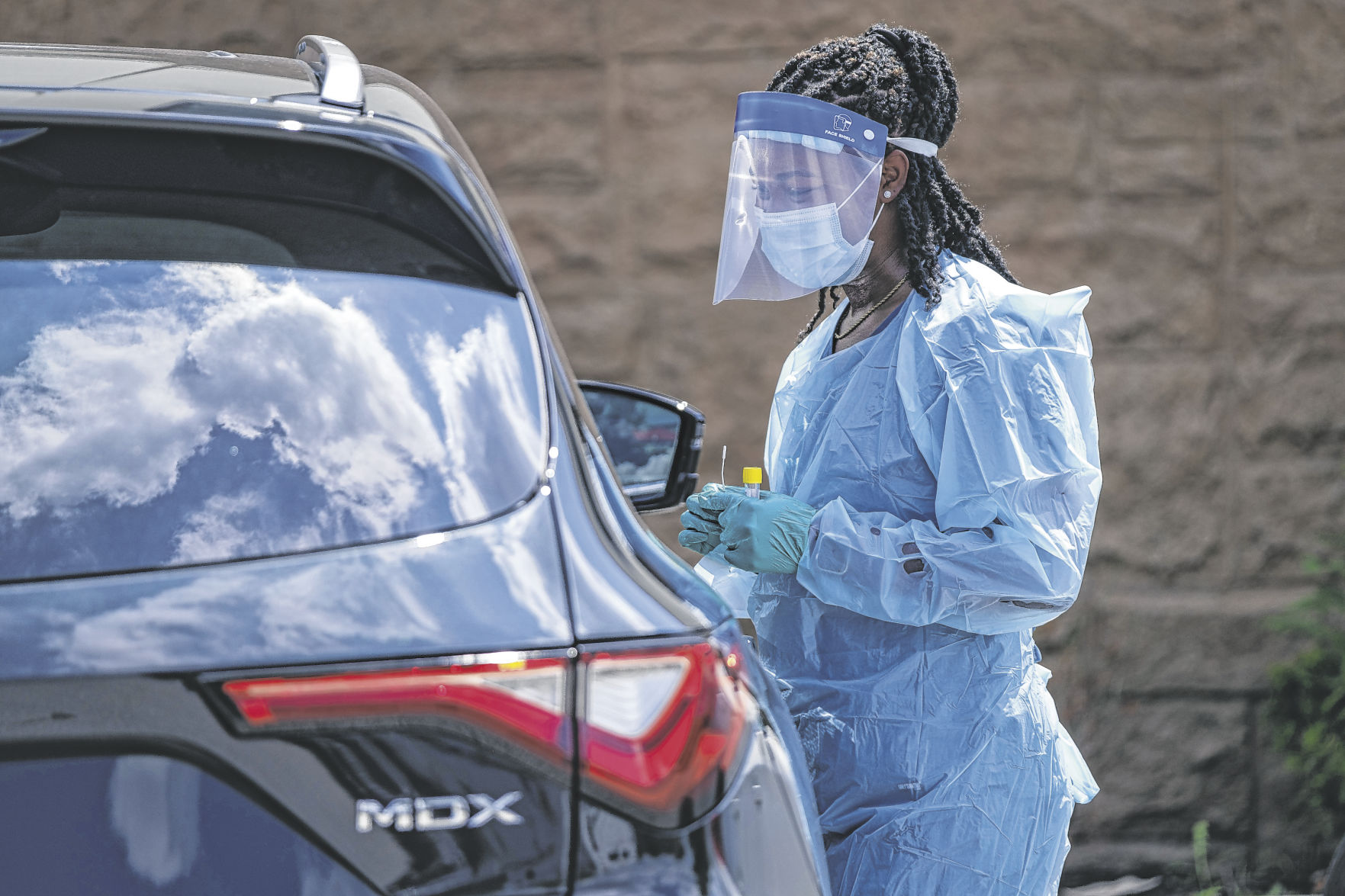
Local health officials warn that hospitals across the state could be overwhelmed in the coming weeks if the recent surge in COVID-19 is not brought under control.
The number of people hospitalized with COVID-19 in Indiana continues rising to levels not seen in months, including cases at Columbus Regional Hospital, hospital officials said.
On Friday, there were 37 people hospitalized for COVID-19 at CRH — an increase of 16 in four days and the highest headcount since mid-January, according to hospital records.
Hospitalizations have inched down since then, but a sobering reality for exhausted healthcare workers still remains — more COVID-19 patients are filling beds at CRH than at any point last year before the winter surge despite effective vaccines being widely available.
The “vast majority” of those hospitalized at CRH with COVID-19 are unvaccinated, though the hospital system has seen “rare episodes of infection after vaccination,” mainly in the elderly, people with weakened immune systems or those taking medications that suppress the body’s defenses, said Dr. (Raymond) Lee Kiser, medical director of hospital care physicians at CRH.
In response to the surge, CRH has been increasing its workforce, bringing in travel nurses and asking staff to take on extra shifts as the hospital braces for what they fear could be a prolonged deluge of COVID-19 patients that is already coinciding with an increase in other hospitalizations, including for respiratory syncytial virus (RSV), Kiser said.
At one point Tuesday morning, the hospital stood at just under 90% occupancy and has generally been hovering between 80% and 90% as of recent days, Kiser said.
“In all honesty, it’s really exhausting the health care providers,” Kiser said. “…We do know that so much of this is now preventable, and to see our numbers hitting similar to what they were doing last December, or at least looking like they may hit that kind of peak, it’s pretty frustrating.”
Some patients at CRH are still refusing to believe that the coronavirus exists — even after being admitted to the hospital with COVID-19, Kiser said. Others were convinced that they wouldn’t get infected until they landed in the hospital.
And some are begging for the vaccine from their hospital beds only for doctors to tell them that it is too late.
“Some (patients) are shocked,” Kiser said. “They said, ‘I never thought I was going to get this.’ We have some who plead for the vaccine at that moment only to have to explain to them that we literally cannot vaccinate them now at this exact time. …And then we still have some people who adamantly refuse to believe that this is even a real disease.”
“We’ve had situations where I had to tell the patient, ‘I’m sorry, we have to put you on the breathing machine. We can’t give you the vaccine. That’s not the treatment that’s indicated at this time.’” Kiser said.
There were two vaccination clinics at Goodwill stores in Columbus on Tuesday, but officials there reported the majority of people lining up in their cars were there to get a COVID-19 test, not a vaccination.
Already, nightmarish scenarios are already playing out in other areas of the country that are being hammered by the delta variant, with hospitals being stretched to the breaking point, The Associated Press reported.
In Oregon, the intensive care unit at Salem Hospital in the state’s capital city is completely full, with 19 of the 30 beds occupied last week by COVID-19 patients, the youngest only 20 years old, according to wire reports. It’s the same at a hospital in Roseburg, a former timber town in western Oregon. A COVID-19 patient died in its emergency room last week while waiting for an ICU bed to open, an event that was deeply distressing to the medical staff.
Florida hospitals slammed with COVID-19 patients are suspending elective surgeries and putting beds in conference rooms, an auditorium and a cafeteria, according to wire reports. As of midweek, Mississippi had just six open intensive care beds in the entire state. Georgia medical centers are turning people away. And in Louisiana, an organ transplant had to be postponed along with other procedures.
Locally, officials are urging people to get vaccinated, hoping to avoid such scenarios and tamp down the surge. But if more people don’t get vaccinated and follow public health guidance, local health officials fear the consequences could be dire.
“I’m very concerned that if we cannot get this surge under control, that our hospital, just like so many others in the state and the nation may start reaching essentially their capacity,” Kiser said.
“If we went with what some people want to do and allow the virus to run rampant through the population and let the chips fall where they may, we will absolutely overwhelm all the health care systems,” Kiser said.