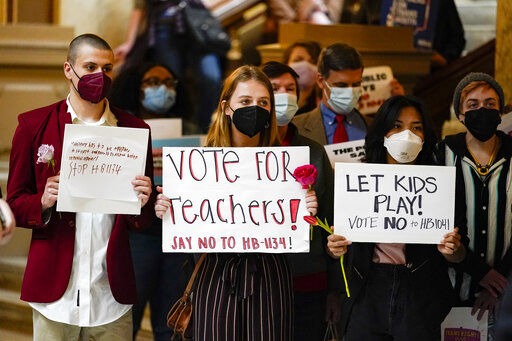
INDIANAPOLIS (AP) — Indiana lawmakers advanced a bill Wednesday that would ban transgender women and girls from participating in K-12 school sports that match their gender identity, despite opposition from activists that it’s unconstitutional, sexist and bigoted.
The Senate’s education committee moved forward with the measure on an 8-3 vote, along party lines, after the House advanced the bill last month. It now heads to the full Senate.
The bill would prohibit students who were born male but identify as female from participating in a sport or on an athletic team that is designated for women or girls. But it wouldn’t prevent students who identify as female or transgender men from playing on men’s sports teams.
Democratic Sen. J.D. Ford, of Indianapolis, called the bill “unnecessary and unconstitutional,” noting that the Indiana High School Athletic Association (IHSAA) already has a policy that requires transgender girls who want to play sports to show they’ve completed hormone therapy, and that their muscle mass or bone density is typical of other girls the same age.
“Instead of addressing the teacher shortage, instead of addressing student mental health, we’re getting sidetracked with bills like this,” Ford said in a statement Wednesday. “Even filing this bill sends a message to trans kids and their families that they’re not welcomed in our state.”
Senators in the education committee voted down Ford amendments to the bill that would have sent the issue to a summer study committee while still allowing the IHSAA to make case-by-case decisions about athlete eligibility.
Republican Rep. Michelle Davis, of Greenwood, who authored the bill, said its purpose is to “maintain fair competition in girls’ sports.”
Representatives from the American Civil Liberties Union maintained on Wednesday that the group will file a lawsuit if the “hateful legislation” is signed into law in Indiana.
If the bill passes the Legislature, Indiana could be the 11th Republican-dominated state to adopt such a ban on transgender women or girls. In two of those states — Idaho and West Virginia — the laws have been halted by federal judges. The U.S. Department of Justice has challenged bans in other states, slamming them as violations of federal law.
___
Casey Smith is a corps member for the Associated Press/Report for America Statehouse News Initiative. Report for America is a nonprofit national service program that places journalists in local newsrooms to report on undercovered issues. Follow Smith on Twitter.