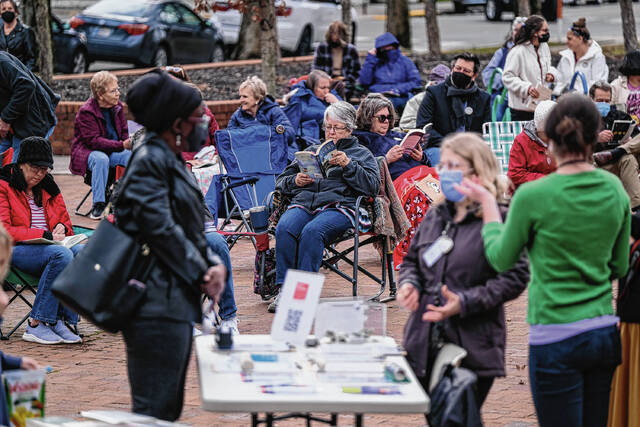
Mike Wolanin | The Republic People attend a community read-in at the Bartholomew County Public Library to protest House Bill 1134 and Senate Bill 17 in Columbus on Feb. 16.
Columbus resident Terry Clark brought a bag of a few banned literary classics with him to a Community Read-In Wednesday afternoon at the Bartholomew County Public Library Plaza — a place that one attendee called “the community’s porch.”
Clark’s premise: What others in some part of the world dislike or are uncomfortable with in reading material can be lauded and celebrated by others for a myriad of reasons — and all people should have the freedom to choose. One of Clark’s volumes he brought included Geoffrey Chaucer’s “The Canterbury Tales.”
Clark was among about 200 people in the first hour alone, and an estimated 350 people after two hours, attending the three-hour read-in organized just a few days ago by Jason Hatton, library director, and his staff. The event was a response to Senate Bill 17, a Republican-backed measure that aims to restrict minors from accessing what it calls “harmful materials” at libraries.
The bill cleared the Senate in a 34-15 vote. Five Republican senators joined Democrats in voting against it.
Senate Bill 17 would strip away protections that public libraries and schools currently have against prosecution for exposing minors to “harmful” material, including the defense that the material was disseminated for educational purposes, librarians around the state say.
Sen. Greg Walker, R-Columbus, who is seeking re-election, voted for the measure. Rep. Ryan Lauer, R-Columbus, also seeking re-election, declined to comment on his views on SB 17 when asked in an earlier interview. The bill was assigned to the House Education committee.
“I’d would say to (to lawmakers) that the Bill of Rights is a very important thing and its elements are numbered in the correct order,” Clark said, equating the freedom of novels and more with the freedom of speech and the press. “Without the First Amendment, everything else is gone. The Second Amendment and every other amendment afterward would be gone, in fact, without the first.”
Clark and others said they would admonish backers of the bill that parents or legal guardians or others in authority over young people are responsible for helping minors understand mature material and why it is deemed so.
Plus, a number of people at the gathering said that the Internet poses much more of a harmful threat to children and young people than library books and related material. Some read paperbacks, others hardbacks and still others read from electronic tablets while relaxing in folding chairs. Many said they were impressed that people felt strongly enough to make their presence and their voice heard over what they feel is a basic American right: the freedom to read what they wish.
And a number of people mentioned that SB 17, if passed, could pose a serious threat to that freedom.
Danny Hollander sat near the back of the crowd.
“Books are so important,” Hollander said. “And censorship is not good for anything.
“Minors can get into more on the Internet than they can get at any library.”
Hatton said he was heartened by the crowd size and even “thrilled” at the quickly growing number that gathered a few minutes before the start time.
He said he hoped the turnout would send a message to state lawmakers about why the bill should not become law.
Retired teacher Karen Lion, the daughter of a former teacher, agreed that the crowd size was encouraging. She said her parents taught her early in life about reading freedom.
“My mother was very vocal about that,” Lion said.
The crowd included youngsters such as 7-year-old Boden Keele. He brought a sign with him that read “I Read Banned Books.” The sign included covers of works ranging from the Harry Potter series to “Charlotte’s Web.”
“People should be able to read what they want to read,” he said.

Mike Wolanin | The Republic People attend a community read-in at the Bartholomew County Public Library to protest House Bill 1134 and Senate Bill 17 in Columbus, Ind., Wednesday, Feb. 16, 2022. The read-in was organized by library director Jason Hatton. Both bills would restrict minors from accessing what is categorized as “harmful materials” at libraries and make it a crime for librarians to provide those materials to minors.
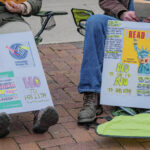
Mike Wolanin | The Republic Signs protesting House Bill 1134 and Senate Bill 17 are displayed at a community read-in at the Bartholomew County Public Library to protest the bills in Columbus, Ind., Wednesday, Feb. 16, 2022. The read-in was organized by library director Jason Hatton. Both bills would restrict minors from accessing what is categorized as “harmful materials” at libraries and make it a crime for librarians to provide those materials to minors.

Mike Wolanin | The Republic Veronica Buckler attends a community read-in at the Bartholomew County Public Library to protest House Bill 1134 and Senate Bill 17 in Columbus, Ind., Wednesday, Feb. 16, 2022. The read-in was organized by library director Jason Hatton. Both bills would restrict minors from accessing what is categorized as “harmful materials” at libraries and make it a crime for librarians to provide those materials to minors.

Mike Wolanin | The Republic Viewpoint Books owner Beth Stroh collects signatures for a petition at a community read-in at the Bartholomew County Public Library to protest House Bill 1134 and Senate Bill 17 in Columbus, Ind., Wednesday, Feb. 16, 2022. The read-in was organized by library director Jason Hatton. Both bills would restrict minors from accessing what is categorized as “harmful materials” at libraries and make it a crime for librarians to provide those materials to minors.
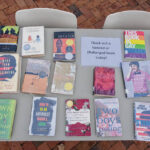
Mike Wolanin | The Republic A selection of banned books is on display at a community read-in at the Bartholomew County Public Library to protest House Bill 1134 and Senate Bill 17 in Columbus, Ind., Wednesday, Feb. 16, 2022. The read-in was organized by library director Jason Hatton. Both bills would restrict minors from accessing what is categorized as “harmful materials” at libraries and make it a crime for librarians to provide those materials to minors.

Mike Wolanin | The Republic Anna Denoyer, from left, reads The Tale of Despereaux to Clara Denoyer and Molly Garrett at a community read-in at the Bartholomew County Public Library to protest House Bill 1134 and Senate Bill 17 in Columbus, Ind., Wednesday, Feb. 16, 2022. The read-in was organized by library director Jason Hatton. Both bills would restrict minors from accessing what is categorized as “harmful materials” at libraries and make it a crime for librarians to provide those materials to minors.

Mike Wolanin | The Republic Children’s books of systemic racism, racism, mental health and feminism are displayed with signs protesting books bans and censorship at a community read-in at the Bartholomew County Public Library to protest House Bill 1134 and Senate Bill 17 in Columbus, Ind., Wednesday, Feb. 16, 2022. The read-in was organized by library director Jason Hatton. Both bills would restrict minors from accessing what is categorized as “harmful materials” at libraries and make it a crime for librarians to provide those materials to minors.

Mike Wolanin | The Republic People attend a community read-in at the Bartholomew County Public Library to protest House Bill 1134 and Senate Bill 17 in Columbus on Feb. 16.

Mike Wolanin | The Republic Boden Keele holds a sign stating he reads banned books at a community read-in to protest HB1134 and SB17 at the Bartholomew County Public Library in Columbus, Ind., Wednesday, Feb. 16, 2022. The read-in was organized by library director Jason Hatton. Both bills would restrict minors from accessing what is categorized as “harmful materials” at libraries and make it a crime for librarians to provide those materials to minors.

Mike Wolanin | The Republic Children’s librarian Kate Grafelman reads children’s book at a community read-in at the Bartholomew County Public Library to protest House Bill 1134 and Senate Bill 17 in Columbus, Ind., Wednesday, Feb. 16, 2022. The read-in was organized by library director Jason Hatton. Both bills would restrict minors from accessing what is categorized as “harmful materials” at libraries and make it a crime for librarians to provide those materials to minors.

Mike Wolanin | The Republic Alan Birkemeier displays a sign at a community read-in at the Bartholomew County Public Library to protest House Bill 1134 and Senate Bill 17 in Columbus, Ind., Wednesday, Feb. 16, 2022. The read-in was organized by library director Jason Hatton. Both bills would restrict minors from accessing what is categorized as “harmful materials” at libraries and make it a crime for librarians to provide those materials to minors.

Mike Wolanin | The Republic Alan Birkemeier makes a sign at a community read-in at the Bartholomew County Public Library to protest House Bill 1134 and Senate Bill 17 in Columbus, Ind., Wednesday, Feb. 16, 2022. The read-in was organized by library director Jason Hatton. Both bills would restrict minors from accessing what is categorized as “harmful materials” at libraries and make it a crime for librarians to provide those materials to minors.

Mike Wolanin | The Republic Michelle Williams reads a book at a community read-in at the Bartholomew County Public Library to protest House Bill 1134 and Senate Bill 17 in Columbus, Ind., Wednesday, Feb. 16, 2022. The read-in was organized by library director Jason Hatton. Both bills would restrict minors from accessing what is categorized as “harmful materials” at libraries and make it a crime for librarians to provide those materials to minors.

Mike Wolanin | The Republic Library staff members Luis Yanez Cisneros, left, and Christina Kelley makes pins bearing the messages Freadom and I Read Banned Books at a community read-in at the Bartholomew County Public Library to protest House Bill 1134 and Senate Bill 17 in Columbus, Ind., Wednesday, Feb. 16, 2022. The read-in was organized by library director Jason Hatton. Both bills would restrict minors from accessing what is categorized as “harmful materials” at libraries and make it a crime for librarians to provide those materials to minors.

Mike Wolanin | The Republic Pins bearing the messages Freadom and I Read Banned Books are being made and given away for free at a community read-in at the Bartholomew County Public Library to protest House Bill 1134 and Senate Bill 17 in Columbus, Ind., Wednesday, Feb. 16, 2022. The read-in was organized by library director Jason Hatton. Both bills would restrict minors from accessing what is categorized as “harmful materials” at libraries and make it a crime for librarians to provide those materials to minors.

Mike Wolanin | The Republic Bartholomew County Public Library Director Jason Hatton speaks with people attending a community read-in at the Bartholomew County Public Library to protest House Bill 1134 and Senate Bill 17 in Columbus, Ind., Wednesday, Feb. 16, 2022. Hatton organized the read-in. Both bills would restrict minors from accessing what is categorized as “harmful materials” at libraries and make it a crime for librarians to provide those materials to minors.

Mike Wolanin | The Republic Laura Hack, BCSC director of Elementary Education, and her husband Gene Hack, director of C4, attend a community read-in at the Bartholomew County Public Library to protest House Bill 1134 and Senate Bill 17 in Columbus, Ind., Wednesday, Feb. 16, 2022. The read-in was organized by library director Jason Hatton. Both bills would restrict minors from accessing what is categorized as “harmful materials” at libraries and make it a crime for librarians to provide those materials to minors.

Mike Wolanin | The Republic Community outreach librarian Sandy Allman waits to hand out free books at a community read-in at the Bartholomew County Public Library to protest House Bill 1134 and Senate Bill 17 in Columbus, Ind., Wednesday, Feb. 16, 2022. The read-in was organized by library director Jason Hatton. Both bills would restrict minors from accessing what is categorized as “harmful materials” at libraries and make it a crime for librarians to provide those materials to minors.

Mike Wolanin | The Republic People browse a selection of free books at a community read-in at the Bartholomew County Public Library to protest House Bill 1134 and Senate Bill 17 in Columbus, Ind., Wednesday, Feb. 16, 2022. The read-in was organized by library director Jason Hatton. Both bills would restrict minors from accessing what is categorized as “harmful materials” at libraries and make it a crime for librarians to provide those materials to minors.

Mike Wolanin | The Republic Sebastian Amuchastegui browses a selection of free books at a community read-in at the Bartholomew County Public Library to protest House Bill 1134 and Senate Bill 17 in Columbus, Ind., Wednesday, Feb. 16, 2022. The read-in was organized by library director Jason Hatton. Both bills would restrict minors from accessing what is categorized as “harmful materials” at libraries and make it a crime for librarians to provide those materials to minors.

Mike Wolanin | The Republic People make their way to a community read-in at the Bartholomew County Public Library to protest House Bill 1134 and Senate Bill 17 in Columbus, Ind., Wednesday, Feb. 16, 2022. The read-in was organized by library director Jason Hatton. Both bills would restrict minors from accessing what is categorized as “harmful materials” at libraries and make it a crime for librarians to provide those materials to minors.

Mike Wolanin | The Republic Scott Keen has a copy of Kurt Vonnegut’s “Slaughterhouse Five” as he attends a community read-in at the Bartholomew County Public Library to protest House Bill 1134 and Senate Bill 17 in Columbus, Ind., Wednesday, Feb. 16, 2022. The read-in was organized by library director Jason Hatton. Both bills would restrict minors from accessing what is categorized as “harmful materials” at libraries and make it a crime for librarians to provide those materials to minors.

Mike Wolanin | The Republic Lori Davies and her daughter Eleri read a book during a community read-in at the Bartholomew County Public Library to protest House Bill 1134 and Senate Bill 17 in Columbus, Ind., Wednesday, Feb. 16, 2022. The read-in was organized by library director Jason Hatton. Both bills would restrict minors from accessing what is categorized as “harmful materials” at libraries and make it a crime for librarians to provide those materials to minors.

Mike Wolanin | The Republic Information about censorship and Senate Bill 17 are on display at a community read-in at the Bartholomew County Public Library in Columbus, Ind., Wednesday, Feb. 16, 2022. The read-in was organized by library director Jason Hatton. The read-in was in response to Senate Bill 17 and House Bill 1134 which would restrict minors from accessing what is categorized as “harmful materials” at libraries and make it a crime for librarians to provide those materials to minors.

Mike Wolanin | The Republic People arrive for a community read-in at the Bartholomew County Public Library to protest House Bill 1134 and Senate Bill 17 in Columbus, Ind., Wednesday, Feb. 16, 2022. The read-in was organized by library director Jason Hatton. Both bills would restrict minors from accessing what is categorized as “harmful materials” at libraries and make it a crime for librarians to provide those materials to minors.

Mike Wolanin | The Republic People attend a community read-in at the Bartholomew County Public Library to protest House Bill 1134 and Senate Bill 17 in Columbus, Ind., Wednesday, Feb. 16, 2022. The read-in was organized by library director Jason Hatton. Both bills would restrict minors from accessing what is categorized as “harmful materials” at libraries and make it a crime for librarians to provide those materials to minors.