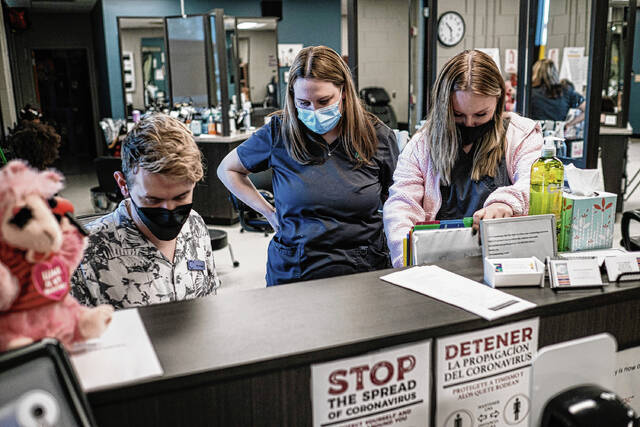
Mike Wolanin | The Republic Cosmetology teacher Chris Knight, from left, talks with students Emma Parker and Izzy Long at the McDowell Education Center in Columbus, Ind., Monday, Feb. 14, 2022.
A beauty salon on Columbus’ east side has one notable difference from others throughout the city — its staff is made up of high schoolers from Bartholomew and surrounding counties.
C4’s Cosmetology program, housed at the McDowell Adult Education Center, provides a public salon from 1:30 to 5:30 p.m. on Mondays, Tuesdays, Thursdays and Fridays to help students receive first-hand experience working with actual clients.
Brittnay Gonzalez, one of the program’s instructors, said their offerings include hair cuts, coloring, facials, perms, scalp treatments, styling, facial waxing, manicures and pedicures. The salon is open to anyone with an appointment.
Costs are low, with haircuts at $5. Proceeds go back to the Bartholomew Consolidated School Corp. and C4.
Gonzalez, who graduated from the cosmetology program in 2006, said that the salon focuses on giving students “real-world experience,” and their work in the salon isn’t just limited to providing treatments. Students also complete tasks such as answering the phone, scheduling appointments, doing inventory and refilling stations. She described it as a clinic run by students and overseen by the program’s instructors.
“It’s like a real job,” said cosmetology student Alyssa Lunsford, who is a Brown County High School senior. “Definitely way different than regular classes — you don’t have this interaction and you don’t learn how to actually talk and communicate with people. … It’s literally like working in a salon.”
Lenora Carne, a junior from CSA New Tech, likewise said that the salon has helped her learn about communication.
“You have to break that barrier of being uncomfortable with strangers,” she said.
“And that’s really helped. And it’s also just helped with my skills in general because every person’s hair is different. So when you work on someone, you have to learn what’s specific to their hair type.”
She added that one of the challenges of working in the salon is knowing what a customer wants “without telling them what you think is best for their hair.”
Gonzalez said that most of the students in the salon are from Cosmetology II. Cosmetology I students start by working on mannequins, as well as each other, before applying their skills to customers.
“Especially for the student that’s on the fence about doing this as a career, I feel like once they actually get to that real person, I think that is the make-or-break-it for them,” she said. “Either they love it or they don’t. You know, your mannequins don’t talk, so they’re not going to give you your feedback that you need.”
The salon has been part of the program since its inception 30 years ago, said Gonzalez. The Indiana State Board of Cosmetology requires cosmetology programs to have a “running, operating clinic” and mandates that a certain percentage of students’ work has to be on customers.
Gonzalez noted that the cosmetology program is a major commitment, with students coming in from 12:30 to 5:30 p.m.
“It’s a longer day than the average school day because they have to get their state hours. They have to get 1,500 hours by their senior year,” she said.
Lunsford noted that she appreciates how the program fits in with her other classes.
“It definitely gave me enough time, at the age I am, to be able to do it,” she said. “I don’t think I could have gone to a regular cosmetology school at 16.”
Once Cosmetology II students graduate in the spring, they will hopefully take their state boards and get licensed, said Gonzalez.
Lunsford hopes to get her license and start working in a salon immediately after high school.
“It’s something that I like to do,” she said. “I’ve always been an artistic person, and this something that you can actually do, make money off of, and you get to be artistic. Especially with color, which is what I want to specialize in.”
The program has seen challenges amid the pandemic — especially since periods of eLearning were “not ideal” for such a hands-on course, said Gonzalez.
The state of Indiana allowed a waiver regarding acceptance of online hours, which helped somewhat. However, this could expire soon.
“Our students could take their stuff home and do hands-on, and they had to submit videos and pictures,” said Gonzalez.
The virtual format posed a challenge for Lunsford, who didn’t have internet access and wasn’t able to get all of her time in.
“This year, I’m really, really behind on my hours,” she said. “… I can’t miss a single day now, pretty much. I have to be here or else I won’t be able to get my license.”
In spite of the challenges, Gonzalez said that the C4 cosmetology program is a good opportunity and relatively inexpensive, with a cost of only about $600 — compared to private schools that might charge $20,000. Students can also earn up to 32 dual credits through Vincennes University, in addition to high school credits.
“If anybody has any kind of instinct that this might be for them, this is a great opportunity for them to try it,” she said.