Photo provided
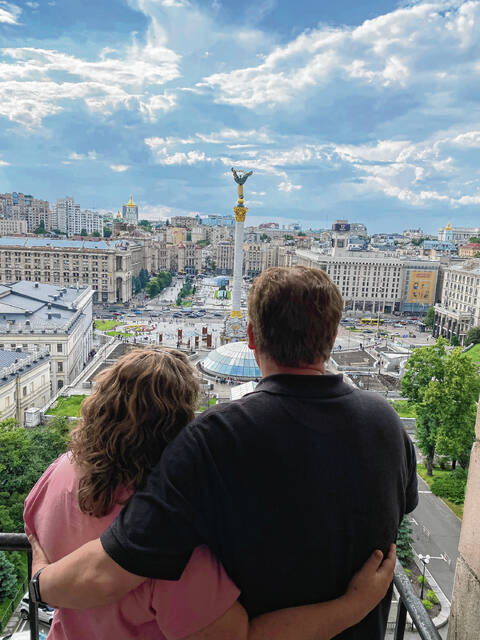
Judy and Mike Manna looking out over Independence Square in Kyiv, Ukraine.
Russia’s invasion of Ukraine hits close to home for local residents who have ties to the country and are watching news reports with trepidation and worry.
At Olesya’s Kitchen on McKinley Avenue on Columbus’ east side, owner Olesya Whitfield had the news on, watching Russian planes fly over Ukraine as she worked on Thursday.
Whitfield was born in Russia but is Ukrainian, as are both of her parents. She lived in Ukraine for more than 25 years and graduated from a culinary institute in Kyiv. She was 37 years old when she came to the United States.
The invasion scares her — and not just for the sake of her children and grandchildren in Ukraine.
“I’m hurt for our kids, our soldiers, our people and hurt for their people, because they’re somebody’s kids too,” said Whitfield.
She feels that if only mothers from Belarus, Ukraine and especially Russia could convince their sons in the army to set down their guns, it could all stop. Russia’s Vladimir Putin, she thinks, is the only one who actually wants this war, and killing each other would be like “killing brothers.”
One of Whitfield’s customers, who is from Russia, seemed to share the sentiment. As she ate, the two women spoke to each other and later shared a hug — a moment of comfort in the midst of chaos.
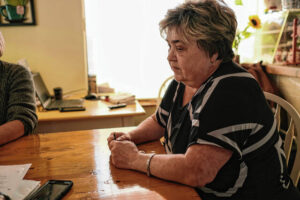 Pictured from top: Olesya Whitfield, the owner of Olesya’s Kitchen, talks about founding her restaurant during an interview Feb. 1 at the Columbus. A GoFundMe campaign has been launched to help Whitfield move her restaurant from its current location after the land where the business is located was purchased. // The exterior of Olesya’s Kitchen is pictured. Mike Wolanin | The Republic
They weren’t the only ones watching the situation. Columbus residents Mike and Judy Manna, who lived in Ukraine for 10 years as missionaries, have been in close contact with a number of people from the country they described as a second home.
The couple served in Ukraine from 2002 to 2012. While they were based in Kyiv, they worked all over the country and have maintained a number of friends there. They also keep in touch with their adopted daughter’s family and visit the country for two months each year.
“It’s been hard to sleep,” Mike Manna said.
The couple was up the night before, texting with several people from a number of different areas throughout Ukraine. While none of the Mannas’ friends and family were personally injured, they reported hearing the sound of nearby bombing, and the widespread nature of the invasion makes it difficult to avoid.
“They don’t really have a place to go,” Mike Manna said. “The bomb shelters are full, and they’re not very organized. … It seems to be everywhere.”
While the eastern part of Ukraine has had conflict for eight years, the more recent invasion is still a shock to many people, who did not expect it to be so widespread or “to be personally affected so quickly,” the couple said.
The Mannas’ prayers are with Ukraine’s defenders, that they would restore peace.
“We really call them defenders, because this is completely Russian aggressors against Ukrainian defenders that are simply defending their homes and their families,” Mike Manna said.
Aleksey Yezerets, executive director of advanced technologies at Cummins, Inc., expressed a similar sentiment. He and his wife are from eastern Ukraine and also lived in Russia for a time before moving to the United States.
“Often … the preferred language of a particular region is mistaken for the preferred country or another,” said Yezerets. “So eastern Ukraine, where we grew up, has been a very diverse area. It was a cradle of the Soviet industrialization, and as such, it was a very diverse area where Russian was — and to a large degree, remains — the preferred language, along with Ukrainian. That does not at all imply that Russian-speaking population, or ethnically Russian population, necessarily prefer to be under Russia and not as part of Ukraine.”
He said they see the invasion as “an absolutely unprovoked attack by a larger and more militarized country against its smaller and more peaceful neighbor.”
“We consider this, in a broader context, not just an attack of one country versus another, but an attempt to challenge the established norms, the norms have been established and paid very hard for by the second World War — the norms that made it unacceptable to change the borders in Europe, or elsewhere, via pure military force,” said Yezerets.
He and his wife have friends in both countries, and the invasion “hurts both ways” for them. However, it doesn’t change their stance on the situation, they said.
“To a large degree, it’s a fight between basically the totalitarianism and a fledgling, but real, democracy with all its imperfections and all its real-world complications,” said Yezerets, “but there’s no doubt that in dichotomy between totalitarianism and democracy, today’s Russia and today’s Ukraine fall on the entirely different parts of that spectrum.”

Photo provided
Judy and Mike Manna looking out over Independence Square in Kyiv, Ukraine.

Photo provided Cam Cooper, Judy Manna, Katya Cooper, Mike Manna are shown in a photo. Katya is their adopted daughter from Ukraine (currently lives in Ft. Wayne); Cam is their son-in law. The picture was taken in Kharkiv.

Photo provided
Aleksey Yezerets