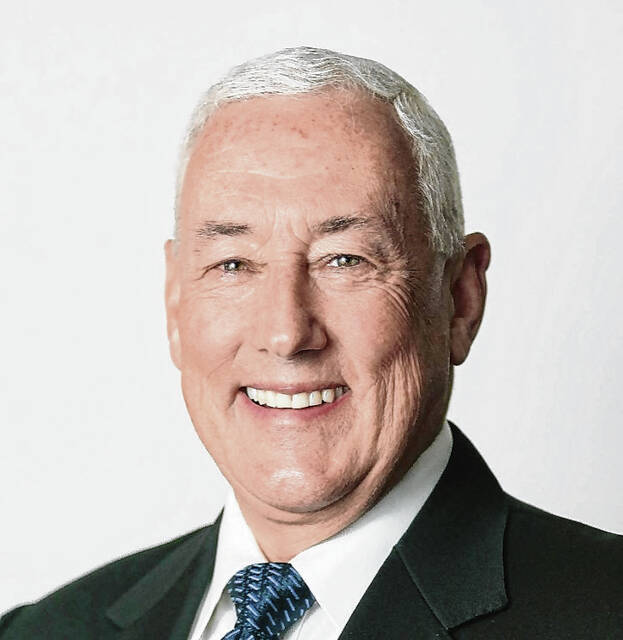
Rep. Greg Pence
Rep. Greg Pence, R-Indiana, voted in favor military aid for Ukraine and allies in Eastern Europe, but against billions of dollars in humanitarian aid for the war-torn country, including emergency food and shelter, congressional records show.
The House approved a massive spending bill late Wednesday that would rush $13.6 billion in emergency aid to Ukraine as part of a sweeping $1.5 trillion spending package, but did so in two separate votes.
In the first vote, which covered the bulk of the measure’s security and military programs, the House — including Pence — voted overwhelmingly 361-69 to approve, The Associated Press reported.
Those programs included, among other things, about $6.5 billion of the $13.6 billion in aid for Ukraine to pay for the U.S. costs of sending troops and weapons to Eastern Europe and equipping allied forces there in response to the Russian invasion of Ukraine, according to wire reports.
The second vote, however, included the rest of the $1.5 trillion package, which included the Ukraine humanitarian aid and provisions to keep U.S. government agencies functioning through Sept. 30. Those measures cleared the House in a 260-171 vote with most Republicans opposed, including Pence.
On Thursday, the House Rules Committee directed The Republic to what officials there said was the most recent copy of the 2,741-page measure.
According to that copy, the provisions in the spending package that Pence voted against included $2.65 billion in international disaster assistance to “respond to humanitarian needs in Ukraine and in countries impacted by the situation in Ukraine, including the provision of emergency food and shelter.”
It also contained $1.4 billion “to assist refugees from Ukraine and other vulnerable populations and communities,” and $1.12 billion to assist countries in Europe, Eurasia and Central Asia “for assistance and related programs for Ukraine and other countries.”
Besides aid for Ukraine, the provisions Pence voted against also included money for agricultural programs, rural development programs, the Department of Veterans Affairs and the reauthorization of the Violence Against Women Act, according to a copy of the legislation.
The measure would keep agencies functioning through Sept. 30, the end of the fiscal year, according to wire reports. Since it began Oct. 1, the government has functioned on short-term measures that prevented federal shutdowns but held programs to levels agreed to under President Donald Trump.
Also on Wednesday, Pence joined all but 17 House members to ban Russian oil imports, a move that the Biden administration imposed this week.
On Thursday, The Republic asked the second-term congressman’s staff multiple times why he voted against part of the spending package related to Ukraine.
Pence’s staff failed to clarify his votes and why he would vote against humanitarian aid to Ukraine, though his press secretary acknowledged that he voted for $6.5 billion of the $13.6 billion in military aid to Ukraine and the ban on Russian oil imports.
“Congressman Pence voted in support of security spending, $6.5 billion in aid for Ukraine and H.R. 6968, Suspending Energy Imports from Russia Act,” said Hannah Osantowske, Pence’s press secretary. “This bill thus goes to the United States Senate for further action where it is expected to pass. So, the main argument that Congressman Pence voted against aid for Ukraine is completely false.”
On Wednesday morning, Pence issued a statement in which he complained that he didn’t receive a copy of the bill until several hours before a planned voted and claimed that the bill, which was the result of bipartisan negotiations, was “crafted behind doors” by House Speaker Nancy Pelosi, D-California, in an effort to “cram it down the American peoples’ throats.”
“At approximately 3:04 AM, I received a 2,741-page, 1.5 TRILLION-dollar spending bill that I am expected to vote on in the next few hours,” Pence said in the statement. “Nancy Pelosi crafted this bill behind closed doors in the dead of night and is trying to cram it down the American peoples’ throats. This is WRONG, and I am fully prepared to vote against it. Now more than ever it’s time for change in Congress and new leadership in the House — and this out of control spending is all the more reason to fire Nancy Pelosi.”
Osantowske said Pence was merely saying he was “fully prepared” to vote against the bill containing aid for Ukraine, “but had not made a final decision at that time.”
Wednesday’s votes came as reports surfaced that a Russian attack severely damaged a maternity hospital in Ukraine, with the country’s president writing on Twitter that there were “people, children under the wreckage” of the hospital, according to wire reports.
Fighting also knocked out power to the decommissioned Chernobyl nuclear plant, raising fears about the spent fuel that is stored at the site and must be kept cool. But the U.N. nuclear watchdog agency said it saw “no critical impact on safety” from the loss of power.
Nationwide, thousands are thought to have been killed, both civilians and soldiers, in the two weeks of fighting since Russian forces invaded, according to the AP. The U.N. estimates that more than more than 2 million people have fled the country, the biggest exodus of refugees in Europe since the end of World War II.
And experts say the crisis is likely to get worse as Moscow’s forces step up their bombardment of cities in response to what appears to be stronger Ukrainian resistance and heavier Russian losses than anticipated.
National media characterized the passage of the Ukraine aid and the $1.5 trillion government-wide legislation carrying it let both parties lay claim to election-year victories for their priorities, according to wire reports. Democrats won treasured domestic initiatives, Republicans achieved defense boosts, and both got their imprint on funds to counter Russia’s brutal invasion of its western neighbor.
Democrats won a 6.7% increase over last year in domestic programs, to a total of $730 billion. Republicans were able to boost defense programs to $782 billion, a 5.6% increase.
The Associated Press contributed to this report.