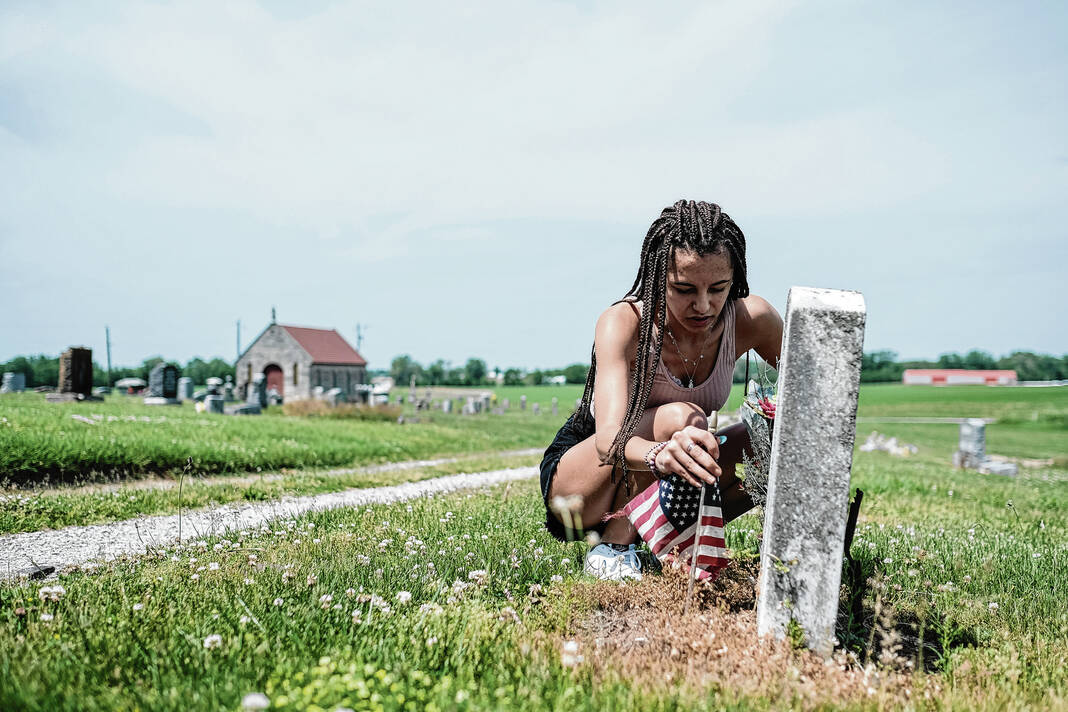
Mike Wolanin | The Republic Columbus East graduate Tia Brown cleans a headstone at Springer Cemetery in Columbus, Ind., Tuesday, May 24, 2022. Brown started caretaking duties at the cemetery for her senior project in December 2021.
A Columbus East High School student worked for months in the spirit of Memorial Day to honor those who have died by cleaning and restoring headstones in historic Sand Creek Township cemeteries.
From Sept. 17, 2021 to Jan. 1, East student Tia Brown made 16 trips to Springer Cemetery, off U.S. 31 and County Road 475S and the Azalia Methodist Cemetery, situated off County Road 350E.
More than 32 hours were invested in cleaning dirt and algae from headstones, brushing off grass, straightening out flowers, uprighting stone markers, picking up trash, straightening flags and fixing ground plaques.
She performed the work, as well as wrote log entries and created presentations, as her senior project. On the surface, the cemetery upkeep seemed an admirable, but not unusual undertaking for the high school requirement.
However Tia’s efforts have also been a way of handling the immense grief she experienced after five close friends or beloved family members all died in 2020 – most due to complications from the COVID-19 virus.
The first was the teen’s grandfather, Roy Joe Brown, who was only 53 when he died on March 13, 2020.
Two ministers that Brown considered important members of her church family died within hours of one another. On Sept. 2, Pastor Harlie Hines died at the age of 83, while the Rev. Glenn Poynter died the same day at the age of 73.
As the year was coming to an end, two more members of Tia’s family died during the holiday season. Her great-grandmother, Ruth Webb, was 75 when she succumbed on Dec. 5. Less than four weeks later, the teen’s great uncle, Robby Webb, died on New Year’s Eve. He was 56.
During this initial year of the pandemic, few funerals were conducted. Even when they were allowed, mourners were denied expressions of comfort through hugs, handshakes or even the support of sitting side-by-side.
The most painful loss
For Tia, the most crushing death in 2020 was the late-summer death of her 79-year-old grandmother, Polly Wyatt.
”She was absolutely like my best friend, and her death really took a toll on me,” Tia said. “If I was upset or anything, I could always go to her. We would just sit there and talk all night or all day. She really shaped my personality.”
Hours before her death on Sept. 12, Tia was in tears as precautions forced her to speak to her grandmother for the last time over the telephone, she said. At the age of 17, Tia told her that while she understood her grandmother didn’t want to leave this world, “it would be better to let go and be rejoined with her husband.”
One of the final words the dying woman heard was Tia expressing her confidence that her grandmother would be watching over her from heaven.
Prior to 2020, Brown described herself as an outgoing, happy girl that would talk with anyone.
“But now, that bubbly person doesn’t feel I should be as bubbly,” she said.
Love and respect
Despite the losses, Tia’s faith did not appear to be shaken. She still loves and cherishes her (blood and church) family, she said, adding that she knows loved ones are looking over us from heaven. Brown also agrees with Burrell that it’s important for the living to convey their love and respect for the deceased.
“So I began to think there are people out there in this world that don’t have family members that are alive,” Brown said. “It’s their grave stones that become neglected. I feel those who are buried in these cemeteries would appreciate it if their graves and markers were cleaned.”
The caretaker for five cemeteries, including Springer and Azalia Methodist, agreed to serve as mentor to the East senior for the project. But Mitchell Barr, 77, said he has been recovering from major surgery since last year and has tried to avoid contact with most people due to his weakened immune system.
“Tia did most of this work on their own,” Barr said. “We would touch base on the phone. I would ask how she was doing with the project, and whether she was keep a log (of her work).
Extra efforts are always made to spruce up the cemeteries prior to holidays – especially Memorial Day. During her trips to the two cemeteries, Brown came across several grave stones marking the graves of soldiers killed in action, she said.
“Azalia (Methodist) is filled with the graves of several veterans, including many who died during the first part of the Civil War,” Brown said. “Springer also has many veterans, but their graves are spread out all over the grounds.”
While Barr was recovering, the teen was able to recruit assistance for cemetery upkeep from others including her mother, Jill Huddleston – her twin sister, Kara – and other family members. If the task required some heavy lifting such as returning headstones to their rightful position, Brown would recruit boyfriend Tony Ruiztapia, a former football player who spent multiple seasons on his school’s wrestling team.
In preparing for the project, Brown came across research that recommended D2 biological solution spray be used on old headstones because it removes dirt and algae, but has no chemicals that would damage the stone markers themselves. She also learned the best results for cleaning deep crevasses might be a small amount of Dawn dishwashing liquid and tooth brushes, she said.
While she painfully scratched up her hands a number of times while cleaning headstones, Brown expressed satisfaction with the overall results.
So has her mentor. Despite the almost 60-year age difference, Mitchell Barr’s beliefs regarding the death of loved ones are close to what Brown expressed.
“I stop by Grandma and Grandpa’s stone at Springer,” the 77-year-old caretaker said. “I know Grandma can’t hear me, but I also know she’s in heaven. I just thank the Lord for everything she has done for me.”