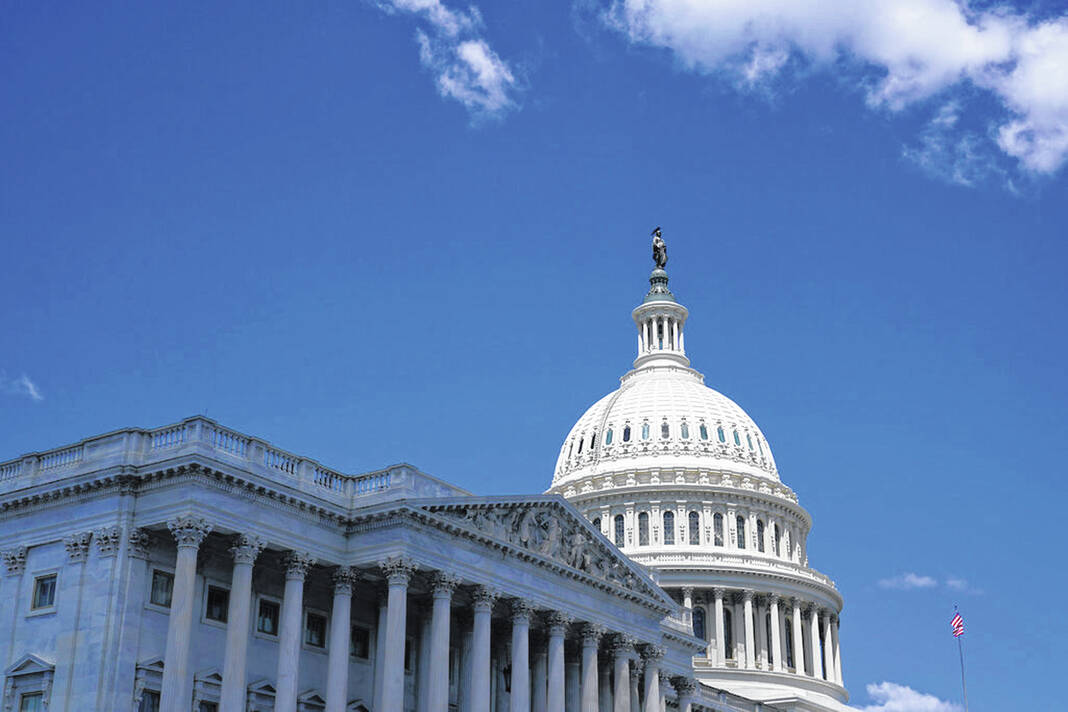
FILE - The sun shines on the dome of Capitol Hill in Washington, Friday, Aug. 12, 2022. A man drove his car into a barricade near the U.S. Capitol early Sunday, Aug. 14, 2022, and then began firing gunshots in the air before fatally shooting himself, police said. (AP Photo/Susan Walsh, File)
By The Franklin Daily Journal
Two candidates are vying to be the U.S. Representative for Indiana’s Sixth Congressional District.
Incumbent Rep. Greg Pence, a Republican who is running for his third term in office, will face Democrat Cynthia “Cinde” Wirth in November’s general election, with the winner representing Bartholomew County in Congress.
Pence, of Columbus, has held the 6th District seat since he was first elected in 2018.
Wirth, an educator and small business owner also from Columbus, previously ran to represent District 59 in the Indiana House of Representatives in the 2020 primary. She later ran for Indiana State Senate in District 44 in the general election that fall.
 Photo by The Daily Journal Cynthia “Cinde” Wirth, a Democrat running for Indiana’s 6th Congressional District, speaks during an interview at the Daily Journal on Oct. 4 in Franklin.
 Photo by The Daily Journal Greg Pence, an incumbent Republican running for Indiana’s 6th Congressional District, speaks during an interview at the Daily Journal on Oct. 3 in Franklin.
The Q&As below include answers from the candidates in their own words. It has been edited for length, grammar and formatting.
Q: What drew you to run for this office?
Pence: I was helping my predecessor, Luke Messer. You know, the 6th District has changed quite a bit. He was a 6th District (representative) from Greensburg. He was in for six years, and then he wanted to run for Senate. I was his statewide finance chair. As I was going around, people said to me, ‘Why don’t you run?’ So then some people talked me into it. I was semi-retired, and I’ve been in politics behind the scenes for a long time, so it wasn’t a big stretch.
Wirth: I was a classroom teacher at the high school level for 10 years, and from what I saw in my classroom, with students, I realized that we have a large issue with our population and supporting our population. We have parents working two and three jobs, trying to raise families and that’s the number one issue I think that people are facing today; that everything is a struggle and there’s essentially not much of a middle class left. I was selected for a fellowship in Washington, D.C. to learn to write policy through the (U.S.) Department of Energy. When I was in D.C. with that fellowship, I learned how … well-written policy, can change people’s lives for the better, including those of my former students and students today, and their families. That’s what really drove me to run for this office.
Q: What are the most pressing issues facing the country? How do they relate to the issues facing this district?
Pence: Inflation, inflation and inflation. …. Everyone is talking about the cost of everything. If you talk to people that work for a living on an hourly basis, their problem is inflation has outstripped increases in pay. This isn’t anything new, but that’s all we’re hearing about. Some people say … “It’s not inflation that bothers people. It’s the economy going in the wrong direction.” To me, inflation is at the heart of, and the core of … what the problem is in the direction of the economy.
You see, with inflation, I’ve talked to a lot of small business people here, just right here in this (courthouse) square. The cost, their costs are eating into their profitability. A lot of restaurants are now struggling because of the cost of labor, the cost of paper, the cost of the food and their sales are starting to dip. I’m concerned that we are; I believe we are in a recession, OK, and in stagflation. It’s not going to get better until we kind of bend some of the curbs that can be bent, and one is in energy.
Wirth: I think we are facing a choice of upholding democracy or not upholding democracy. I think there is no gray area in this election. At every level, we’re looking at people who are attempting to undermine the democratic process. We saw that on Jan. 6 with the insurrection. We’re seeing that in Indiana Senate Bill 1 (which banned most abortions). We saw the rejection of that in Kansas, with their laws similar to SB1 that they put on as a referendum, which we’re not able to do in Indiana. … We have a process for democracy that works as long as we all support it. When we undermine the democratic process, it removes people’s voice from decisions that are being made in Washington or at the Statehouse.
Q: What are your top priorities and how will you execute those?
Pence: Definitely (will) continue with the constituent services. I know that sounds simplistic, but again, my title is ‘I’m representative of the Indiana Sixth District.’ We need to make sure that we represent folks.
Legislatively is fighting inflation, and that would be vis-à-vis deregulation. We have to let the market come back in and solve some of these problems. We’ve really shut down, particularly in the energy world. I live in the county and I pay for my trash pickup. It’s usually $60-some dollars. Now because of fuel surcharges, a week ago Sunday, I paid $100.14 with $40 fuel surcharge.
Inflation is also affecting the delivery of all goods across the country. My electric bill is up over 50% because my natural gas costs have gone up, because we’ve stopped the development or expansion of natural gas in this country and … in some cases, shut down coal plants before we had an alternative so I’ll focus on that very much. Deregulation will be key. … Even deregulation in the medical industry. There’s some things that are getting in the way of them being able to deliver care to patients as well.
Wirth: I think we need to work on codifying reproductive freedom, which would be upholding Roe v. Wade. That’s a priority because when we have those personal freedoms that start to erode, it just leads to more freedoms being removed.
Public education is one of my top priorities always, and supporting public education with public dollars is one of my main priorities. Being in the classroom and seeing how teachers have been deprofessionalized and are facing increased scrutiny from just the general public from people inflaming issues that are really non-issues. Public education is one of the biggest concerns I have to work on, and that can be done through federal means in accountability and testing, removing some of those barriers for teachers in the classroom; through eliminating some of the testing procedures and retooling the entire system.
The other thing is healthcare. We are still in the healthcare crisis. We’re better than we were (before, but) I think healthcare needs to be completely decoupled from employment. We have a system … (where) healthcare is based on your employment. We have some supplemental systems that go outside of that, but if we have an entire federal system that … attaches healthcare to the person and not to the employer or the job, then people can make decisions for their employment and their vocation not based on healthcare. Healthcare-based decisions for employment and vocation are the basis of many people making decisions about where they’re going to work and what they’re going to do. I’ve had to make that decision myself, so I understand that.
Q: There is a push right now moving towards greener and cleaner energy sources, what are your thoughts on it? Do you think the country is moving in the right direction?
Pence: I think they’re moving in a fine direction. It’s the speed at which they’re moving which is a real problem. In August, we had to fire up to two coal plants in Southern Indiana because we had shut those down because we’re trying to move to green before we have an alternate source of electricity or energy. We’ve spent 150 years creating an energy distribution matrix across the country … to get energy in the right place at the right time, affordably and reliably. When we’re pushing out one of the options before the other alternatives are really to scale, that’s causing problems. California, announced, two, three weeks ago that you couldn’t charge your electric cars for a week because there wasn’t enough electricity there. They had moved too quick to solar and wind. … I’m fine with solar and nuclear and wind, natural gas, liquid natural gas, hydrogen — I’ve sponsored a hydrogen bill that would kind of take diesel out of the mix and put hydrogen, which would create electricity on trucks and heavy-duty and on-road and off-road (vehicles) — but we’re not there in terms of the distribution side yet.
Wirth: Absolutely, we need to push for greener solutions. What we’re seeing Republicans do is blow around some hot air, if you will, that is trying to place blame of things just for partisan politicking. I think we are in a global climate crisis. We know we are; we’ve known for over 30 years that we are and we have had Republicans at the helm and control that have not made decisions that we should have and we’re paying for it now. We’re seeing increased storms, we’re seeing increased temperatures. We have to shut the carbon source off at the tap, and one of the ways to do that is to look at alternative energy sources. It’s not anything that’s new.
Q: What are your thoughts on President Biden’s student loan debt relief plans?
Pence: I couldn’t be more opposed to that decision to arbitrarily forgive loans that no one forced people to take out. I don’t really even understand the thinking. … The parents that have sacrificed; if you’re a parent, and you borrowed money to put your child through college that will not be forgiven, that loan doesn’t qualify for forgiveness. It’s only a loan that the student took out. … We need to address the real issue. When I went to college, I paid for college myself. It’s a private school in Chicago, and I did it with summer jobs and part-time work during school. That school now (costs) $63,000 a year. There’s no way you could do what I did. The incredible rise of room, board, tuition at colleges … we need to be talking about that. Bring (colleges) to the table, ask them why. Some of these colleges have enormous endowments, have huge building programs, and yet the tuition keeps going up.
Wirth: I think it goes far enough to give people relief. I think it’s not anything that is taking away something from people, it is giving relief. I view it as overwhelmingly positive and not any different than the relief that was given under the Paycheck Protection Program loans during the pandemic. Those loans were completely forgivable and there was no principal or interest paid back on any of those loans, whereas student loan debt, people have been paying for years and what we’re seeing go away is essentially mostly interest.
Q: Right now, people are becoming more and more concerned about the data tech companies are collecting. How do you feel about it and what should be done to address these privacy concerns?
Pence: I am on Energy and Commerce, we have authority on consumer protection. … I’m on that committee and there isn’t a Democrat or Republican in the House or the Senate who doesn’t want to do something about privacy and Big Tech. I thought we almost had something done last spring, but there’s some nuances we have to work through. … Everything we do today, Big Tech is gathering information and they’re selling your information, and my personal solution is I need to give you very explicit permission for you to sell my information, and you should pay me for it. How’s that for a novel idea, huh? … I do believe the bot issue kind of ranks and moves mundane stuff around manipulatively you know, but it’s us personally too. These electric cars are just going to suck information from you and in send it off. Did you know, when you buy a new car, you actually give up your rights to all the information in that car? You go ‘Oh no, it doesn’t say that.’ Yeah, it’s been saying that for a couple years. They own your data, and that leads to … right to repair. … There’s a right to repair bill that I actually sponsored, but this is all under that same Big Tech blanket: the right to privacy, your data, who owns it.
Wirth: I do think we need to protect data privacy. I think this is a position where we can look to government regulations to provide some structure for that, and some guidance. We have a lot of data that is out in the world of big data, and there are many people making profits from that. I think profiting at the expense of taxpayers and citizens and people is never a good idea. … There are a lot of cyber type of intelligence professionals, and I think there are a lot of beneficial pieces that we can put in place to protect consumers and protect everyday citizens.
Q: What are your thoughts on the U.S. aiding Ukraine? Are we too involved or not involved enough?
Pence: I have voted in support of humanitarian aid. I did not on (Sept. 29). I think this is part of our inflation problem. … This last Congress, I was on the Foreign Affairs committee. I don’t know why we’re paying four times as much for Ukraine to defend itself versus the European Union, or NATO. … I think they need to solve problems over there. There’s going to be a pause there because of winter … but I will not be supportive of any additional military aid to Ukraine.
Wirth: I think we have a responsibility to help uphold democracy where it exists, and where it is desired. I think we are supporting Ukraine and I do support that, and I think it should be done. People need assistance from external threats when their country is being invaded. I think when we remember that these are people who have lives and families, that’s important.
Q: How will you communicate with constituents?
Pence: We respond to any inquiries we get. We always do that. I do a lot of radio in … we’ll call it the old 6th District. … We got some billboards up to let you know. We send out mailers. We sent out a number of mailers in August (on) how you contact our office; postcards. We have offices in Richmond, Greenfield and Columbus. I come home every week, I get out and about like this and fly the flag.
Wirth: I think there needs to be more interaction between representatives and their constituents on a regular basis. Regular town halls, regular small group roundtable meeting sessions with stakeholders of different issues — like farmers — open-door forums, not closed-door forums. I have a strong belief, and it’s kind of at the core of this, that a representative government represents people openly and doesn’t hide behind closed doors or big dollar donation events.
Q: What else would you like to say to voters?
Pence: Vote. Sometimes I don’t understand folks who are eligible to vote that don’t vote. Get out and vote. If you disagree with us, then vote. If you agree with us, vote. If you want to make changes, vote. It’s really sad how little — it’s about 30% in the state of Indiana — eligible voters that show up and it’s not hard to vote.
Wirth: My entire goal is to put people before partisan politics because, at the very core, people live in the 6th District. People have needs in the 6th District. … I think when a representative votes according only to partisan lines, it’s playing games with hardworking people’s lives. Playing games with people’s lives is shameful; when you vote against capping insulin prices at $35, that harms people. Those are the kinds of things that I will not do.