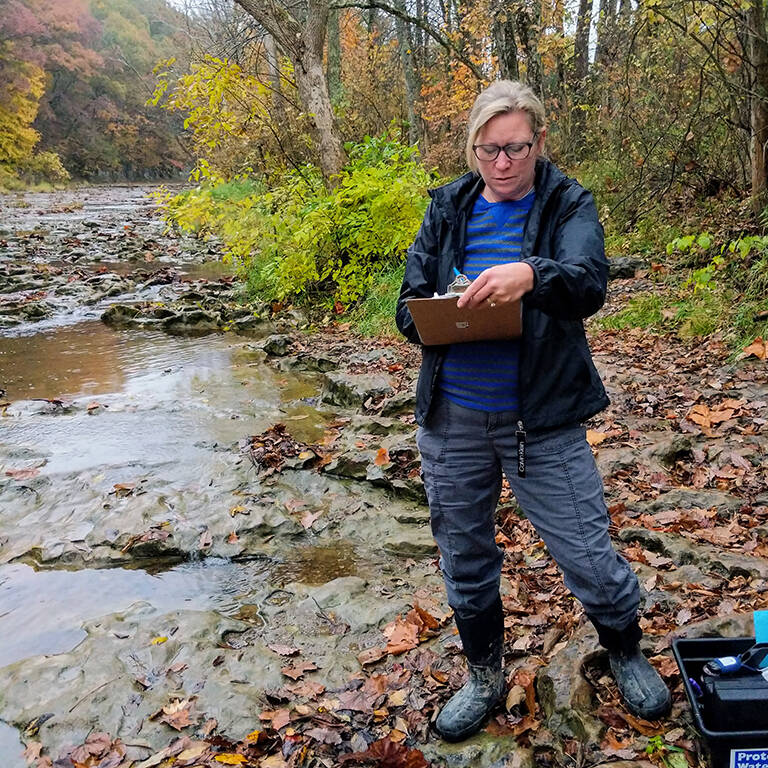
When Julia Lowe planted herself as a youngster amid the moss-covered limestone of Spring Mill State Park in Mitchell half a century ago where her grandfather served as property manager, she felt a deep connection with her surroundings.
The relative, Ray Gaines, would drive her around in his Indiana Department of Natural Resources truck.
“He was like the king,” Lowe said. “That’s probably how all this really started.”
“This” refers to the 56-year-old Lowe’s passion for all things environmental. Because on this Earth Day, it’s fair to say that the Columbus resident is something of the Queen of Green.
The chair of the Sierra Club Hoosier Chapter is one of 13 people named by Indiana University’s Environmental Resilience Institute as 2023 Hoosier Resilience Heroes. The list includes professionals, students, and volunteers dedicated to climate policy, renewable energy, sustainable business practices and more.
She helps educate residents about the importance of native plants and pollinators. She secured a grant from the Grassroots Network in 2017 to distribute native plants locally and create public pollinator gardens in partnership with local schools and the parks departments.
She coordinates volunteers to monitor local streams for pollutants as part of Sierra Club’s Winding Waters group, helped found the Blazing Stars CISMA of Bartholomew County to combat the spread of invasive species and organizes community members in support of responsible public land management, clean water, and clean air.
The retired health care professional who moved to Columbus from Indianapolis 10 years ago, mentioned that the honor means plenty to her both personally and practically.
“It’s like maybe you can really believe it now when others say that you’ve done a good job,” she said.
Eric Riddle, who has worked alongside Lowe especially on pollinator projects, believes she has done far more than a good job. He overflows with superlatives when discussing her tireless efforts. Then he summarizes her impact with two sentences.
“She is a volunteer,” Riddle said. “But you would think that this is her full-time job.
“She’s been using the expression that her tank is getting full. I think that means that she is very encouraged by the work that is going on.”
That includes Project 46, the new multi-county climate change alliance announced recently between Bartholomew, Brown and Monroe counties.
“My eyes just teared up,” Lowe said of the pact ceremony in Nashville.
“I was so overjoyed, because I worry so much about climate issues and my children and my whole family. It’s hard sometimes to go at this 90 miles per hour. A couple of bad days per year, there are times when everything really overwhelms me.
“But with this (alliance), I had to stop and realize, ‘Wow, this really happening.’”
Lowe mentioned that, in her 15 years in Columbus, she has been impressed with the community’s broad-based sense of altruism, and of leaders directly confronting serious issues. She was especially impressed when then-Cummins CEO Tom Linebarger called climate change the “existential crisis of our time” during a visit to the White House last year.
“It’s not just the Sierra Club doing this work,” Riddle said. “It’s many organizations working together, and Julia does a great job working across the breadth of organizations and volunteers.”
She herself passes credit for environmental progress to a range of others. She lauds the patience and listening skills of Sen. Greg Walker, R-Columbus, with whom she has formed a respectful working relationship after initially being somewhat intimidated by him at a Third House legislative session.
“It can be so easy for people to be politically polarizing on platforms like Facebook or maybe in an email,” Lowe said. “But when you sit down face to face with people, you hope they revert to being kind. And the professional relationship between us really grew, even though I sometimes used to be really mad at him before that (connection).”
Sarah Mincey, the Environmental Resilience Institute’s managing director, highlighted a fundamental element needed for people and the environment to grow in a healthy fashion.
“Creating a thriving future for all Hoosiers starts with recognizing our interconnectedness to natural systems,” Mincey said. “This is something our heroes understand deeply and put into practice in their personal and professional lives.”
About the institute
Indiana University’s Environmental Resilience Institute brings together a broad coalition of government, business, nonprofit, and community leaders to help Indiana and the Midwest better prepare for the challenges of environmental change. By integrating research, education, and community, ERI is working to create a more sustainable, equitable, and prosperous future. Learn more at eri.iu.edu.