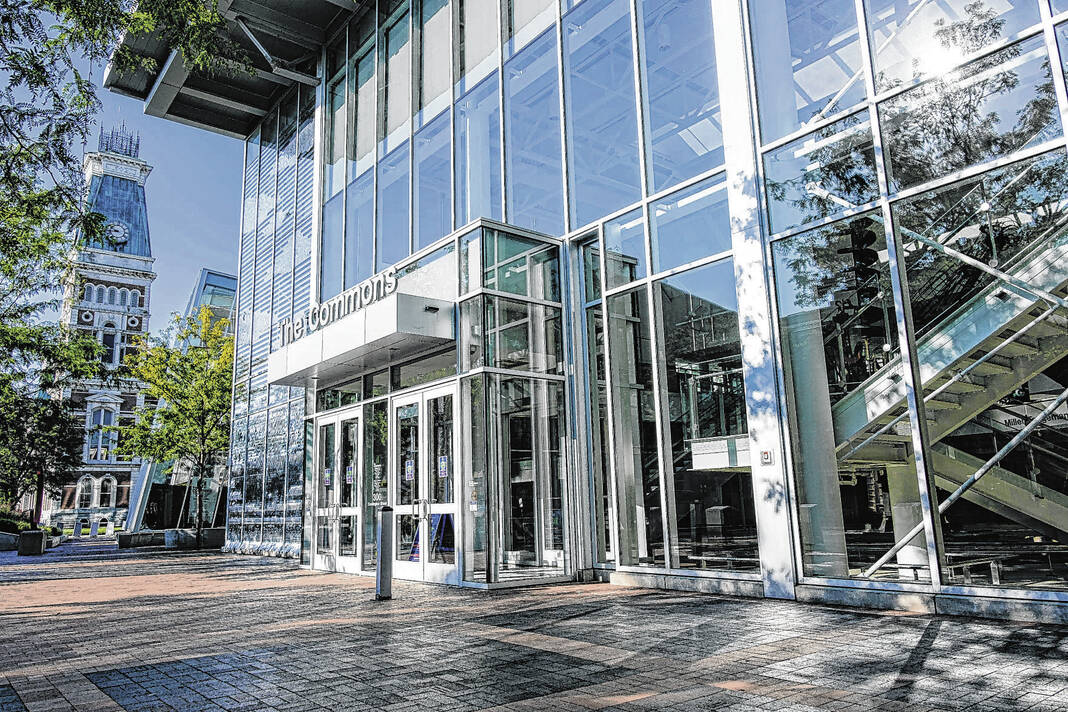
Mike Wolanin | The Republic An exterior view of The Commons in downtown Columbus, Ind., Wednesday, Sept. 8, 2021.
Officials at a local homeless shelter say they have seen an increase in the number of people turning to them to keep a roof over their heads this summer.
Brighter Days, at 421 S. Mapleton St., normally sees about 12 to 15 people come through its doors each night during the summer, said Kelly Daugherty, executive director of Love Chapel, which operates the facility.
However, this summer has been different.
“We’re just seeing an influx of more homeless,” Daugherty said. “…This summer, we’ve been running 25 to 27 (people) every day.”
Daugherty attributed the increase to a variety of factors, including wages not keeping up with inflation, mental illness and drug abuse. “I think that a lot of the folks we see are in that same ballpark,” he said. “They really struggle without support to keep their housing.”
In addition, local officials said the local hot meal program is “continuing to be very busy” and has seen about a 5% to 10% increase in the number of people who are showing up for food as of late, including a growing number of families with children.
“We are seeing a few more families with kids,” Daugherty said. “We never used to see many kids that came for the hot meals.”
‘Lack of places’ to go
The issue of homelessness in Columbus has been thrust into the spotlight in recent weeks as leadership at The Commons was criticized for proposed building rules that some view as targeted against the local homeless population.
The Commons Board voted in April to approve new building rules that would prohibit a number of actions on the premises, including loitering, soliciting, panhandling, sleeping or lying down, cluttering spaces with personal belongings, bringing in outside alcohol, smoking and vaping.
Commons officials said previously that there have been issues with people bringing in crockpots and cooking in the space.
The rules are still being considered, and the board is expected to vote on a final draft at its next meeting, which is tentatively set for Aug. 23.
Commons manager Shanda Sasse declined to comment, saying she felt uncomfortable discussing the issues that The Commons has been experiencing without some other staff who were not in the office last week.
The Commons is not the only public place considering these kinds of questions, however.
The Bartholomew County Public Library’s board of trustees is considering plans to update their code of conduct for patrons, with a recent draft emphasizing that individuals have rights within the space and the responsibility not to infringe on the rights of other users.
Library Director Jason Hatton said the potential rule changes are not targeting homeless individuals who spend time at the library, but rather largely focus on food and drink rules due to the library’s new carpeting.
“(Homelessness) has always been an issue for the community, and us as a library, as a community place, we definitely feel that because we serve everybody, and we want everybody to have access to the resources that they need,” Hatton said. “…We do want it to be a place that is welcoming to everyone.”
Daugherty said that many of the people who spend the night in Brighter Days have few places to go once the shelter closes each morning.
“It’s really a lack of places to go during the daytime,” Daugherty said. “That’s really what it boils down to. A lot of folks at The Commons and the library are folks who stay at Brighter Days, but there is no place for them to go, especially on the weekends. There’s an engagement center, and they can go to it Monday through Friday but (on) weekends, it’s closed. So, when they leave Brighter Days at 8 a.m., they really don’t have any place to go.”
“More and more businesses have said, ‘No, we don’t want you there,’” Daugherty said. “And, so, it has caused a big problem in that they don’t have any place to go. They’ve been hanging out at The Commons. They’ve been hanging out at different places like the library.”
Longstanding problem
Homelessness is not a new problem in Columbus.
Experts say the origins of the current U.S. homelessness crisis can be traced back decades to policies that drastically cut federal affordable housing programs, according to Washington-based group National Coalitions for the Homeless. Poverty, mental illness, addiction and other issues also have played a role in the crisis.
Columbus Mayor Jim Lienhoop said the city has been trying to “help that population” and has participated with Brighter Days, the Alliance for Substance Abuse Progress and Columbus Regional Health on its mental health initiative. The city also is planning to embark on its first housing study in more than a decade.
“That one word (homeless) applies to several different groups of people,” Lienhoop said. “…There are several sides of this issue, and it’s important to understand which side of this issue we’re trying to address at any moment.”
“We’re working to try to help,” Lienhoop said later in the interview. “…It’s just slow-going.”
Currently, local officials largely rely on what is called “rapid rehousing,” which is an intervention model that seeks to help homeless people with more moderate needs find a home as quickly as possible.
Most of the time, the recipients of rapid rehousing rent an apartment and are provided temporary community support services that might include case management and temporary financial assistance.
However, that intervention model may not work for everybody who is experiencing homelessness, especially those with more severe cases of substance use or mental health disorders or other barriers, Columbus Township Trustee Ben Jackson, whose office owns the shelter’s building and pays for utilities, said in April.
The end result, Jackson said, is that some people who are being rehoused in Columbus have wound up homeless again, sometimes bouncing in and out of homelessness multiple times.
At the same time, not everyone who is experiencing homelessness is willing to stay at a homeless shelter, officials said.
“There is a definite number of individuals who don’t stay at Brighter Days, and there are several reasons for that,” Daugherty said. “Some have pets, and they don’t want to part with their pet. Some are couples, and they don’t want to sleep in separate dorms. We have a men’s dorm and a women’s dorm. And then, quite honestly, one of the things we do is we do a search for drugs and alcohol and weapons, and they don’t want to part with either drugs, alcohol or weapons. It’s easier for them to sleep outside than to be searched and have to hide those somewhere and be able to get them the next day.”
Lienhoop said Columbus has “really worthwhile programs” to help “those people who have fallen on hard times” but “one of the other aspects of homelessness is the people who are homeless because of drug use or some kind of mental illness.” Some of those people “are unwilling or unable to participate in the programs at Brighter Days,” he said.
“It becomes difficult for us to help them because they sometimes aren’t very receptive to the help,” Lienhoop said.
Permanent supportive housing
At the same time, some officials say the community lacks the one resource they “desperately need” to get the most vulnerable chronically homeless people off the streets — permanent supportive housing.
Permanent supportive housing is a program that seeks to provide housing and supportive services on a more long-term basis to people who are experiencing chronic homelessness, according to the National Health Care for the Homeless Council. The services can include, among other things, connecting people with community-based health care and treatment services.
The National Alliance to End Homelessness says permanent supportive housing is a “proven solution” for the most vulnerable chronically homeless people and “has been shown to lower public costs associated with the use of crisis services such as shelters, hospitals, jails and prisons.”
Local officials have attempted to establish a permanent supportive housing complex in Columbus in the past but were met with opposition from local residents who expressed concerns about public safety and its potential impact on property values in the area.
The last major push was in 2017, when plans were unveiled to set up the first permanent supportive housing complex in the city with 20 to 25 apartment units inside the former Faith Victory Church building, 1703 Home Ave., near Donner Park.
The complex, which would have been called the Victory Apartments and served homeless people in Bartholomew County and the surrounding area, was part of a partnership between Thrive Alliance, Centerstone Behavioral Health and the city of Columbus.
However, neighbors quickly voiced concerns that “possible felons will be moving in” and said property values in the area would plummet. By mid-2018, the plans had been abandoned, in part, due to the opposition from neighbors, as well as insufficient funding to make the project viable, officials said.
Since then, there has not been much movement on the issue in Columbus, officials said.
“I don’t see that happening here anytime soon,” Lienhoop said. “People need to understand what the definition of that term is. Permanent supportive housing … means that people can bring their drugs into the facility and continue to use while they are residing there. And that was the part of that proposal that really excited the neighbors and would excite anybody who is going to find themselves living next door to a place like that. While there may be an opportunity to transition some folks from drug use to sober living, I don’t know how we’re going to (permanent supportive housing) here in Columbus. It has just proven to be difficult to find a location where we don’t receive the neighborhood pushback.”
In the meantime, officials say they are expecting to see an increasing number of people turn to homeless shelters in the coming months as colder weather sets in.
“(Demand at Brighter Days) always goes up in the cold weather months, so it will increase in the cold weather months,” Daugherty said.