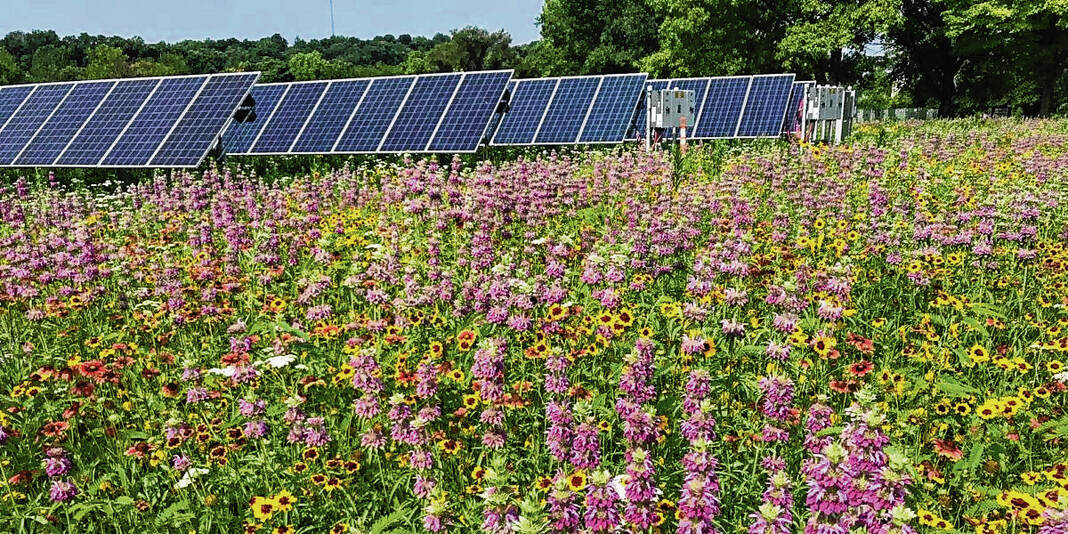
Photo provided A pollinator-friendly solar installation at the University of Dayton is similar to what developers say is planned at the proposed Swallowtail Solar Farm in northeast Bartholomew County.
The Columbus Plan Commission is set to resume discussions around solar facility regulations and may choose to send a recommendation forward to Columbus City Council.
The commission will meet at 4 p.m. on Wednesday in the council chambers of Columbus City Hall.
“The Columbus Plan Commission will hold a public hearing on several proposed zoning ordinance amendments, including those related to commercial solar facilities,” said city/county planning director Jeff Bergman. “The plan commission may vote on a recommendation to the City Council on those amendments following the public hearing.”
Other proposed amendments touch on topics such as manufactured housing, accessory dwellings and electrical vehicle charging stations. The proposal also includes provisions for solar facilities that do not fall under the classification of commercial solar.
According to a previous memo from Bergman, Commercial Solar Energy Systems (CSES) or solar farms are “large-scale facilities that generate electricity for commercial sales.” The classification does not apply to solar panels at individual homes or businesses that primarily provide energy for the property on which they are located.
For the city plan commission’s jurisdiction, solar farms are listed as a conditional use in the Agriculture: Preferred zoning district and prohibited elsewhere, he said. At present, the city’s zoning ordinance does not include specific minimum setbacks or other development standards for these systems.
The Bartholomew County Plan Commission, on the other hand, voted in late 2022 to approve an ordinance on CSES with specific regulations.
In a Sept. 5 memo to the commission, Bergman wrote that the proposed zoning ordinance amendments for Columbus include the following “solar energy provisions”:
- Incorporate the county’s standards for CSES
- Provide a one-and-a-half mile minimum setback from Columbus city limits that could be waived on a case-by-case basis by Columbus City Council “for specific project locations or based on changing community priorities”
- “Make clear the minimal regulations applicable to solar panels installed on buildings and the ground for use in supplying electricity to that property”
- “Enable future neighborhoods and developments that may include a shared solar facility providing electricity to those homes or businesses”
- “Include both a CSES and neighborhood-scale solar energy system as a part of the definition of a public airport, enabling a solar facility of either type on airport-associated property”
The zoning ordinance amendments outline three types of solar systems: on-site use systems, neighborhood-scale systems and CSES.
On-site use systems are defined as systems that capture solar energy primarily for use on the property where the system is located, with excess amounts supplied to the electrical grid.
Neighborhood scale systems are defined as “solar energy systems capturing solar energy for use primarily by those properties within a specific neighborhood or development, with any excess amounts supplied to the electrical grid.”
A CSES is defined as “A system that captures and converts solar energy into electricity for the primary purpose of wholesale sales of generated electricity and for use in locations other than where it is generated. … It also includes facilities from which solar energy is made available to individual off-site residential, commercial, industrial, or other end users through a subscription or sponsorship system.”
In conformity with the county regulations, the proposed city regulations state that setbacks of a commercial solar field must be 200 feet from all nonparticipating property lines and 500 feet from all nonparticipating residences. Electrical substations for solar fields must be setback at least 500 feet from nonparticipating property lines.
However, while the county regulations state that solar fields must be at least a half-mile away from municipal boundary lines, the proposed city rules state that solar fields must be at least a mile and a half away from Columbus’s city limits and a half-mile from any other municipal boundary line.
No exceptions will be made to the setback standards unless the affected property owners or municipality leaders grant a waiver.
Apart from the municipal setbacks, the proposed regulations generally mirror the county’s ordinance.
This includes a proposed change to make CSES a conditional use in the Agriculture: General Rural zoning district. These facilities are already a conditional use in the Agriculture: Preferred district.
Any instance of a conditional use must be authorized by either the Columbus Board of Zoning Appeals or the BZA hearing officer. The board of zoning appeals makes its decision based on specific criteria and has the option to place conditions or commitments on applications that it chooses to approve.
The zoning ordinance amendments also propose making neighborhood-scale systems a conditional use in nearly every type of zoning district, with the exception of Agriculture: Voluntary Protection.
These systems are to be entirely located within the neighborhood or development they serve. The document also includes regulations for ground-mounted solar arrays or battery systems within a neighborhood system that are the primary use on a piece of property.
“Any inverters and similar equipment should be located and designed to minimize the extent to which any noise generated is detectable beyond the property on which it is located,” the document adds.
Improvement location permits would be required for both CSES and neighborhood-scale systems.
Under the amended ordinance, on-site systems would be considered “(1) mechanical appurtenances when attached to a structure and (2) incidental or accessory structures, as appropriate, when ground-mounted, consistent with the applicable provisions of this Ordinance.”
The proposed content around solar energy is based on preferences expressed by the commission, Bergman said. These included generally mirroring the county standards for CSES and minimizing the possibility that solar farms could be a barrier to the city’s growth.
However, he also wrote that while the commission indicated that the “limited supply of developable land” should be prioritized for new housing and jobs, they also felt there should also be opportunities for these developments to be served by solar energy. They also expressed a desire for the city to be “generally welcoming to solar energy and embrace its role in energy diversification and combating climate change.”
In the same vein, the proposed section on EV charging states, “Electric vehicle charging spaces shall be required in association with newly constructed or expanded multifamily residential uses, hotels, and parking lots / garages (where that lot or garage is a primary use), that provide 25 or more parking spaces, at a minimum ratio of 1 charging space for every 50 total parking spaces provided, rounded up to the nearest whole charging space.”
If you go
What: Columbus Plan Commission meeting
When: 4 p.m. Wednesday
Where: Council Chambers, Columbus City Hall, 123 Washington St.
Additional information: A link for those wishing to participate virtually will be posted columbus.in.gov/planning/agendas-materials/. A meeting agenda and materials will be available at the same site.
Commission meetings are also livestreamed at columbus.in.gov/video/live-streaming/.