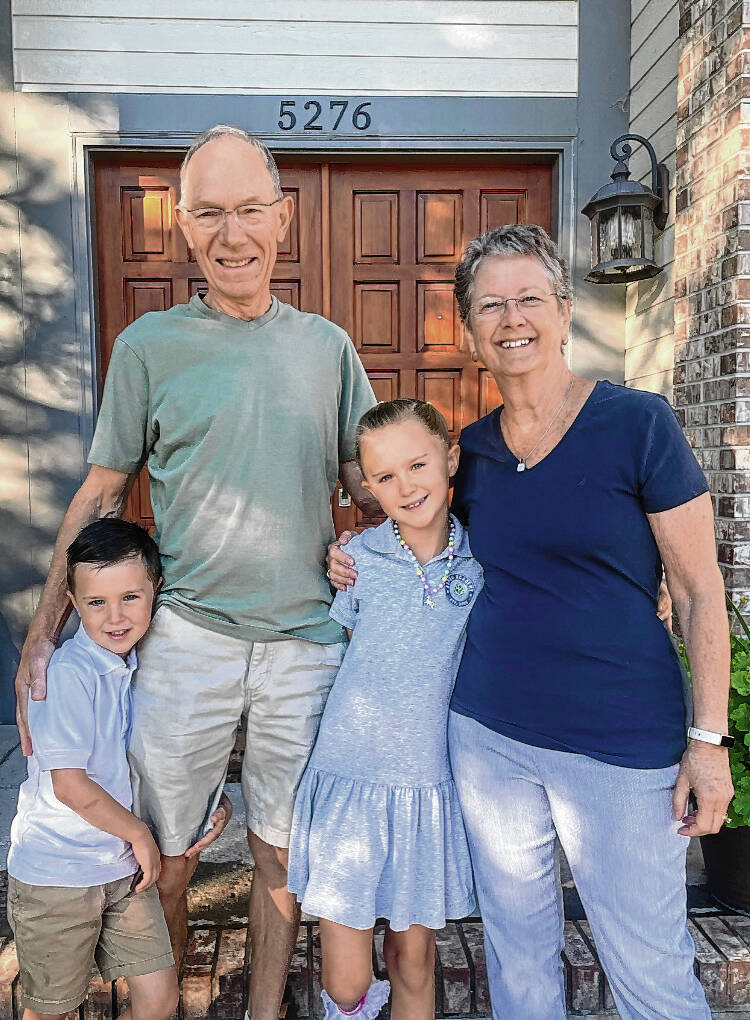
Taffy Schroer of Columbus, right, who was diagnosed with breast cancer a year ago, poses for a photo during an August visit with family in Denver. From left are grandson Eli, 5, husband Dan, and granddaughter Izzie, 7.
Almost exactly one year ago, retired teacher Taffy Schroer was diagnosed with breast cancer, but she knows her diagnosis could have been worse.
Schroer, 72, said her cancer was detected much earlier than some, including an acquaintance who is a current breast cancer patient whom Schroer regularly accompanies to far more intensive treatments than she received.
After teaching elementary music at Bartholomew Consolidated School Corp. for 30 years, Schroer retired in 2005, but she continued to stay active helping young people in the Columbus area. She served as a court appointed special advocate for children in the juvenile justice system and with volunteered with Big Brothers Big Sisters, among other activities.
But her breast cancer diagnosis was a life-changing event. She turned for care to Columbus Regional Hospital for radiology treatment and Franciscan Health in Indianapolis — where her doctor practices — for chemotherapy treatments. She said the care she received from both was excellent.
She said she is doing well, though she said fighting cancer and the attendant treatments leave her quite tired by most afternoons. That said, near the one-year mark, Schroer said she was hoping for a scan that would show she is now fully cancer-free.
Schroer offered the following first-person account of her yearlong journey from breast cancer diagnosis, through treatment, and to the cusp of full recovery.
* * *
“I was diagnosed with breast cancer in October 2022 and experienced chemotherapy and radiation. Letting my mind wander on what I could maybe share with others, I found that I experienced five stages — denial, acceptance, education, treatment and recovery.
Denial: October 2022 — “We need to do a biopsy. It looks like you may have breast cancer. We can see you on Friday at 10 a.m.” To which my brain said, “Well, I can’t do that! My husband and I are hiking in North Carolina that day. We have an Airbnb reserved. We’re flying to Colorado next month to be with our grandkids. The holidays are coming …” Cancer was not to interfere with my plans!
Acceptance: Time to regroup! Circle the wagons with your immediate family, extended family, friends and church. (This precious circle to which I continue to be indebted became known as my support crew.) Surround yourself with positive thinkers, books, music, TV, etc. Know that it is OK to accept prayers and help. Leaning on others is not a sign of weakness. Helping is what people do to show they care.
Know that you are not alone. Breast cancer alone affects 1 in 8 women. Cancer in these women affects multitudes of other caring lives.
This is important! This is the time to start a medical journal that includes all professional contact information, appointment dates, visit summaries, questions and thoughts. Every question is worth asking. Leave room to write answers. Journaling thoughts can help with your mental health.
Education: Cancer does not define who you are, but consider cancer your new “job”, and your health providers are your new bosses. You and your new bosses create a new team. They are the experts and you are the novice. Your input is extremely valuable. You have a responsibility in your new job and as a new team member to get educated. Read, listen and learn so you can contribute to the team to the best of your ability. Keep journaling as you learn. Use internet searches as a tool, not for definitive answers.
Treatment: You are about to enter a whole new territory. As with any trip, the starting point is set but the unknown, untraveled ground is unpredictable. The anxiety is real because the experience is real and you are not in the driver seat. The professionals will be your trusted guides. They will help you get through this tough phase along with your support crew.
Reach out! There are other cancer resources available through the hospital to help you and your family. I joined an online chair yoga class for cancer patients available through Franciscan.
Remember that your case is uniquely your case. Know that treatment may not always go as planned or how you may have anticipated it. Continue to educate yourself and keep journaling.
During treatment, I received encouraging cards, texts and prayers from relatives, friends and church members. This was the best medicine! One card pictured a disgruntled little girl and read “I don’t know about you, but I’m tired of putting on my Big Girl panties!” Yes, I got tired of pulling up and keeping up those “panties”, but there was no way I was going to let them hit the ground!
Recovery: Time to join back into life’s mainstream and climb back up the ladder. This, too, is part of the journey. It is not a race. Slow and steady with small goals works best.
Some days you will climb steps with ease only to find the next day you may need to go back a few rungs and regroup. Be patient but remain persistent! The top of that ladder will be there. It is still waiting my own arrival.”
— Compiled by Dave Stafford