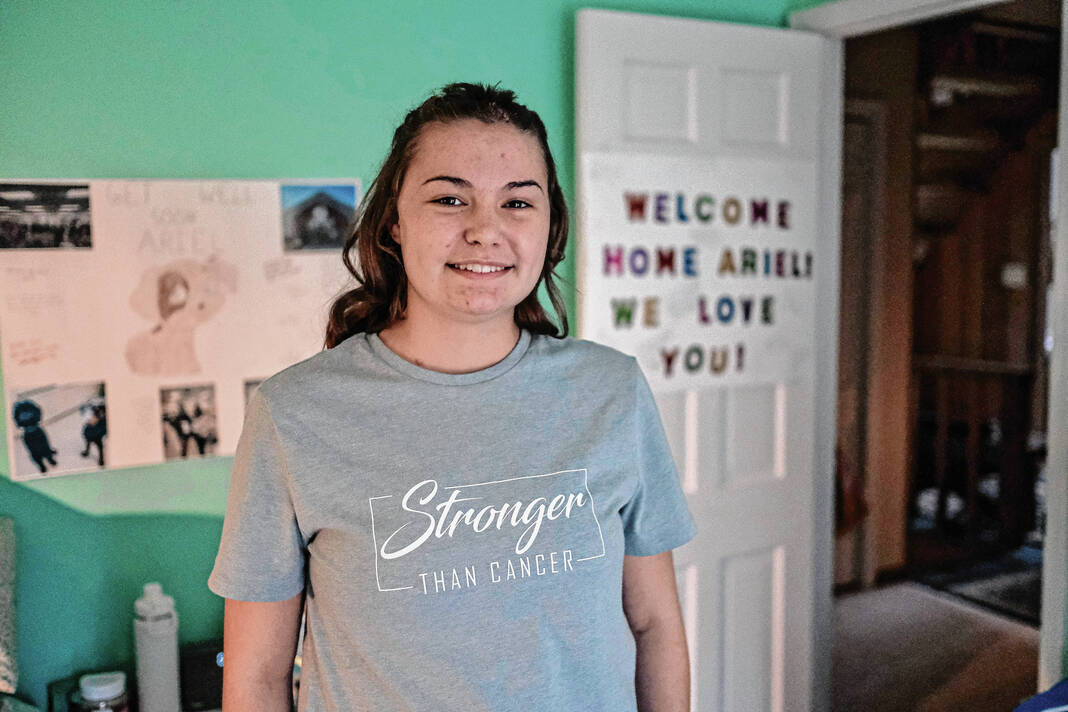
Former Columbus North cheerleader Ariel Roberts poses for a photo in her room at her parents’ home in Columbus in February 2022. Ariel died from a glioblastoma in January.
Republic file photo
Mothers who have lost a child to cancer say no one can ever know how it feels. No one, except perhaps another mom who also has experienced that same indescribable grief.
Several Bartholomew County moms who’ve lost children to cancer have recently made connections that are fueling a shared sense of mission to raise awareness of pediatric cancer and strive toward cures. By advocating in their children’s names, they hope to spare other children and parents the pain their families have experienced.
“We are sitting in a time and place right now where we are incredibly motivated to turn the dial and make a difference,” said Robyn Spoon of Columbus, whose son Justin died in March at age 24 after a battle with rhabdomyosarcoma, a form of pediatric cancer.
A Columbus North graduate whose deep faith led him to Asbury University, his mother said Justin disliked being described as a warrior or hero as he battled cancer for years, including 275 nights in the hospital during 28 months of treatments.
Spoon recalled that toward the end of her son’s cancer fight, a friend asked Justin for a list of life tips. Her son replied, “I get up every day and I serve God, and I figure the rest will take care of itself.” When the friend pressed him for more tips, Justin replied, “there aren’t any.”
Yet Spoon recalled that when her son ran out of treatment options, he became angry. Not for his fate, though, but for children younger than him who faced the same, and for their families.
Long an advocate for education policy, Robyn now focuses her energy on what she and other moms see as a systemic problem.
“There’s never ever been, in the history of the world, a drug developed to treat pediatric cancer,” she said. “… We don’t have targeted therapeutics for children’s cancer, and it’s really a problem.”
Spoon has met with state and federal health leaders, researchers and a long list of impressive experts. But locally, she’s also helped organize an arguably more potent force: determined moms who have lost a child to cancer. Moms like Tracy Brooks of Columbus, whose daughter Emmie died at 13 from Wilms tumor in October 2022. And Carrie Roberts, whose daughter Ariel, a Columbus North High School cheerleader, died from glioblastoma in January at age 18. And Kim Taylor of Hope, whose daughter Sarah died at 14 from osteosarcoma in September 2020.
Raising awareness
If you’ve seen gold balloons, signs promoting childhood cancer awareness, or knew about a prayer vigil at City Hall on Sept. 17, those are just a few of the ways these moms and others are raising awareness and funds for research they hope will make a difference for future generations.
And their children are helping in this — their tumors were donated for medical research at institutions such as Riley Children’s Hospital and the Herman B Wells Center for Pediatric Research at Indiana University.
The moms, their families and support networks do fundraisers — bake sales, lemonade stands, 5k runs and so forth, to try to support these efforts. And while the events are uplifting, taking a step back, Kim Taylor of Hope said it’s also a little disheartening.
“Most of this research is being funded by families that have already lost a child,” Taylor said. “We are already exhausted, but we know how important this is. … We’re fighting for the healthy kids and not just the ones who died.
“Until we make it a priority to fund research and do more for these kids, there will be more people from our community that have to walk down this road and this path, and it’s heartbreaking,” she said.
Like other moms, Taylor has established a fund in Sarah’s name — GLOW Like Sarah. It supports the healthy development of young people through scholarships and other programs. GLOW represents the person Taylor says Sarah was, standing for growth, love, optimism and worship.
“Sarah was a very creative person,” Taylor said, and in addition to funding research, part of the mission of GLOW Like Sarah is helping young people find the ways they are creatively gifted.
Spoon likewise has a foundation, Elevate Childhood Cancer Research and Advocacy, as does Roberts — the Well Yeah Ariel Roberts Foundation.
Roberts said the name of the foundation in her daughter’s name was a natural. Even as she fought cancer, whenever Ariel was asked if she wanted to join in some activity, the Columbus North cheerleader’s reflexive response was, “Well, yeah!”
“I want to try to always stay positive,” Roberts said, drawing strength from a memory of her daughter. “She always smiled,” even when fighting for her life. “She did it so well, so gracefully. We want to be able to continue doing that, even in our sadness and grief.”
‘It’s just right there’
Taylor said researchers at Riley are seeing some successes in lab tests conducted on sarcomas using tumors donated for research, including from Sarah. Other moms are encouraged by similar developments.
Tracy Brooks’ daughter Emmie was diagnosed with CLOVES syndrome in 2016 and died from Wilms tumor. “She was a feisty little girl, and she fought it for eight years,” Brooks said, noting Emmie had been “a Riley child pretty much all her life.” Emmie loved Pokemon, horseback riding and animals — “her dog Marley was her favorite thing,” her mom said.
Brooks supports research at Riley, which includes quests for cures using her daughter’s donated tumor cells. Brooks is grateful for their work, noting that doctors had found success treating Emmie’s condition in tests on lab mice, but the results could not be replicated to cure her daughter.
“There’s so much more to be done, but it’s just right there,” Brooks said, urgency in her voice. “… We just need a little more funding to get there.”
Ironically, she said the research revealed striking links between Emmie’s cancer diagnosis and that of Justin Spoon.
Discoveries like those are encouraging, and the moms say there is good reason to pursue therapies specifically targeted to fight pediatric cancers.
“Children get the hand-me-downs,” Spoon said, noting her son was on seven different courses of treatments, all of which had been derived from therapies developed to treat cancers in adults.
“That’s pretty much how children’s cancer is being treated at this point,” she said. “It’s simply not acceptable, and it’s not working very well.” She noted research also shows that adult treatments used to fight pediatric cancer often result in adverse health outcomes later in life for children who survive.
The moms also recoil when they hear a particular word in conjunction with their kid’s diagnosis, Spoon said: “Parents become particularly annoyed by the word ‘rare’” to describe pediatric cancer. “… It’s oftentimes used to discount the problem.”
Noting that about 60 Hoosier kids each year die from pediatric cancer, Spoon said, “If we had 60 kids die from any other thing, we’d make a big deal about it. … Somehow, this doesn’t seem to stick or resonate.”
‘Moms who get it’
Taylor said she has experienced a distinct feeling she describes as going someplace where she can feel her presence has “sucked the joy out of the room.” People know what she has been through. Yet they can’t really know.
“There’s just no one else that can relate to me and my specific situation like another aggrieved mom,” Taylor said. “We get together and we talk about just … day-to-day life.
“It’s never going to feel normal without our children, but we have to find a way to grow around it,” she said, noting society has made it something of a taboo to be a grieving mother.
She noted she was recently chatting with another mom in this group who asked her, ‘Do you have days where you think you’re going to do something and you just can’t; you’re completely paralyzed?’ … Your feeling isn’t wrong,” Taylor said.
“You’re grieving a child, but you’re also grieving the loss of grandchildren and depending on where they were, all those life events you assumed you’d get to share together,” she said.
“It’s motivating to have other moms who get it,” Brooks said. “It’s a weird place to be because I wouldn’t wish this on my worst enemy, yet it’s comforting to have people who understand. … For a long time, childhood cancer has just been swept under the rug.”
Roberts said advocating for research toward cures is almost like having another full-time job, but she is grateful for the community she has found with other moms who can empathize and push for greater understanding and advocate for more research toward cures.
“I was probably one of those parents that if someone came to me five years ago and asked about childhood cancer, I would have known nothing about it,” Roberts said, noting she and her family were humbled by the outpouring of community support for Ariel.
“One way we can give back is to just constantly keep bringing awareness to it,” she said. “… We are definitely determined and a group of feisty moms, but we can’t do it on our own. We need community support.”