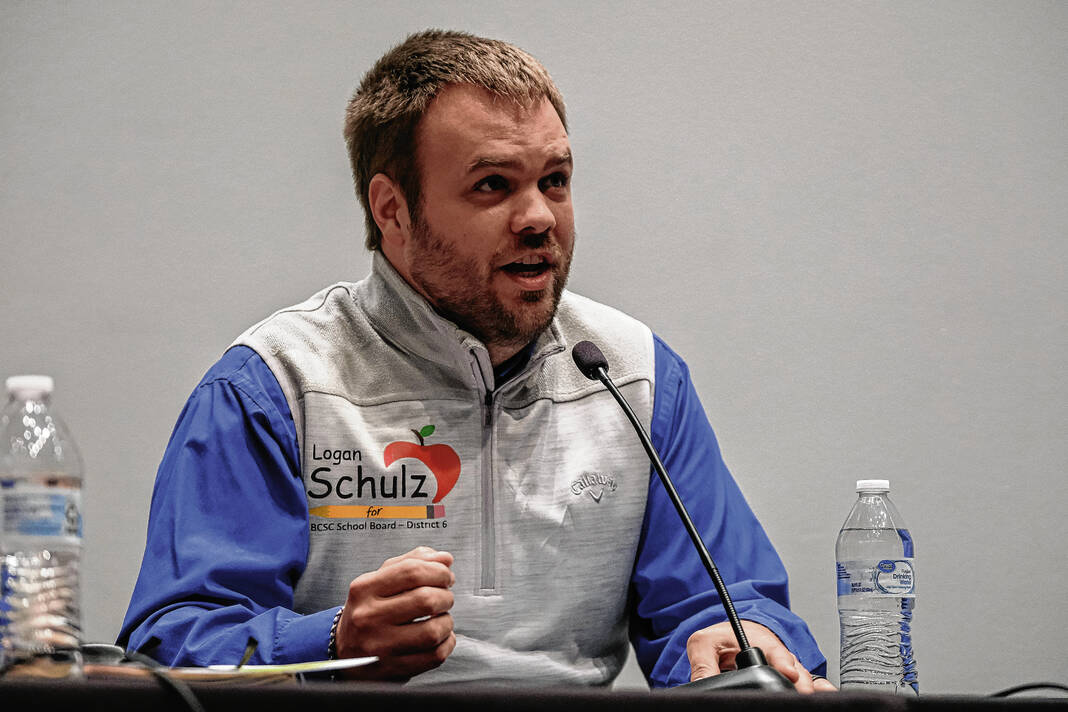
Mike Wolanin | The Republic Bartholomew Consolidated School Corp. school board candidate for District 6 Logan Schulz speaks during an IUPUC Office of Student Affairs candidate forum at the Columbus Learning Center in Columbus, Ind., Wednesday, Oct. 16, 2022.
With about a month and a half to go until the state-appointed deadline, the Bartholomew Consolidated School Corp. board has yet to approve updates to its policies regarding library books.
The school board discussed these policies during a work session Monday evening but decided not to vote on them at the regular board meeting due to not having finished drafts ready.
Additionally, board members Logan Schulz and Jason Major have expressed a desire to implement additional procedures regarding “controversial” library books, but the rest of the board has not agreed to the proposal.
The school board plans to have another public work session at 5:15 p.m. on Dec. 11 prior to its regular meeting, said board president Nicole Wheeldon.
Over the last couple of months, board members have been discussing updates to three policies due to a new law that requires school libraries to post a catalog of their available materials on the school’s website and make a hard copy list available upon request.
Schools must also establish a formal complaint process for parents, guardians and community members to submit a request to remove library materials that are obscene or harmful to minors.
The BCSC school board has been working to update relevant policies by Jan. 1, which is when these changes go into effect. Monday’s work session focused on Policy 2510 – Adoption of Curricular Materials; Policy 2520 – Selection of Instructional Materials; and Policy 9130 – Public Complaints and Concerns.
The five board members who attended Monday’s work session — Todd Grimes and Pat Bryant were not present — appeared to be split on how to proceed with Policy 9130.
“Per the statute, your only obligation is to determine whether (library material) is obscene or material harmful to minors,” said BCSC attorney Michael McIver. “That is all that has to happen here.”
Indiana Code defines a matter or performance as obscene if:
(1) the average person, applying contemporary community standards, finds that the dominant theme of the matter or performance, taken as a whole, appeals to the prurient interest in sex;
(2) the matter or performance depicts or describes, in a patently offensive way, sexual conduct; and
(3) the matter or performance, taken as a whole, lacks serious literary, artistic, political, or scientific value.
On the other hand, material is harmful to minors if:
(1) it describes or represents, in any form, nudity, sexual conduct, sexual excitement, or sado-masochistic abuse;
(2) considered as a whole, it appeals to the prurient interest in sex of minors;
(3) it is patently offensive to prevailing standards in the adult community as a whole with respect to what is suitable matter for or performance before minors; and
(4) considered as a whole, it lacks serious literary, artistic, political, or scientific value for minors.
Schulz said that he takes issue with these definitions because they do not take age into account.
“There’s no bar to protect the elementary ages,” he said.
While a draft from education consulting firm Neola proposes that the criteria for reviewing a complaint would include “the appropriateness of the material for the age and maturity level of the students who have access to it,” Schulz said that there is not a definition that defines what is appropriate.
At the board’s Oct. 30 session, he presented a proposal for an additional policy wherein school libraries would classify certain titles as “controversial” and require parental permission for students to access these materials.
Major added that the Indiana Code definition focuses on the book as a whole, rather than specific parts of a work.
He said in a previous interview that he submitted a complaint for the book “People Kill People” by Ellen Hopkins, which Amazon describes as novel about gun violence and white supremacy. It also features characters dealing with teenage parenthood, racial tension and depression.
At a candidate forum in October of 2022, Major responded to a question about censorship by reading an explicit passage from the book.
“The stuff I read in the forum was two pages, but if you look at the book as a whole, they’re going to say the other 498 pages, ‘Oh, those were just fine and dandy,’” he said at Monday’s work session. “Throw out the fact that you’ve got this child getting raped by a man in very, very vivid detail. That’s the part for me that you’re going to have a lot of parents that are going to tell you, ‘We’re challenging it no matter what.’ And they will, at some point in time, if we don’t overprescribe some of this stuff, it will end up in the hands of a judge.”
He went on to say that an account of an adult raping a child should not be in any school library, regardless on whether it’s on one page “or a thousand pages.”
Wheeldon replied that this is his opinion.
In talking about how to proceed, board member Dale Nowlin said he would be fine moving forward with a draft based on the statute but also including language about the developmental and maturity level of students. Board member Rich Stenner also said he thought it makes sense to consider age appropriateness in reviewing complaints.
McIver stated that without consensus from the board, he will work provide a draft for 9130 based on the statute, though there the board always has the option to amend the draft as part of the approval process.
As for the other two policies, Neola recommends adding language to 2520 stating that the superintendent will establish a procedure for each school to prepare the catalog of library materials as required by the state. The firm also recommends specifying that school libraries may not make include materials that contain obscene matter or matter harmful to minors and referencing the complaint process that will be provided in Policy 9130.
In reviewing 2520, board members considered the possibility of splitting it into two separate policies, with one focusing on library materials and the other on instructional materials that are used in the classroom but not part of the adopted curriculum.
They also discussed simply splitting the policy into two different sections so that it is clear which rules apply to instructional material and which apply to library material. Wheeldon said she believes this is the approach that BCSC officials will work into the next draft of the policy.
The changes to 2510 mainly pertain to other legislative changes around the science of reading and the elimination of curricular fees.
The subject of library books also came up during Monday’s regular meeting, with about a dozen individuals speaking on the matter during the time for public comment. Several discussed a desire for BCSC to take greater efforts to shield students from materials they believe to be inappropriate and endorsed Schulz’s proposal for a “controversial” section.
Others pushed back and asked the board not to implement additional regulations, which they see as a burden to librarians.