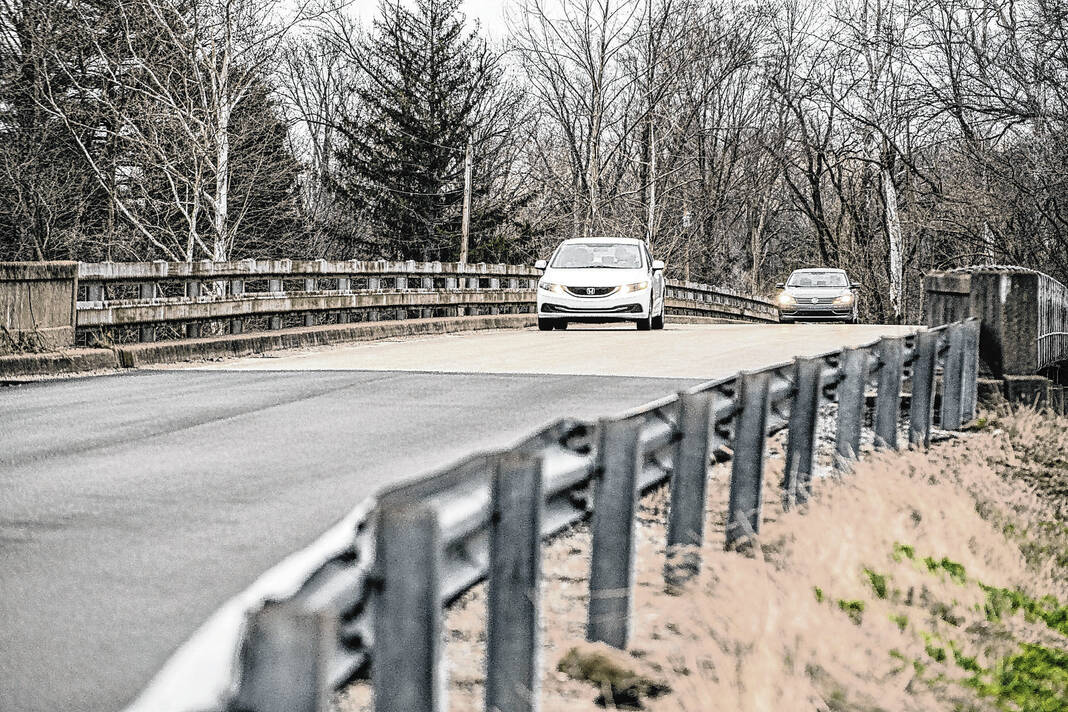
After inspecting more than 200 bridges over the past four years, an Indianapolis consulting firm has provided Bartholomew County officials an updated list of bridges most in need of replacement or rehabilitation.
“It shows that the bridge program is moving in the right direction in keeping up with the deterioration and changes that need to be happening,” said United Consulting of Indianapolis engineer Chris Dyer after noting some bridges are already on schedule to be addressed. None of the bridges are in danger of collapsing at this time.
Few, if any, of the county officials seemed surprised that United Consulting identified Lowell Bridge, located along Lowell Road over the Driftwood River, in the most need of being torn down and rebuilt.
But the two bridges determined to be in the worst shape are also the most expensive to replace. While federal grants have been obtained, the local required matching funds appear at this time to be beyond available financial resources. But county officials have two or more years to find the required revenue.
1) Lowell Bridge (Bridge 170)
While the current 433-foot bridge is structurally sound, county highway engineer Danny Hollander says the lanes are considered too narrow for today’s vehicles.
In March 2023, it was announced that Bartholomew County will receive $5,520,000 for the Lowell Bridge replacement, while a separate grant of $2,397,600 will be provided to reconfigure the southern approach to the future new bridge from County Road 325W.
But in order to receive the federal money, county government will be required to come up with 20% of the grant for the bridge replacement and 10% for the reconfiguration, Hollander added.
Estimates for a new bridge, a roundabout at the junction of Lowell and Road 325W, additional designing and engineering fees run as high as $11 million. That’s much higher that the $195,000 spent on the current bridge in 1959, but Hollander is expressing confidence the structure can be built for less money.
Work on a new bridge isn’t likely to begin until 2027 because the federal funds aren’t expected to become available until late 2026, he said.
2) Tannehill Road Bridge (Bridge 149)
Costs for a new bridge along West Tannehill Road that crosses the Driftwood River near the Bill Newton Public Access site are expected to reach $7.2 million. But when soft costs such as obtaining right of way, preliminary engineering, design and utility relocation are factored in, the total is expected to rise to about $9.3 million.
On March 11, the county announced it had received a $6.7 million federal grant for the replacement of the 236-feet long bridge. Although construction could get underway as early as July 2028, it’s more realistic to predict work starting in the spring of 2030, Hollander said.
When a new bridge was constructed along Tannehill Road from 1965 to 1966, the total cost to taxpayers was $79,161. However, there has always been a posted 15-ton weight limit.
“When you have a weight limit sign on a bridge the first day you open it, it’s not right,” Hollander said.
3) County Road 850N over Duck Creek (Bridge 50)
Located in a remote area northeast of Rugby, this narrow, one-lane concrete through girder bridge will turn 100 next year. Bridges built in early 1915 were generally constructed to withstand the weight of heavy horse-drawn carriages and early automobiles. The width of the roadway is 15.7 feet, while the main span length is 31 feet.
While certainly a historic bridge, the structure has a weight limit of 12 tons. In contrast, combine harvesters can weigh as much as 36 tons when fully loaded with grain.
Although this bridge has performed well for almost a century, extensive deterioration is evident in the concrete under the deck of the structure, county officials said.
4) County Road 400W over Denois Creek (Bridge 249)
Located south of the Tipton Lakes area at the border of Columbus and Harrison townships, this bridge was also ranked fourth in need of replacement two years ago.
It has been mentioned for replacement since at least 2017.
5) Stafford Road Bridge (Bridge 56)
Located three miles northeast of Hope over Haw Creek along County Road 900N, this simple concrete arch bridge with a concrete closed spandrel deck was built in 1909. Once again, the one-lane bridge was designed mainly for heavy horse-drawn carriages and early automobiles.
With the exception of the shape of the arch, the structure has no noteworthy architectural details and is fairly plain in appearance. But it’s considered historic because most of these concrete arch bridges in Indiana have already been replaced.
This bridge has also spent a number of years on the list, with deterioration of the concrete evident above and below the deck.
United Consulting has also determined the top three bridges that need to be rehabilitated, rather than replaced.
They are:
- Bridge 73 – County Road 900N over Flatrock River
- Bridge 317 – 25th Street over Clifty Creek
- Bridge 118 – County Road 500S over Little Sand Creek
Inspections are typically contracted on a four-year basis, and the inventory is supported and paid for by the county, with 20% of the overall contract cost. The Federal Highway Administration requires that bridges must be inspected every two years to be eligible for federal funding, Dyer said.
State comparisons
Number of bridges
Average of all counties: 145
Bartholomew County: 202
Average daily traffic on bridges
State average: 1,615
Bartholomew County: 1,729
Average age of bridges
State average- 46 years
Bartholomew County – 40 years
Load posted bridges
State average – 13.1%
Bartholomew County – 7.9%
Bridges older than 50 years old
State average – 35.8%
Bartholomew County – 20.8%
Increased frequency inspections
State average – 6.0%
Bartholomew County – 3.0%
Source: United Consulting 2024 bridge inventory for Bartholomew County