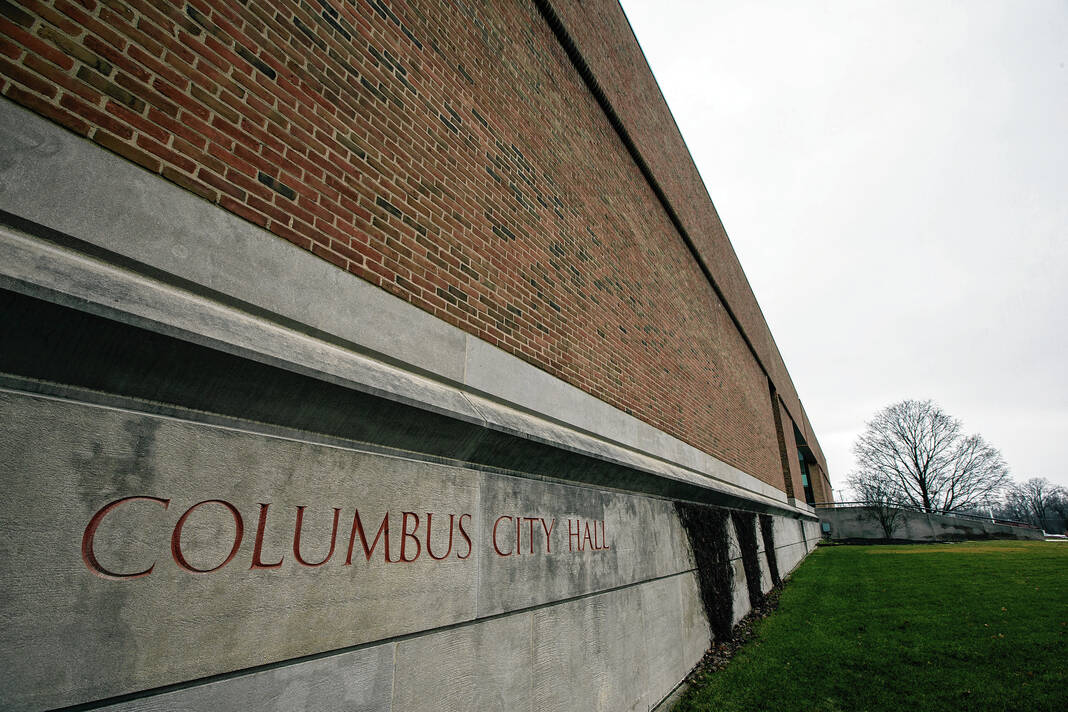
City officials on Tuesday gave initial approval to appropriate nearly $2 million dollars to go towards homelessness and affordable housing initiatives.
Columbus City Council members unanimously voted to pass the first reading of an ordinance, directing the remaining balance of the city’s American Rescue Plan (ARP) funds—totaling $1.97 million— to the causes.
Ordinances must be passed on two readings to be fully approved.
A memo Eric Frey, executive director of administration, sent to council members outlines a general allocation of the funds, with $1.5 million going towards affordable housing development and $500,000 for implementation of United Way of Bartholomew County’s Homelessness Initiative. Frey mentioned that in part because United Way is still gathering community input, some of the programs and allotments could change.
Columbus received $8 million in ARP funds in total, Mayor Mary Ferdon said. The federal government requires that they be committed by the end of this year and spent by the end of 2026.
The $1.5 million is targeted for programs which were identified as potential remedies for affordable housing concerns mentioned in the city’s recently released housing study, done by RDG Planning & Design.
“We met with Charlie (Cowell) from RDG and worked with him on some of these programs, saying does this fit with what you saw as a need in the community?” per Frey. “We also worked with some of the city council on tweaking some of these and paring them down to what I think is a good list of programs that will hopefully address some of the housing needs we have.”
The bulk of the affordable housing funding, totaling roughly $1 million, is for an incentive program to help finance more affordable housing projects that use federal grant or tax credit funding.
The program would work in conjunction with the Administrative Resources association (ARa). According to city officials, $10,000 would be provided per unit of affordable housing that is developed for low to moderate income households, specified as those with household incomes at 80% or less of area median income (AMI).
According to the memo, there would be a potential maximum award of $500,000 dollars, which Frey said would be reserved for a large-scale development.
Another strategy is the institution of a blighted home acquisition program, potentially set to receive about $300,000. The city would use funding for the purchase, renovation and demolition of blighted homes and look to partner with the Columbus Housing Authority (CHA) to “try to activate some of their Section 8 vouchers,” Frey said.
CHA would work with community development to find and acquire sites to expand CHA’s scatter sites under Section 8. Scatter sites refer to public housing that is spread across a city, instead of being centrally located.
The final affordable housing program mentioned in the memo to potentially receive $200,000 in funding would be an expanded owner-occupied rehab (OOR) program for accessibility improvements, along with interior and exterior upgrades.
“(The housing study) mentioned trying to beef up the current housing stock of those individuals that are starting to have concerns with either aging in place or keeping up maintenance” of their homes, Frey said. The expanded OOR program would include those who are above 80% area-median-income (AMI). Frey mentioned that the city already has a similar program for those at 80% of AMI and below that uses community development block grant dollars, but the housing study found that a large gap still remains.
The $500,000 for the homelessness initiative could go to four different programs: rental assistance and homeless response, supportive housing, eviction prevention and a street social worker program.
The additional potential influx of funding comes after city council members in April agreed to appropriate $133,000 of ARP money to get United Way of Bartholomew County’s homelessness initiative off the ground.
The rental assistance and homeless response effort, earmarked for about $50,000, would provide some funds to those at risk of being homeless “in the next 14 days” or to re-house someone who has been homeless.
The largest portion of homelessness initiative funding of $300,000 would fund some type of supportive housing, according to the memo.
City officials said $75,000 could fund an eviction prevention program “to proactively help those people facing eviction or foreclosure.” The program would include eviction counseling and would have an element where someone would complete training through a partnership with local organizations like Love Chapel and receive rental assistance.
The Street Social Worker program is already being piloted due to council’s April appropriation and about $75,000 would continue to fund it. The program is designed to “meet people who are homeless where they are” and “would create trust-based relationships in trying to get people into permanent housing.”
Council Member Kent Anderson, R-District 6, asked if the funding would be “a one-time effort” and was worried if its recipients understood that “this is coming from a singular source of money that’s not going to repeat anytime soon.”
“I guess my only concern when I looked at this was: are we planting any seeds where, when we get a little more sober fiscally in this nation, are we going to have people coming back a year from now, looking at city council saying, ‘Hey, thanks for that money. We need more.’”
Frey responded that the program would address a current need in housing, adding that the programs could not be “perpetually funded by the city.”
“One of the things the housing study talked about is we’re behind the eight-ball,” Frey said. “We’ve got to catch up and build more and incentivize more.”
Council Member Grace Kestler, D-at-large, said she saw the funds as a means to assess which programs are successful, adding that ideally the funds would have already been spent on these initiatives.
“I don’t think just because we potentially fund a program now, means we’d never fund it again just because it’s a one-time program,” Kestler said. “This is a rough list that we still have to weed through, some of these are pilot programs.”
Ferdon said that when the city first received their ARP dollars, “housing always was a placeholder.”
“We got down to where we had $2 million left and we knew there was a deadline. But when it was gone, it was gone, and we didn’t want to just throw it away— we wanted to be really intentional,” the mayor said.