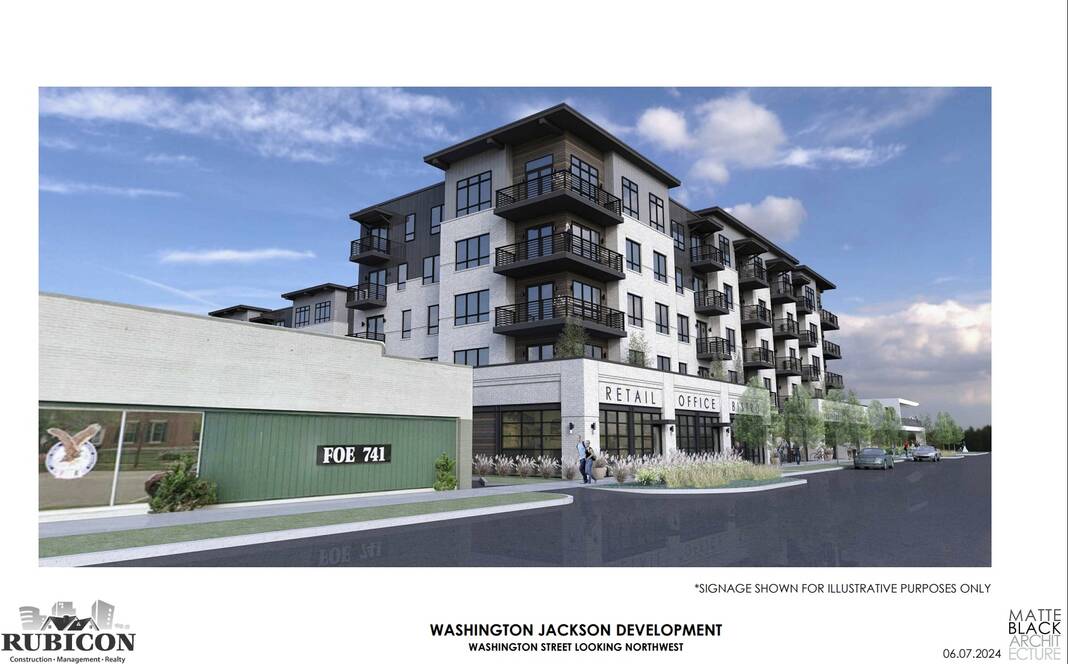
Photo provided An artist’s rendition of the Rubicon project, a planned five-story, 120-unit apartment building that would cause the demolition of a drive-thru bank at 921 Jackson St. and house with historical ties at 1008 Washington St.
City officials on Tuesday will consider a project agreement with a Bloomington-based developer that would allow for a five-story mixed-use development near the corner of 11th and Washington streets.
Columbus City Council members will consider a project agreement with Rubicon Development and the first reading of an ordinance authorizing a direct loan to the developer, according to the agenda. Ordinances must be passed on two readings to be fully-approved.
The agreement includes a city subsidy of $6.4 million as a forgivable loan to cover a financing gap for the $30.9 million project, which will include apartments, commercial space and a parking garage on three parcels at 921 Jackson St. and 1008 and 1020 Washington streets.
The Columbus Redevelopment Commission on Nov. 18 unanimously approved the agreement with Rubicon, along with a resolution to create a separate tax increment financing (TIF) district bounded by the project site, as redevelopment has done for other mixed-use developments in recent years, including The Taylor and a development at Sixth and Washington streets.
Neighbors and community members who have attended city meetings regarding the project over the past calendar year —particularly the Historic Downtown Neighborhood Alliance— have consistently voiced their displeasure about the project, including it’s price-point, size, look and its perceived encroachment on the city’s architectural identity.
But city officials say the development will help fill part of a need of new housing of all types, while also serving as a potential way to bring more activity into the downtown.
According to site plans, the development would include a ground floor with 51,000 square feet for parking and 5,300 square feet of first-floor commercial and tenant common space.
Floors two through five will be 32,000 square feet each for residential space, including eight three-bedroom units, 40 two-bedroom units, 48 one-bedroom units and 24 studio units.
Studio units would be $1,320 per month, one-bedroom units $1,435 per month, two-bedroom $1,970 per month and three-bedroom units up to $2,376 per month, according to Rubicon.
Rubicon will designate 10% of the building to be reserved for workforce housing, factored at a 20% discount.
Neighbors have also been concerned that the project would mean the destruction of the home at 1008 Washington St., built by F.T. Crump for his daughter Minnie and her husband, Joseph Weller, at the end of the 19th century.
Another issue repeatedly brought up by those opposed to the project is that there is an environmental covenant placed on the site, meaning groundwater there is contaminated. Because of this, Rubicon is proposing a type of underground detention system to address drainage issues, which community members have questioned.
During the Nov. 18 redevelopment meeting, city department heads walked through a presentation addressing various concerns the public have voiced about the project over the past few months, including how the development would assist in filling housing gaps identified in the city’s housing study, how engineering is looking at sorting out traffic issues in the area, along with the potential financial benefit.
According to a memo sent by Director of Redevelopment Heather Pope to council, the same presentation will occur Tuesday night as well.
Rubicon representatives have stated they received $3.2 million in redevelopment taxes from the Indiana Economic Development Corp. to support the project. Rubicon’s cash equity amount is $2.92 million and they have deferred development fees of $1.4 million. In addition, Rubicon is personally guaranteeing a construction loan in excess of $20 million.
Redevelopment financial consultant Andrew Lanam said that the city will recoup the $6.4 million in the development’s 21st year. Lanam added that the current assessed value of the three parcels as of this year was $464,000 and projected assessments will reach as high as $15 million if and when the project is built.
In terms of how the Rubicon development and others in the works would address gaps in the housing study, particularly those regarding multi-family units, Lanam referenced a chart that showed that even including the 6th and Washington development, Thrive Alliance’s Haw Creek Meadows and TWG Development’s Flats on 14th, “there is still a deficit for pretty much every single type of class of rent-range” through 2035.
The Columbus Plan Commission on May 8 continued Rubicon’s request for site development plan approval to give Rubicon time to address more than 20 comments from planning staff that related to compliance-related documentation that Rubicon didn’t submit or was lacking detail. The commission then approved Rubicon’s request on June 12, but still outlined 15 items that were to be addressed and have not been, according to city officials.
But, city/county planning director Jeff Bergman said it’s not unusual for a developer to still have outstanding conditions at this point. Developers typically don’t make the kind of project edits asked for in the conditions until they have officially secured financing, according to Bergman.
If approved by the city council, the project would be subject to review by planning and city engineering, and Rubicon would be required to address all the conditions with revised project drawings before any construction would begin and building permits issued, according to city officials.
Columbus City Council members in February rezoned parcels the project will sit on from “Commercial: Neighborhood” to “Commercial: Downtown,” to allow for more dense development. Councilors approved the rezoning 7-2, with council members Jerone Wood, D-District 3, and Jay Foyst, R-District 6, voting against.