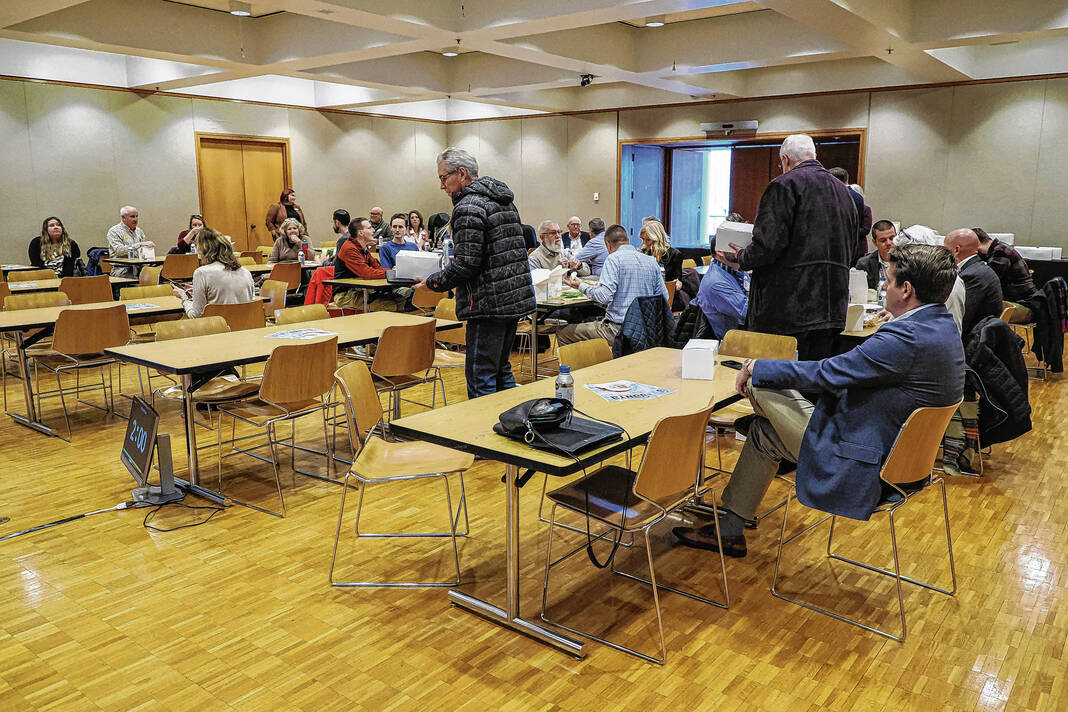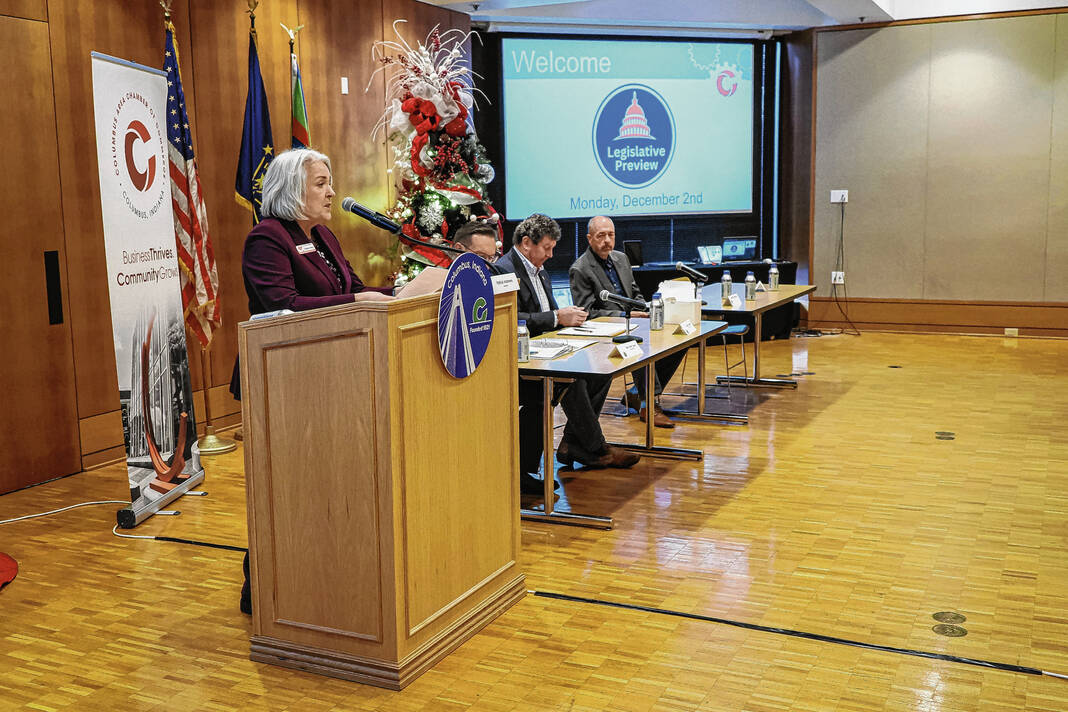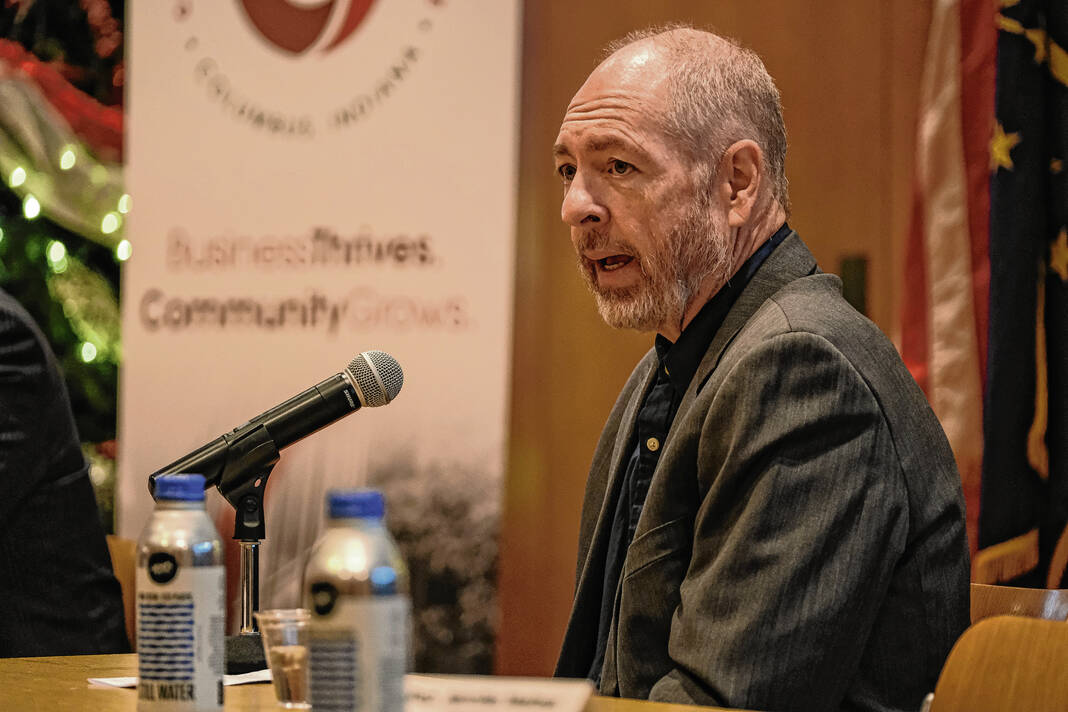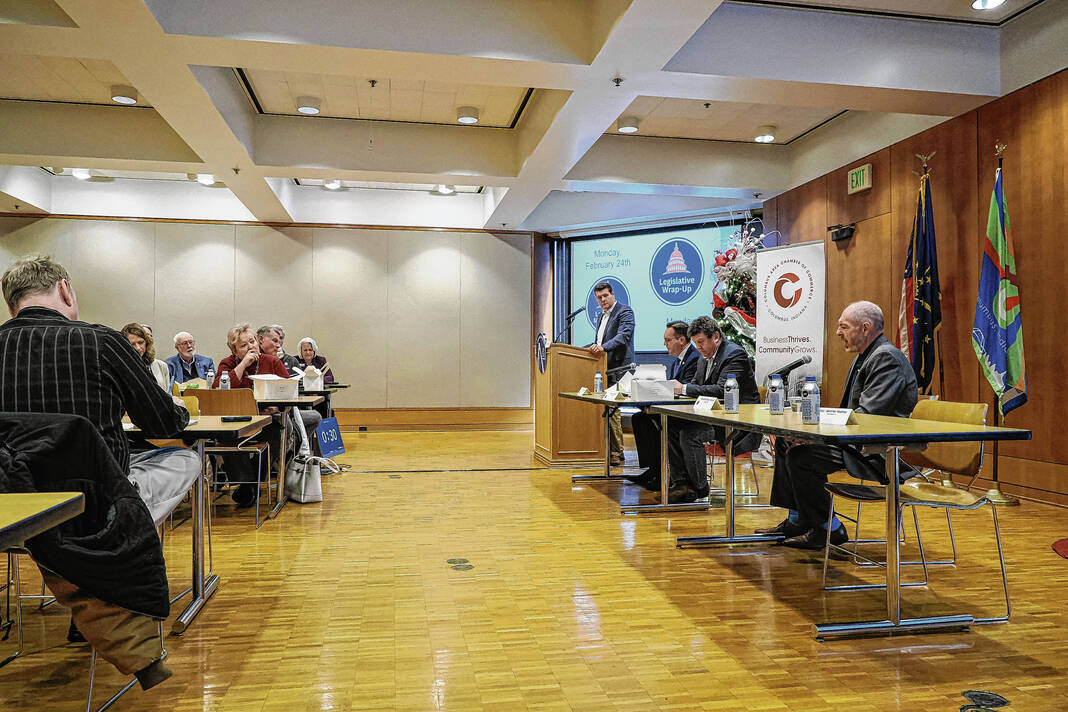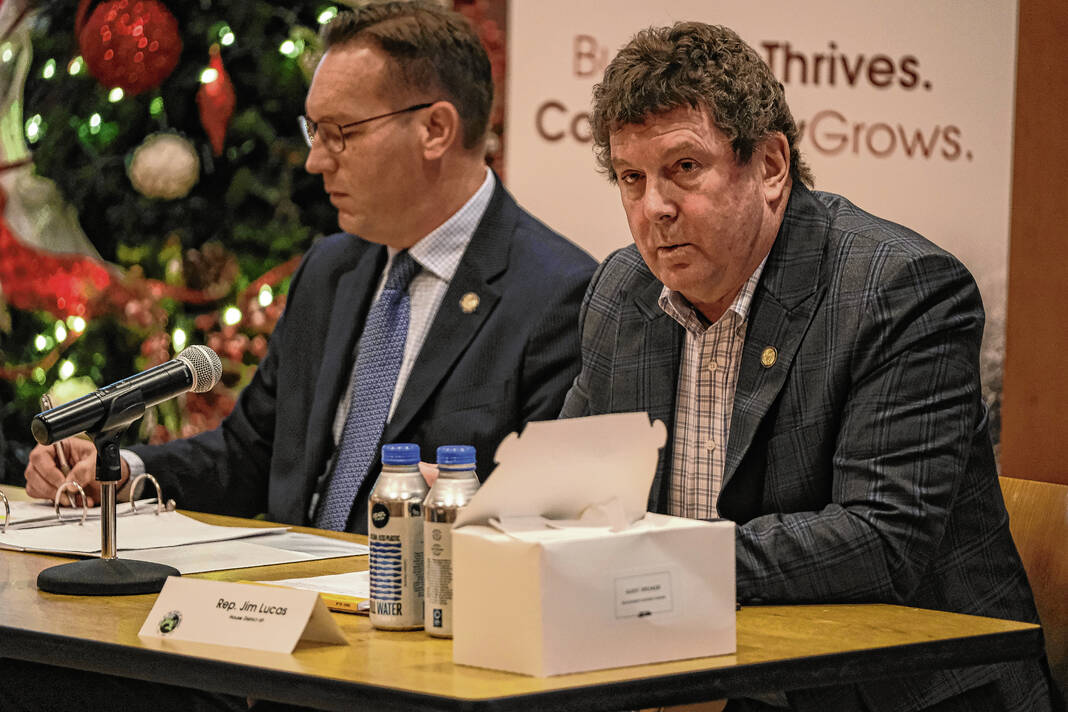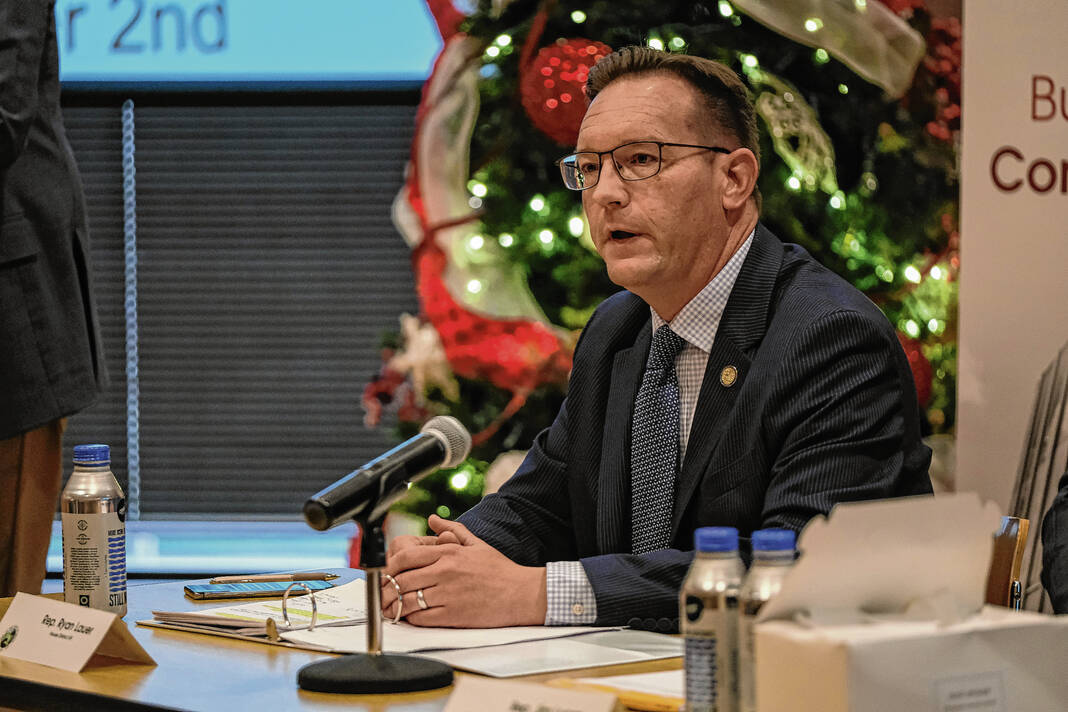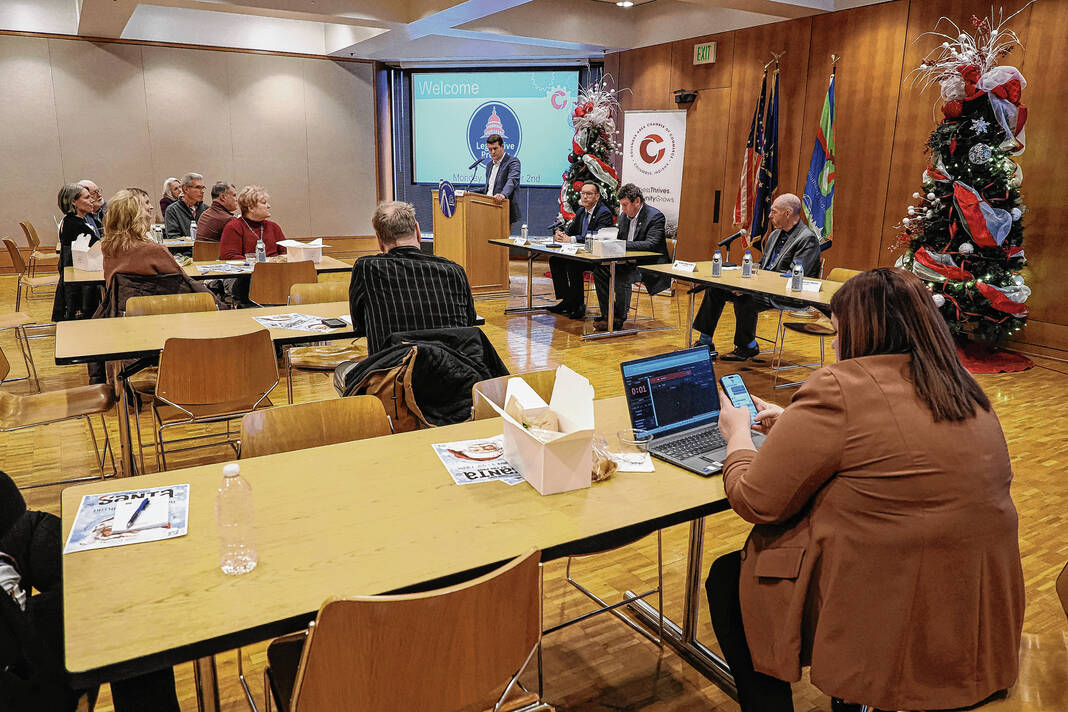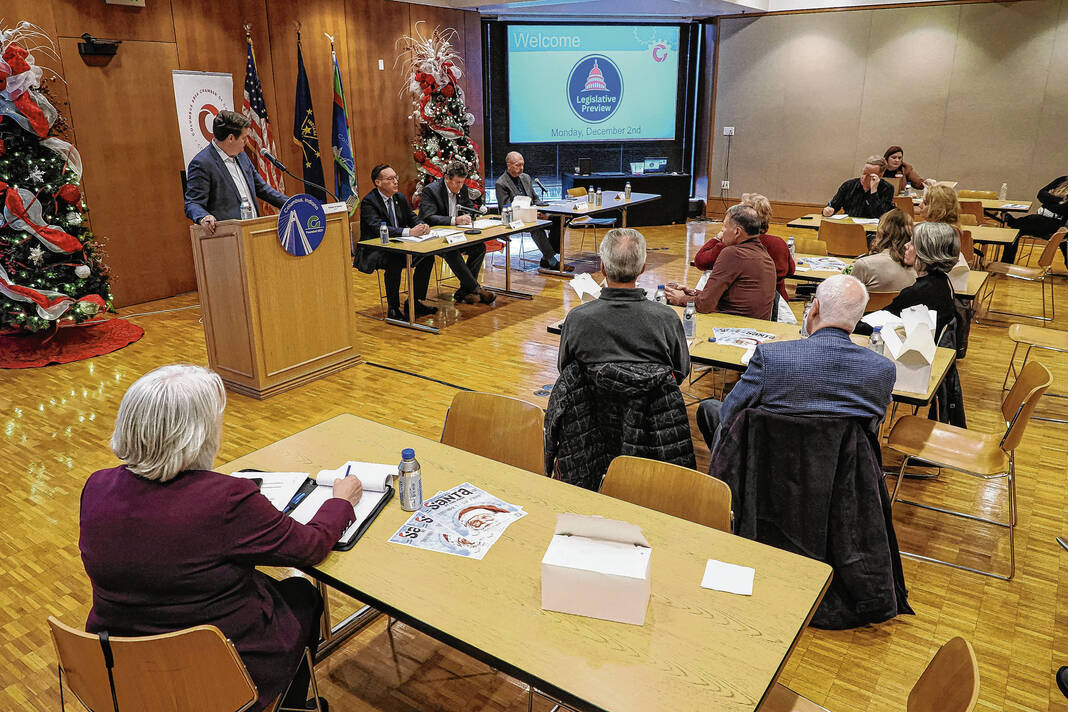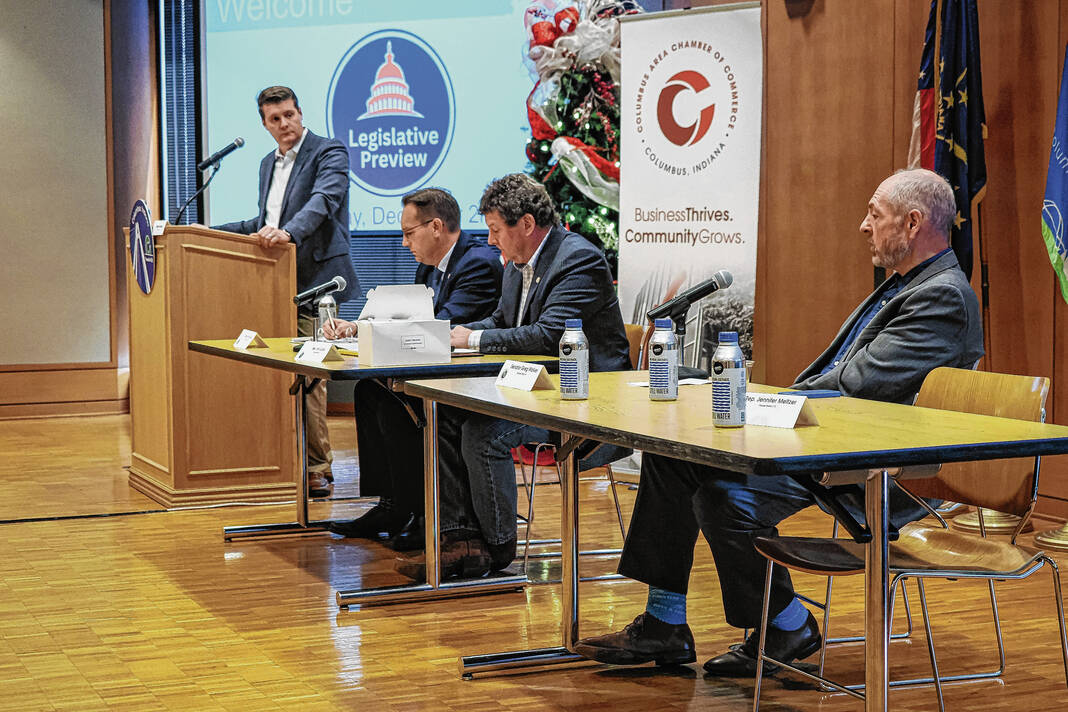
Mike Wolanin | The Republic Patrick Andrews moderates a legislative preview session with State Representatives Ryan Lauer, Jim Lucas and State Sen. Greg Walker at Columbus City Hall in Columbus, Ind., Monday, Dec.2, 2024.
More than 50 people turned out at Columbus City Hall Monday to hear three state lawmakers answer questions about the upcoming session of the Indiana General Assembly.
The event was sponsored by the Columbus Area Chamber of Commerce. Questions submitted by chamber members were asked by event moderator Patrick Andrews.
Since the legislative session doesn’t start until Jan. 8, chamber President Cindy Frey said lawmakers can do little at this point but “read the tea leaves and predict what to expect.”
But the initial questions asked by Andrews focused on the upcoming administration of Indiana’s next governor.
Q: Where do you anticipate a significant shift under the new administration of Governor-elect Mike Braun?
Health care will have to be changed because Medicaid, with almost 2 million Hoosiers enrolled, is unsustainable, Rep. Jim Lucas, R-Seymour, said. Rep. Ryan Lauer, R-Columbus, agreed with Lucas.
“We saw an almost $800 million jump in one year,” Lauer said. Lucas claimed an average of 53% of the annual births in Indiana are paid for by Medicaid.
The Seymour lawmaker also feels that the Indiana Economic Development Corp. (IEDC) needs a closer look after spending nearly a billion dollars in the last budget cycle. Sen. Greg Walker, R-Columbus, agreed that the IEDC, which helps businesses launch, grow and locate in the state. needs to be revamped.
“If you look at return on investment, we are sometimes putting 30, 40, 50-thousand dollars per job on the table,” Walker said. “I have to wonder if that money could be better spent to support the business climate in general.”
When the Braun administration takes over next month, there’s going to be a new dynamic in state government with a different focus, Lauer said. But lawmakers will have to wait until Braun puts out a budget to begin establishing priorities, he said.
With Braun showing a clear preference for business people in key positions, Walker said he hopes state government doesn’t lose focus on health care, mental wellness and families living in poverty by focusing on accounting and balance sheets.
Q: Is there an appetite in the General Assembly to be more aggressive with insurance companies, hospitals, pharmacies and benefit managers?
Health care is one of the biggest stressors of Hoosiers today, Lauer said. A number of efforts passed by the General Assembly are just starting to go into effect, he added. One is a bill on price transparency that passed last session that allows Hoosiers to compare prices between health care providers, according to Lauer.
Indiana has one of the highest percentages of companies that manage their own health care coverage for employees, Walker said. While those corporations pay medical expenses out-of-pocket, the senator says the companies try to make up for it with wellness programs and preventive health care. New laws will prompt a number of other companies to become self-insured, which Walker said will place more Hoosiers out of reach of government-subsidized healthcare.
Q: What are the prospects that teachers will received new incentives to stay in education and lower staffing shortages?
In order to afford those incentives, Walker suggested using one-third to one-half of the IDEC budget and investing it in the schools – especially early education. The senator said that is the kind of re-balance that would yield the type of benefits that teachers are looking for.
Over half of Indiana’s college graduates are either unemployed or underemployed, according to Lucas. He said he will sponsor a bill that gives parents choices regarding their child’s education, as well as control on every cent spent on their child’s education. While teachers can become independent contractors, they would still be eligible for state benefits under his proposal, Lucas said.
On average, teachers in Bartholomew County are paid $8,000 more a year than the state average, Lauer said. Describing himself as an advocate of local control of schools, Lauer says he’s like to see more local options and less state regulation. He also said lawmakers have already created some very clear pathways for students in choosing a career, he said.
After Lauer questioned why there’s an average 18% absenteeism in kindergarten across the state, it prompted Walker to respond.
“SNAP benefits (food assistance) lasts 13 days in the average household,” Walker said. “So if that means the kid is hungry 20 days out of the month, that’s why they’re not getting to kindergarten.”
Q: Fuel efficiency means less gas tax money for roads and bridges. Do you anticipate a statewide push for a wheel tax?
“I don’t want to see new taxes,” Lauer said.
He also mentioned a concept being considered among some lawmakers that proposes that counties that do not implement a wheel tax become ineligible for Community Crossing matching grant funds.
“Strong-arming local jurisdictions to implement a new tax to receive more tax money?” Lauer asked. “That’s come up before. That’a bad idea.”
Walker said road funding is still subsidized with general collection receipts though sales tax.
“I don’t see us doing any significant changes,” the senator said. “I’m not sure Indiana has a road funding problem.”
Lucas says he likes Indiana’s tax structure for road and bridge funding because 100% of Indiana’s gas taxes are spent on this type of infrastructure.
“That makes it as close to a user fee as you can get,” the Seymour lawmaker said. “Another benefit is that 20% of our road funding comes from out-of-state people traveling through Indiana.”
Choices regarding road and bridge funding should be made by local lawmakers, instead of the Indiana General Assembly, Lucas said.
The chamber will host two more informational public meetings with the lawmakers. The Legislative mid-session will be held on Monday, Feb. 24, while a legislative wrap-up is set for Monday, April 21.
A survey of 100 members of the Columbus Area Chamber of Commerce resulted in the following top five concerns.
- Healthcare access and affordability
- K-12 Funding
- Expansion of early learning programs and childcare
- Talent attraction and retention (tied with) infrastructure
- Economic development incentives