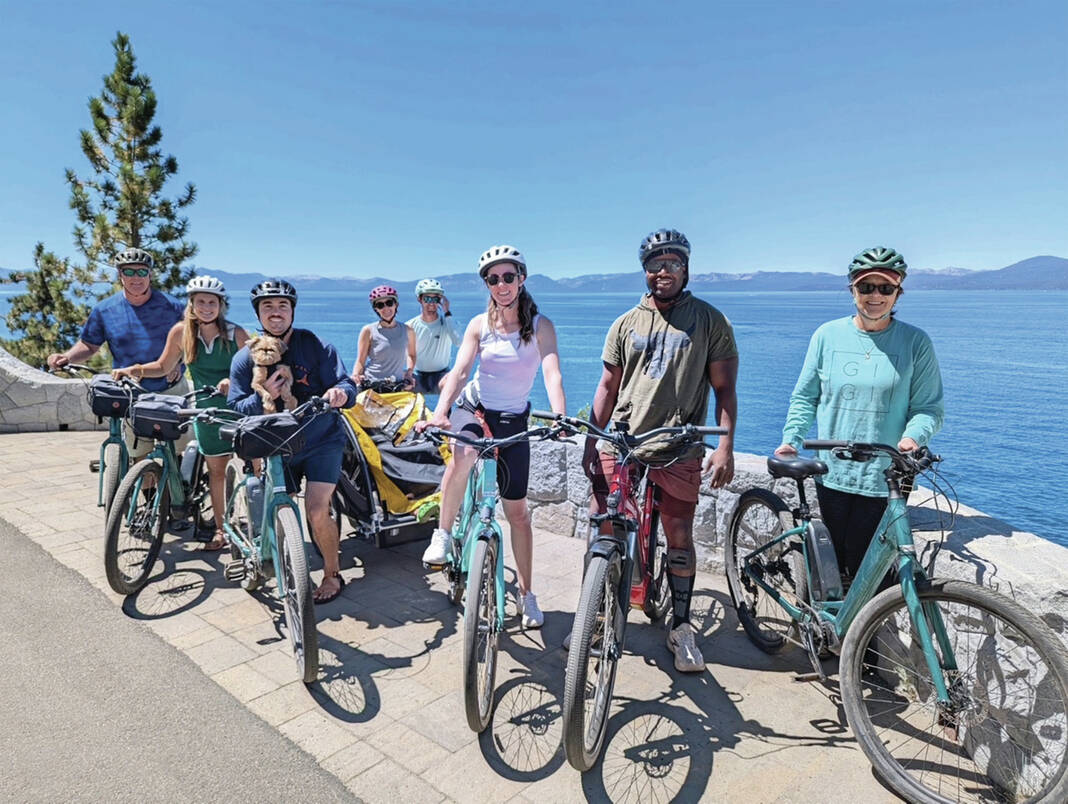
Photo Provided Family photo from a vacation in Lake Tahoe. Dr. Tom Sonderman, from left, Danielle Hritsko, Evan Sonderman, holding Sprout the dog, Grace Sonderman, Ross Fischer, Quincy Sanders, in yellow bike carrier, Sydney Sanders, Royce Sanders, and Therese Sonderman.
Thirty-five years ago, Dr. Tom Sonderman couldn’t have foreseen all his accomplishments at Columbus Regional Health, and, most noteworthy, the unexpected challenges he and the CRH would have to face. Now that he’s retiring as CRH’s chief medical officer, he’s reflecting on an eventful career, experiencing the launch of PromptMed, the implementation of the CRH electronic medical records platform, the 2008 flood and the COVID-19 pandemic.
Dr. Sonderman is a native Hoosier from the town of Ferdinand in Dubois County. His undergraduate degree is from the University of Evansville. From there, he went to the Indiana University School of Medicine and completed his residency at Methodist Hospital in Indianapolis.
Why did Soderman decide to come to Columbus?
“As two of my residency colleagues and I were approaching graduation, we knew we wanted to practice together,” he said.
They heard developments were afoot at what was then the Bartholomew County Hospital. Then, when efforts began to expand clinical specialty units, including the cancer center, adding a staff cardiologist and pulmonary critical care unit, Sonderman and his wife, Therese, also a Ferdinand native, decided to make the move.
It didn’t take long to find a place within the greater Columbus area that had unquestionable appeal.
“We drove around Grandview Lake and knew we wanted to live there,” he said. “We were there for our first seven or eight years.”
Over the years, they raised a family, including daughters, Sydney Sanders and Grace Sonderman, as well as son, Evan.
“It was really easy to transition into Columbus life,” he said. “Both in general and at the hospital, everyone really welcomed us.”
PromptMed, which opened in 1995, resulted from conversations among Sonderman and colleagues regarding “some trends we’d been seeing. Young people were becoming more inclined toward episodic care than a relationship with one family doctor,” he said. “Also, the occupational medicine business became a very important part of the population we took care of.”
The flood of 2008, the worst for the city since 1913, while traumatic, gave CHR the opportunity to regroup and go back to basics.
“All kinds of critical services were in the basement,” Sonderman recalled. “We essentially had to move everything out. The data center is now in a hardened building near the airport. Labs and imaging are now on the first floor of the hospital.”
While the hospital had a disaster response plan, unexpected problems usually require learning by doing.
“That was definitely flying the airplane while you’re building it. It was stressful, but it gave you so much clarity as to what you needed to be working on. Everybody’s creativity and perseverance was amazing. CRH people even went out into the community and helped other agencies.”
Regarding COVID-19, Sonderman said, “I think about it chronologically. In late 2019 and early 2020, we were hearing about this atypical pneumonia coming out of Wuhan, China. When Italy really got hit, it was the biggest glimpse into what the virus was about. Washington state was the first U.S. area to really get impacted. I remember an internet thread that said, ‘This is not the flu. If you think you might need to do something soon, do it now.’”
He said CRH used an approach called incident command, a structure of assigned roles.
“It was so broad it touched the entire community,” he said. “That response lasted about three years.”
One of his foremost thoughts during the long crisis was: “How long can our workforce run on adrenaline?”
Consequently, he increased focus on the stress of fostering a work-life balance that the staff was feeling.
“It’s so important to work for provider wellness,” he said. “We’re still working through the backlog of normal services that got interrupted during that time.”
The chief medical officer’s roles include strategic responsibilities for driving the health care system and overseeing the quality program that credentials new providers. The CMO is part of the leadership-management team that works with the CRH board of trustees. The board is appointed by the county commissioners.
What has changed over his 25 years at CRH?
“At first, everybody was in private practice,” he said. “Now, most work for hospitals.”
What has remained constant?
“The patient being at the center of everything we do,” Sonderman responded. “We’re actually dialing up the degree of decision making that the patient does in his or her own case.”
What does the next phase of life look like for him?
He and Therese plan to spend considerable time in Denver and Fort Collins in Colorado, as well as Austin, Texas, visiting kids and grandkids. Sonderman enjoys fishing and bicycling, but he comes particularly alive when talking about motorcycles. His current bike is a BMW.
“When I was a kid, I used my paper route money to buy my first one.”
Why did he decide to study medicine?
“As high school was coming to a close, I thought I’d go into a pre-law program, but when I’d tell friends that my favorite high school courses had been biology and physics, they’d say, ‘That sounds like pre-med.’”
He is immensely pleased about where he’s spent his career.
“Medicine is a team sport, and I’ve had an opportunity to work in one that’s tremendous.”