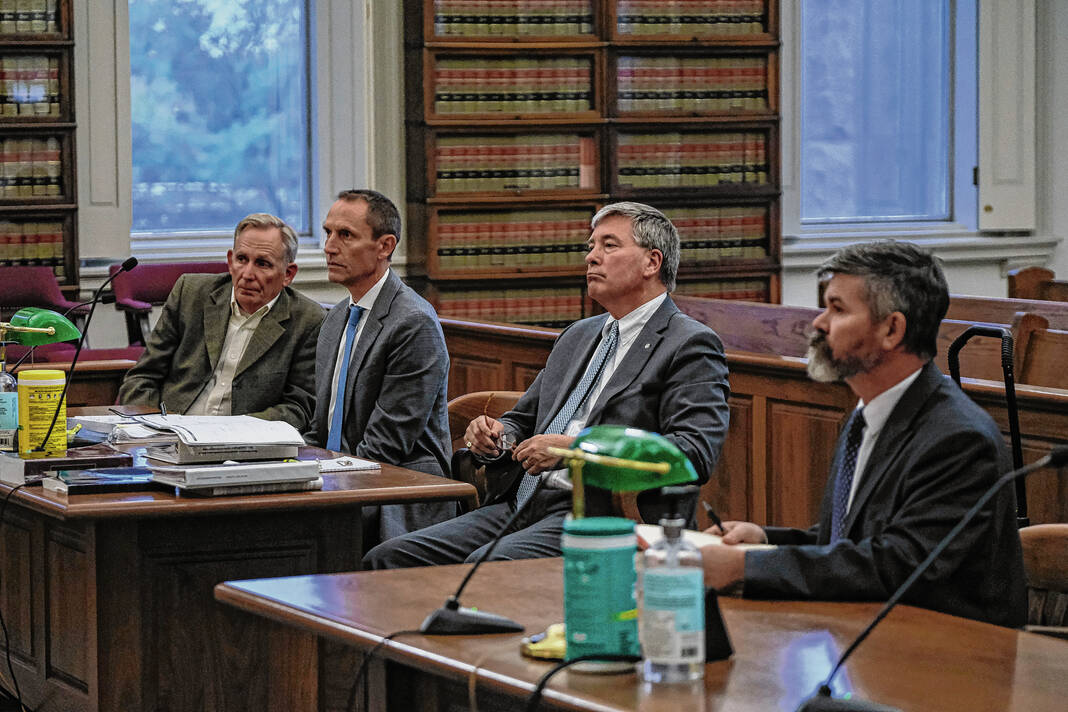
Mike Wolanin | The Republic Columbus City Council District 6 candidate Joseph Jay Foyst, from left, his attorney George “Jay” Hoffman III, attorney Peter King, representing the Bartholomew County Election Board, and attorney Ross Thomas take part in a pretrial hearing for Ross Thomas’ lawsuit against Joseph Jay Foyst and the Bartholomew County Election Board at the Bartholomew County Courthouse in Columbus, Ind., Monday, Oct. 16, 2023.
Indiana Attorney General Todd Rokita and the Indiana Democratic Party have filed briefs in the long-running legal battle over the validity of a Columbus City Council member’s candidacy in the 2023 election that is now pending before the state’s highest court.
The briefs, filed Friday, outline drastically different interpretations of Indiana laws governing how political parties can fill ballot vacancies, according to Indiana Supreme Court records. The case is currently scheduled for oral arguments on March 13 as the justices consider whether they will take up the dispute.
Rokita filed a brief in support of Columbus City Council member Joseph “Jay” Foyst, urging the high court to hear the case and overturn a unanimous appellate court decision finding that Foyst was not a valid candidate for Columbus City Council District 6 in the 2023 municipal election.
The Indiana Democratic Party filed a brief in support of Bartholomew County Democratic Party Chair Ross Thomas, who challenged Foyst’s candidacy and filed the lawsuit that is now before the Indiana Supreme Court. The Democrats are asking the justices to deny Foyst’s request to hear the case.
The legal fight over Foyst’s candidacy began in summer 2023 after Foyst was selected as the Republican nominee for Columbus City Council District 6 in a party caucus after nobody filed to run for the seat in the GOP primary, leaving a vacancy on the general election ballot.
Thomas challenged Foyst’s candidacy, arguing that local GOP officials failed to file a required notice of the party caucus with the Bartholomew County Clerk’s Office before the state-imposed deadline. The bipartisan Bartholomew County Election Board upheld Thomas’ challenge and removed Foyst from the ballot.
However, the Bartholomew County Republican Party held another caucus and selected Foyst again to fill the vacancy, pointing to a section in the Indiana Code that GOP officials said allowed them to fill a vacancy following “the successful challenge of a candidate.”
Thomas attempted to challenge Foyst’s candidacy again, but his request was denied by Bartholomew County Clerk Shari Lentz because the deadline had passed to file a challenge, prompting Thomas to file a lawsuit. While the lawsuit was pending, Foyst won the 2023 general election, defeating Democrat Bryan Munoz with 59.5% of the vote.
A trial court judge later upheld Foyst’s candidacy, ruling that the additional Republican caucus in which Foyst was renominated met requirements under state law.
Thomas appealed the decision, and a panel of appellate judges sided with him, unanimously finding that “Foyst’s candidacy never existed in the eyes of the law” and therefore he could not be placed on the ballot during the second caucus.” The appellate court judges also directed the trial court to declare Munoz the winner of the election.
In August, Foyst filed a petition asking the Indiana Supreme Court to take up the case. While the high court is currently considering whether to hear the case, it has no obligation to do so. If the justices decide not to hear the case, the appellate court decision would be final.
In his brief, Rokita argues, among other things, that Thomas does not have legal standing to challenge Foyst’s candidacy because he has not claimed that “alleged violation of timing rules injured him in any particularized, personal way.” Legal standing refers to the legal right to bring a lawsuit.
The attorney general alleges that the trial and appellate courts took an “expansive approach to standing” that would imply that “virtually any Hoosier could bring a suit to enforce election laws.”
Rokita also characterizes the missed deadline by local GOP officials as a “harmless error” and a “procedural defect” that did not “undermine the purpose of statutory deadlines,” arguing that the Bartholomew County Republican Party’s second caucus did not violate state election laws.
“Nothing in the election statutes dictates that a purported procedural error in a party’s initial selection acts to forever bar the party from renominating the same candidate (in the same election); to the contrary, the election code painstakingly creates multiple paths for a party to cure harmless errors and select the candidate of its choice at various points leading up to the election,” Rokita states in the brief. “…Thomas has identified no provision barring a party from renominating a candidate whose initial nomination has been invalidated based on procedural defect.”
The Indiana Democratic Party, for its part, argues in its brief that Thomas does have legal standing because he is “expressly authorized by statute” as the local party chair to challenge Foyst’s candidacy before the election board and therefore has a “personal stake in the outcome of this case.”
The Democrats also argue that a statutory deadline that local GOP officials missed “is not a mere ‘technical’ or procedural requirement.”
“Missing a mandatory deadline for filing a notice of intent to convence a party caucus to fill an early candidate vacancy is not a mere ‘technical’ or procedural requirement, but one to prevent a party chair from circumventing the power of precinct committeepersons by calling a caucus in secret,” according to the Indiana Democratic Party’s brief.
Additionally, the statute used by local GOP officials to renominate Foyst “presupposes that the vacancy exists due to the successful challenge or death of a bona fide candidate,” the Indiana Democratic Party’s brief states.
“Because of the belated submission to the clerk of the notice of caucus form … and the clerk’s unlawful acceptance of that late filing … Foyst’s candidacy never existed in the eyes of the law,” the Indiana Democratic Party argues in its brief. “Therefore, there was no late vacancy to fill.”
Both Thomas and Foyst have until Feb. 20 to respond to briefs.
Whatever decision the high court ultimately makes will determine which party holds a majority on the Columbus City Council through the end of 2027.
With Foyst on the city council, the Republicans have a 5-4 majority. Should Thomas ultimately prevail in court, the Democrats would have a 5-4 majority.