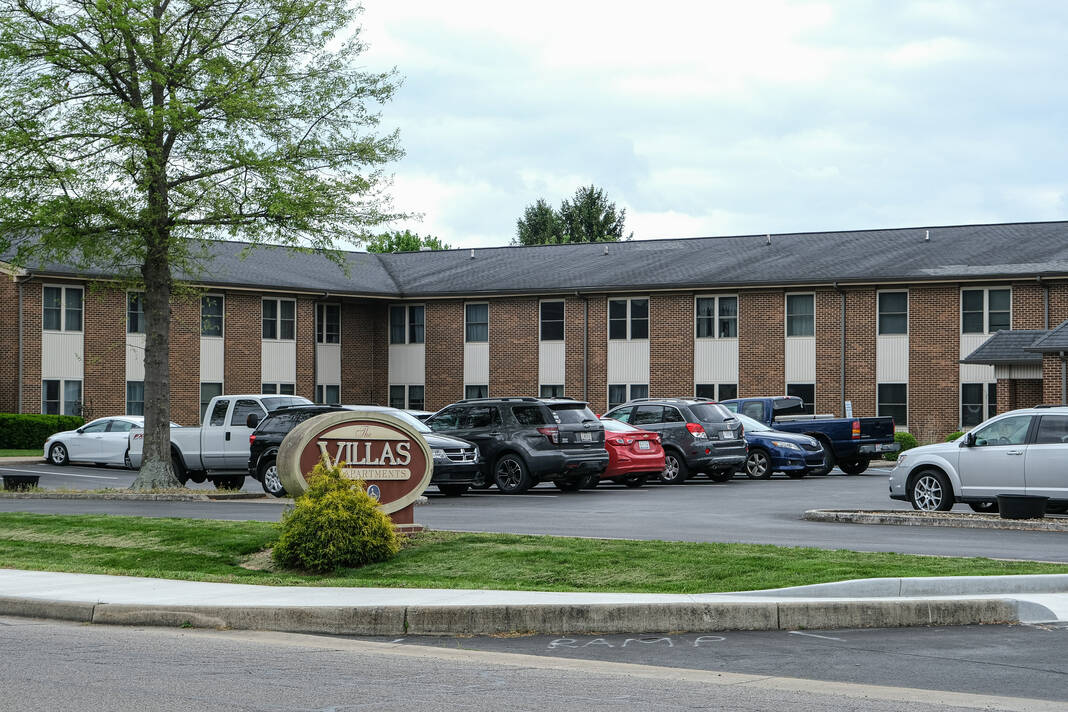
Mike Wolanin | The Republic An exterior view of the Villas Apartments in Columbus, Ind., Monday, April 29, 2024.
Residents of an affordable housing complex that is scheduled to close in less than three months say they are still grappling with high levels of stress and uncertainty about where they will be living, while local officials say they are still working to help the nearly 100 seniors who are facing displacement in the coming months.
The affordable housing complex, the Villas apartments at 4101 Waycross Drive, is currently on schedule to close by April 30, when property owner BHI Senior Living’s contract with the U.S. Department of Housing and Urban Development that subsidizes rent for the residents of the 99-unit complex is set to expire.
Kathrine Trujillo, a resident at the Villas, said she is “very concerned,” describing the situation as “very confusing” and stressful for herself and other residents — including some who are elderly or disabled — who have been facing an uncertain future since late April, when BHI Senior Living announced the closure.
While some residents have moved in with family or assisted-living facilities, “by and large” most of the residents at the Villas have not left, officials said.
“It’s very confusing. I would really like to get moved, since we’ve been told they will be closing their doors,” Trujillo said. “We are very stressed (and) not getting any word.”
City officials formed a subcommittee last year tasked with helping the nearly 100 low-income residents, including some who are elderly or disabled following BHI Senior Living announcing that it would close the complex.
Currently, local officials are waiting on the U.S. Department of Housing and Urban Development (HUD) to issue tenant protection vouchers to the residents at the Villas, said Alan Degner, executive director of the Columbus Housing Authority, which is on the subcommittee.
Tenant protection vouchers are a special type of housing voucher aiming to, among other things, provide assistance to low-income residents who are at risk of losing their affordable housing, according to HUD.
“We are waiting for those tenant protection vouchers to be issued so that we can then provide those to the tenants who are at the Villas and they can find a new location, wherever that may be,” Degner said. “It could be in our community, it could be outside our community.”
HUD officials have told local officials that the vouchers are “in processing” but have not given an estimate on when the vouchers will be available, Degner said.
“We don’t have a measure for when (the vouchers) will be released,” Degner said. “…We’re trying to set up a meeting with the residents to come over and just walk them through the general process so they know what to expect.”
“They won’t want to relocate until they receive their tenant protection voucher,” Degner added. “If they are no longer a qualifying resident at the Villas, they wouldn’t be eligible for a tenant protection voucher. …We encourage folks (to) look now (for places to live) but don’t move.”
BHI Senior Living, for its part, told The Republic this week that the Villas remains on schedule to close by April 30 and that the company has been “actively supporting residents.” Company officials said the closing date was determined “with input from HUD.”
“The Villas has been actively supporting residents by offering one-on-one meetings to help them explore housing options, collaborating with the city and local housing authorities and organizations and providing relocation stipends to ease the financial burden of moving,” said BHI Senior Living spokeswoman Megan Ulrich. “While some processes, such as Section 8 housing vouchers, are managed by HUD, our team continues to work closely with residents to ensure they are informed and supported every step of the way.”
However, finding a place to live may not be easy.
Local officials previously said the loss of the Villas’ 99 units “will have a significant impact” on affordable housing in Columbus, as the market for affordable units was already “extremely tight.”
Besides private property owners who offer affordable units, the Columbus Housing Authority owns public housing developments, but the wait list to get a unit is currently about 12 to 18 months, according to its website.
The lowest-income renters across the U.S. are currently facing a shortage of 7.3 million affordable and available rental homes, according to the National Low Income Housing Coalition, or NLIHC, a non-profit based in Washington, D.C., that seeks to end the country’s “affordable housing crisis.”
The shortage has widened since the pandemic struck, growing by more than 480,000 from 2019 to 2022, according NLIHC.
Indiana has a shortage of 139,318 affordable and available units for extremely low-income renters, according to NLIHC. That comes out to about 34 affordable and available units for every 100 extremely low-income renters in the state.
Extremely low-income renters are defined as households as at or below either the federal poverty guideline or 30% of the area median income, whichever is greater.
At the same time, larger cities in Indiana do not appear to be faring better than Columbus in terms of affordable housing, according to HUD’s database and U.S. Census Bureau population estimates.
Overall, Columbus currently has more affordable housing units per capita than Indianapolis, Fort Wayne and Evansville and has a lower poverty rate. Even with the loss of the Villas, Columbus would still have more affordable units per capita than many Indiana communities, including Kokomo, Terre Haute and Bloomington.
Degner said the Columbus Housing Authority has also encouraged residents of the Villas to fill out applications for “some other project-based locations” in the Columbus area through separate project-based vouchers in order to “give them the greatest possible opportunity” to find a place.
“Anytime you’re uprooting your family, anytime you’re moving, it’s stressful,” Degner said. “Our goal is to try to provide as much information as we can when we have it to make it as understood as it can be.”
In the meantime, new residents have been moving into the Villas even though it is scheduled to close at the end of April, according to current residents and BHI Senior Living.
“HUD regulations require that available units continue to be open to the public, and as a result, some new residents have moved into the Villas,” Ulrich said. “Each individual was fully informed of the upcoming closure prior to signing their lease, ensuring they were aware of the timeline and expectations. The Villas remains committed to maintaining the property and providing services to all residents until the closing date.”