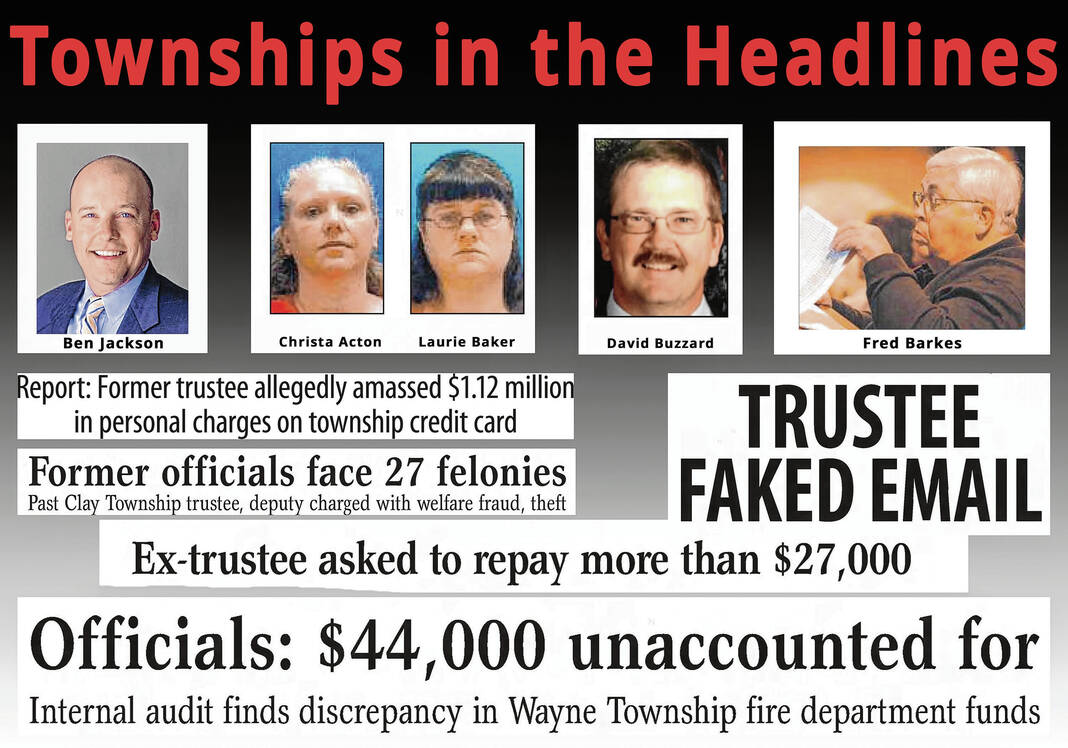
Graphic by Mike Wolanin | The Republic This graphic shows photos and various headlines from stories that have appeared in The Republic surrounding financial audits and financial issues at the different township governments in Bartholomew County. The photos from left to right are former Columbus Township Trustee Ben Jackson, former Clay Township Trustee Christa Acton, former Deputy Clay Township Trustee Laurie Baker, former Rockcreek Township Trustee David Buzzard and former Columbus Township Trustee Fred Barkes.
Experts say that Indiana’s township governments may be particularly vulnerable to mismanagement, misuse of funds and corruption largely because they face little state oversight and often escape public scrutiny.
A check of Bartholomew County’s township government criminal cases show that misuse of funds has happened here over the years.
Townships are small units of local government that operate below the county level, each comprised of a trustee — who serves as the executive — and an advisory board — which functions as the legislative body. The trustee and advisory board are elected by township residents.
Indiana has just over 1,000 townships, including 12 in Bartholomew County, and their budgets are primarily funded through property taxes.
The issue of oversight in Indiana’s township governments gained renewed attention recently after a special investigation by the Indiana State Board of Accounts found that former Columbus Township Trustee Ben Jackson had amassed more than $1.12 million in personal expenses to a township credit card over an eight-year period.
The expenses allegedly included $657,831 for dozens of personal trips across 10 countries, $150,078 in retail purchases, $90,915 in tuition and school expenses for his children, $39,913 for personal utilities, among several other things, according to a report released last week by the SBOA.
“The checks and balances that are supposed to be in the system don’t work as well anymore,” said Paul Helmke, director of Civic Leaders Center and professor of practice at the Indiana University Paul H. O’Neill School of Public and Environmental Affairs and former Fort Wayne mayor. “…(Townships) are under the radar of the public.”
Indiana’s township system traces its roots back to the 1850s, when state’s population was largely rural. Early on, townships provided essential services including poor relief, fire protection, road maintenance, library operations, school administration and even burial of Civil War veterans.
But today, many of these functions have shifted elsewhere, as townships typically no longer maintain roads, operate libraries or oversee schools. Poor relief and fire protection are the main functions of township government, meaning if people have daily needs, they go to the main city in the county, or the main city even in the region, “They don’t think about their township trustee or township government,”
“They were drawn up not even to reflect population numbers,” Helmke said. “They’re drawn up basically to be close to even squares with the idea that you could walk or go to the school or respond to the fire or take care of somebody in need. This was drawn up before we had cars. This was drawn up before we had telephones. …The way they set up townships back in the 1850s is still the way we do it today.”
While the Indiana State Board of Accounts is tasked with auditing local government units, including townships, “there are too many townships for them to really look at” and is more likely to focus its efforts in areas with larger populations such as Marion or Lake counties, Helmke said.
Additionally, township trustee is not usually a highly sought-after office, and trustees are elected in midterm election years, which generally see lower turnout. In 2022, 10 of the 12 township trustees elected in Bartholomew County ran unopposed in the general election, according to the Bartholomew County Clerk’s Office.
Political polarization also plays a role, as township trustees and board members often end up being from the same party, which can lead to a lack of scrutiny and public attention, experts said. While the township board is designed to be a check and balance on the trustee’s authority, it often does not work out that way.
“In many cases, … (township board members) are part-time people,” Helmke said. “…The township trustee comes in and says, ‘Here’s the budget,’ it balances, they see numbers. They don’t know they should be asking questions. …Particularly if you’ve been in the job for a while and you know the people, it’s sort of a good-old-boy, good-old-girl network. You get along, you know everybody, the (budget is) balanced. Nobody’s raised a ruckus.”
A troubled history
While the scale of the allegations against Jackson may be unprecedented in Bartholomew County, his case reflects a broader trend in which local township trustees have come under scrutiny for alleged financial misconduct.
Since 2013, at least five other former township trustees in Bartholomew County have come under investigation for alleged misuse of funds — including at least three who were charged with felonies — according to state and federal records.
Additionally, a sixth criminal probe involved Jackson’s predecessor, former Columbus Township Trustee Frank Barkes, who acknowledged forging an email from The Republic in an effort to secure the state’s approval of the township’s budget in 2013.
The following year, former Clay Township Trustee Christa Acton was sentenced to one year in jail and ordered to pay $19,610 in restitution after pleading guilty to five felonies related to related to financial irregularities at the trustee’s office.
A state audit and found that Acton had overpaid herself by thousands of dollars and used township funds to pay her husband’s mowing business at inflated rates, according to a copy of the audit and court records.
Former Clay Township deputy trustee under Acton, Laurie Baker, was convicted in 2014 of four felonies — including welfare fraud, theft, forgery and perjury — and sentenced to six months in jail and ordered to pay $6,000 in restitution, according to court records.
The financial misconduct left the township’s finances in disarray and its accounts overdrawn in 2009 and 2010, resulting in the township defaulting on its contract with the fire department.
The township’s fire department received just $15,828 of the $40,000 it had been promised for basic needs, forcing firefighters to rely on community donations and fish fry fundraisers to keep operations afloat, The Republic reported at the time.
When Rebecca “Becky” Smith, Acton’s successor, took the reins of the trustee’s office, it was “nearly broke,” she later told state officials.
“Computer equipment had all been confiscated by the Indiana State Police, the books were all mismanaged, there were hardly any files, and the ones that were there were all copies that had been reworked and recopied numerous times over in an attempt to disguise the thefts that had taken place,” Smith told state auditors.
In 2017, Smith herself was accused of receiving $3,459 in various forms she wasn’t entitled to, including excess reimbursements of cell phone and internet expenses, salary overpayments and $1,207 in “personal expenses paid with township funds,” according to a copy of a state audit.
Smith, for her part, told state auditors that she “inadvertently miscalculated an extra month” when paying herself, adding that the error “was definitely not intentional nor an elaborate act to cover anything up.”
In 2018, former Wayne Township Trustee and Jonesville Volunteer Rural Fire Department Treasurer Clint Madden was accused of misappropriating more than $100,000 from the township and fire department, according to the U.S. Department of Justice.
A state audit had found that Madden had forged the signatures of two firefighters to secure a $28,000 lease for a personal concession trailer. When his successor received a notice from a bank about overdue payments on the trailer not in the township’s possession, Madden returned the trailer — but by then, it had been stripped of its fixtures.
Although he made some payments on the lease, the trailer was eventually repossessed, and the township incurred $10,497 in attorney’s fees to settle a lawsuit over the matter.
Auditors also reported that Madden used township and fire department funds to purchase a 2006 Hummer and a 2004 Cadillac Escalade, but neither vehicle was titled in the name of the township or the department, The Republic reported previously. When the vehicles were later sold, the proceeds were not deposited into township accounts.
Additional irregularities included $17,070 in undocumented payments, fraudulent invoices used to purchase a vehicle for a third party and personal expenditures such as $3,831 for a vacation cruise and $941 for satellite television, among others. Auditors also flagged several rent payments made on behalf of individuals who had no township assistance documentation on file.
In 2020, former Rockcreek Township Trustee David Buzzard received a one-year suspended jail sentence and one year of probation after pleading guilty to a felony charge of official misconduct related to financial irregularities at his office.
A special investigation by SBOA found that former Buzzard overpaid himself and his wife, who was the township clerk at the time, by around $27,000 over a four-year period.
In addition, auditors found that Buzzard had set up the township office in his own home and had used $4,389 in township funds to pay for a wireless home phone line and internet service without authorization from the township board or an appropriation in the township’s budget.
Auditors also flagged other questionable spending, including a $1,000 check to David Buzzard with no documented purpose and $1,511 in unsupported trustee office expenses. Though Buzzard repaid $12,825 before resigning, the state later requested an additional $27,541, plus $4,445 to cover investigation costs.
The special investigation report highlighted a lack of financial oversight at the township, which they said allowed the improper payments to go undetected for years.
The former trustee was “responsible for all aspects of township financial activity,” including preparing checks, recording financial transactions and monitoring budget compliance, the report states.
“There was no required oversight of township financial activity on an ongoing basis by another individual,” the report states. “Due to this lack of segregation of duties, the salary overpayment, payment of personal expenses, reimbursement for unallowable cell phone and internet expenses … were able to occur and not be identified timely.”
Lack of compliance
At the same time, audits of several other townships in Bartholomew County have repeatedly turned up issues.
For instance, the two most recent state audits into Ohio Township found that officials did not have any internal controls in place from 2016 to 2023 — including oversight, review or approval procedures for managing the township’s cash, investments, disbursements or financial reporting.
The Ohio Township trustee was “the sole person responsible for all financial processes,” which “could have enabled material misstatements or irregularities to remain undetected,” the two audits state.
From 2020 to 2023, the township allegedly failed to maintain an inventory of capital assets, provide records supporting the $944,000 in assets it declared to the state, payroll documentation was missing, employee time records were not kept, payroll was not approved by the trustee and the township did not follow required procedures for setting salaries for officials.
After a former Clay Township trustee was sentenced to jail for financial misconduct and her successor was under investigation for alleged misuse of funds, the township had still failed to establish an adequate system of internal controls related to financial transactions and reporting, according to the most recent state audit of the township, which covered calendar years 2019 to 2022.
According to the audit, the trustee managed collections, recorded transactions, and made deposits without any oversight. The trustee also entered disbursements and issued checks with no review procedures in place.
In Flat Rock Township, a state audit covering 2019 to 2022 found that the township had failed to upload required financial reports for four consecutive years and had no capital assets policy in place. It also had not conducted a physical inventory or maintained records of its assets.
A 2016 compliance report revealed earlier financial issues, including overdrawn township funds in 2012, 2013 and 2014; budget overruns in the fire fund in 2015; and a failure by the township board to set officer and employee salaries over a four-year span.
Auditors have documented issues in other townships in the county, including, among other things, inadequate internal controls, a lack of training on internal control standards, filing required financial reports late, inaccurate reporting, undocumented transactions, failures to put nepotism policies in place, not keeping an inventory of assets, not holding required board meetings, among several others.
“If the mayor screws up, or the city council screws up, or the county commissioners screw up — and that still happens — people spot it a little more quickly,” Helmke said. “But the township trustee, it’s kind of like, who is that? What do they do? Where are they? And so, they become invisible to people.”
“I think that’s the case not only in Bartholomew County, but in most counties in the state,” Helmke added.