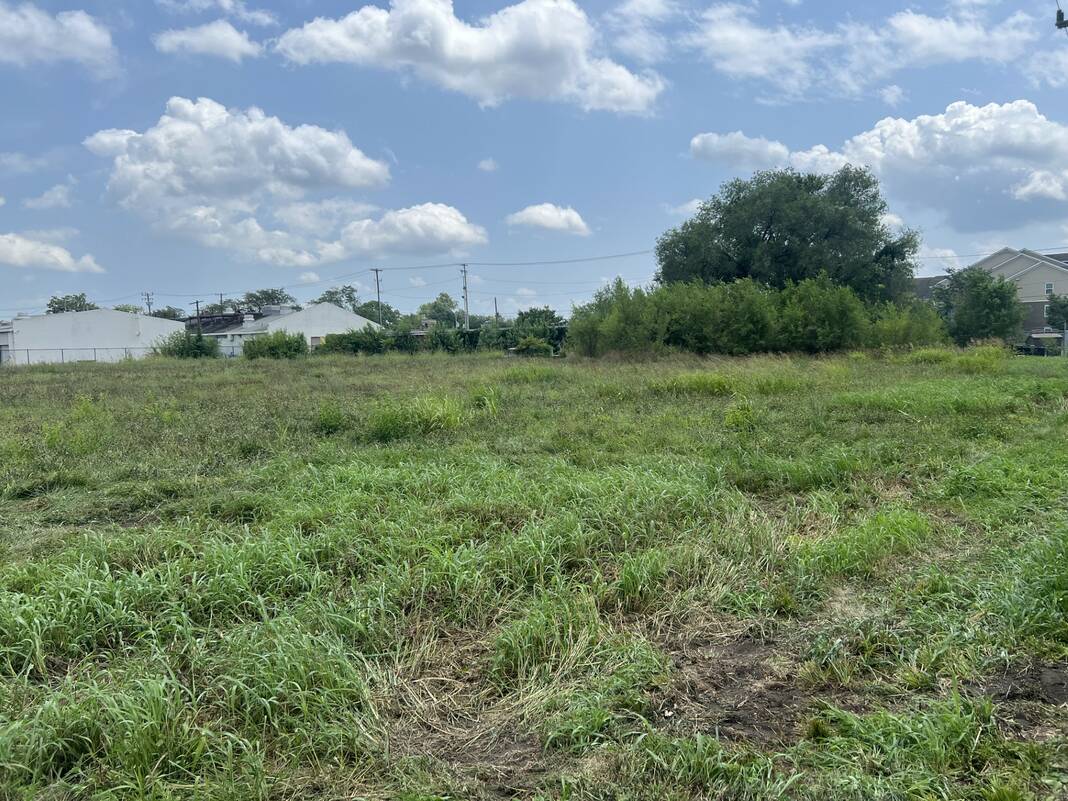
Brad Davis | The Republic The property shown is the prospective site for the Flats on 14th, a new affordable housing complex proposal.
The Columbus Board of Zoning Appeals on Tuesday approved a few variance requests related to what will be a four-story, 110-unit affordable housing development on 14th Street.
TWG Development’s Flats on 14th project will be located on three adjoining lots at the northeast corner of the intersection of 14th Street and Michigan Avenue.
The project, which is expected to cost $29.1 million, was made possible after TWG was awarded 4% federal low-income tax credits (LIHTC) along with affordable and workforce state tax credits (AWHTC) in a competitive process in the fall.
TWG’s Marisa Conaster explained to board members that because the development is part of the Indiana Housing and Community Development Authority’s Affordable and Workforce Housing program, TWG is committing to providing affordable rents for 40 years.
Residents will pay 30% of their income toward the affordable rent figure, identified based upon area media income (AMI) in a given year.
In other words, the units will be reserved for people who earn below $62,000 a year, based upon the latest annual AMI numbers.
TWG asked for, and were granted, the following variances, which planning staff recommended approval of and the board agreed upon:
- To allow 110 dwelling units, 30 more than the maximum 80.
- To allow 124 parking spaces, 41 fewer than the minimum required 165.
- To waive the requirement to provide a Type A Buffer along 230 feet of the east property line.
- To waive the requirement to provide a Type A Buffer along the southwest property line.
- To allow a parking lot to encroach 6 feet into a Type B Buffer along the northwest property line.
Planning staff in their report noted they hadn’t been provided any unit makeup for the development, but TWG officials previously said in city meetings that they tentatively planned for 35 one-bedroom units, 50 two-bedroom units, and 25 three-bedroom units.
The development will also have an on-site, licensed daycare center.
Columbus City Council members in April of this year approved two ordinances related to the project: one authorizing a payment in lieu of taxes (PILOT) agreement where the developer will claim tax savings towards their total development costs. Another established a restricted affordable housing fund, required by state statute as part of the PILOT agreement.
The city agreeing to the PILOT boosted TWG’s application to the Indiana Housing & Community Development Authority for the state and federal tax credits that made the project possible.
Under the terms of the PILOT, TWG is required to make a $33,000 payment that will go into the affordable housing fund starting in 2027. That amount will increase 3% annually and will be paid across 15 years. The total amount to be paid will be $613,764 over that period of time.
The money in the affordable housing fund can only be used for specific purposes, outlined by the law. After the 15 years are over, TWG could come back and ask for another PILOT agreement or the money in the fund would go back to the original tax base, according to the developer.
Half of the money in the fund will go towards the production, rehabilitation or purchase of housing units for very low income households. The other half will go a nonprofit, public housing authority, unit of government, or a private development entity as determined by the advisory board.
Things the fund can be used for specifically includes providing financial assistance to individuals who make 80% of AMI or less for rent and to pay expenses associated with administering the fund.
In addition, the fund can be used to provide grants for the development, rehabilitation or financing of affordable housing for those whose income is at or below 80% AMI “including the elderly, persons with disabilities and homeless individuals and families.”
As part of the affordable housing fund, it’s required that an 11-member housing fund advisory committee be created that would implement spending the funds. Decisions the board will make about spending will still be subject to final approval by the Columbus City Council.
That board will be made up of representatives for the interest of low income families, owners of subsidized multi-family communities and financial institutions. Six of the positions would be appointed by the mayor, with the rest appointed by the council. The five other members “must be nominated to the legislative body after a general call for nominations from township trustees, community development corporations, neighborhood associations, community-based organizations, and other social services agencies,” according to Indiana Code.
The board likely wouldn’t convene until there’s a few payments in the fund, meaning that may not happen until 2030 or 2031, according to community development.