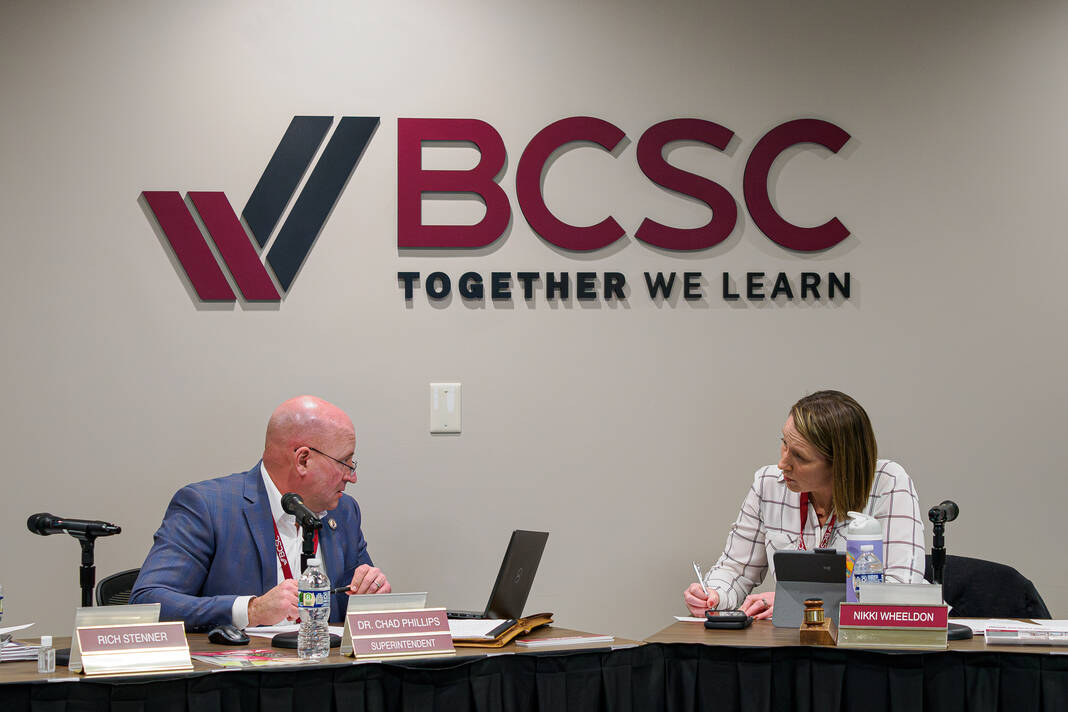
Bartholomew Consolidated School Corp. board members agreed to add two more elementary schools to a meal service option that, if approved by the state, would provide federally-funded meals at no cost to students, but a few members pushed for its expansion to every elementary.
Board members on Monday night voted 4-3 to allow administrators to submit an application to the Indiana Department of Education to add W.D. Richards and Mt. Healthy elementary schools to the Community Eligibility Provision (CEP) program, which allows schools located in high poverty areas to offer breakfast and lunch at no cost to all enrolled students, according to the U.S. Department of Agriculture’s (USDA) Food and Nutrition Service.
Those who voted against the motion— board members Jason Major, District 1, Tom Glick, District 5, and Logan Schulz, District 6 — wanted to extend the CEP to every elementary, saying they believed the district had ample funds to do so.
Later in the meeting, board members agreed to begin accepting bids for an already-budgeted $2 million, one-time payment, athletic turf project for Columbus North baseball and softball on the fields at Southside Elementary, which in itself sparked more discussion.
Schulz, who has been particularly vocal about expanding accessibility to school meals, linked the two matters and asserted that the board “prioritized athletic luxuries over providing necessities to families that are struggling” and that the body had “failed” in a statement on social media.
Board members who opted to add just the two schools at this time in part said it would give the board a better idea of the impact of adding additional schools to the CEP in the future.
Rather than collecting and verifying individual school meal applications for free and reduced-priced meals, schools that adopt the CEP are reimbursed by the federal government using a formula based on the percentage of students who automatically qualify for free meals through programs such as the Supplemental Nutrition Assistance Program (SNAP) or Temporary Assistance for Needy Families (TANF), according to the USDA, among other factors.
This is referred to as a district’s direct certification rate, which automatically qualifies students for free and reduced meals using data from the Family and Social Service Administration. The direct certification rate of BCSC’s students is around 35%, according to district officials.
The CEP program, while federally-funded, is administered by the state, which allows districts to apply individually, as groups or as the entire district. The CEP application, if approved, lasts for four years, but the district is able to back out every year if the cost proves too much. BCSC officials said they plan to consider adding additional schools every year, and that federal changes could widen the scope of schools added.
BCSC’s four Title One schools — Clifty Creek, Schmitt, Smith and Taylorsville elementaries — are already in the program after being added last summer. Assistant Superintendent for Finance and Operations Brett Boezeman said last year that the school corporation was initially focusing on the four Title One schools because using the CEP district-wide would cause a “substantial financial setback” in lost reimbursement from the federal government.
Board members during their last meeting on May 19 approved a motion to add all the remaining elementary schools to the program, pending a budget review to see the impact of doing so. Administrators had initially recommended adding just Mt. Healthy and Richards because those are the schools with the next two highest direct certification rates. Adding Mt. Healthy and Richards to the program would be a near break-even for the district financially.
The budget analysis found that adding every elementary school to the CEP would cost the district anywhere between an estimated $781,053.88 and $955,893.30 in the next year, depending on how much meal participation increases. The more meals students in a given school eat as a result of the CEP, the higher number of meals the district gets reimbursed for by the federal government.
Most of the additional cost, Superintendent Chad Phillips said, would be derived from providing free meals to students that otherwise do not qualify for any of the federal meal programs and who would typically be paying the normal rate for meals.
Meal participation at the four Title One schools jumped on average 30% for breakfast and 15% for lunch in the past year, exceeding what administrators had initially expected. Officials with the Indiana Department of Education indicated to BCSC that schools added to the CEP typically see anywhere between a 4% and 8% increase in meal participation.
While officials said the increase in participation would not nearly be as high in the non-Title schools, the analysis included that assumption. Meaning if meal participation were to increase 30% for breakfast and 15% for lunch across all elementary schools, BCSC’s food service account would run $781,053 in the red, and the district would be required to make that up with non-federal dollars in other accounts.
The analysis provided that adding Richards and Mt. Healthy would result in an impact on the food service account anywhere between negative $65,185.16 and $11,980.21 in the green. The school with the next highest direct certification rate was Parkside. Adding Richards, Mt. Healthy and Parkside would result in a financial impact anywhere between $155,393 and $262,972 in the red, according to the analysis.
Schulz and Major have consistently discussed the $35 million in the district’s cash reserves at the start of 2024, and contended extending the CEP to every elementary would be a worthy use of it.
“Tonight, the majority of the BCSC School Board chose $2M+ turf on softball diamonds over providing every child free hot lunches and breakfast for $750K at all elementary schools because there are not enough funds,” Schulz said on his school board member Facebook page. “We prioritized athletic luxuries over providing necessities to families that are struggling. I see the Board’s job as putting our students in the best position to succeed and today the Board, as a whole, has failed!”
BCSC officials have said the large cash reserves are a result of a number of factors including conservative budgeting, higher-than-expected interest rates the past couple of years and increasing property tax evaluations in the county.
Phillips said the school board in July will consider a cash reserve policy “so that the public and the board get to weigh in on what is an appropriate amount of cash we have on hand for emergency purposes, and following what’s recommended by professional organizations in the State of Indiana.”
Phillips added as well that changes to federal poverty guidelines could make it more feasible to add more schools, without sacrificing funding in other areas.
“Changing the poverty criteria would help us be able to serve those folks who need it most, without taking money that might go towards teacher salaries, or Book Buddy supplies, or whatever the long-list of opportunity costs there is there,” Phillips said on Monday night.
BCSC officials pointed out that $750,000 would pay for about 150 local students to attend Pre-K on the heels of steep cuts to state On-My-Way Pre-K funding.
“If these guidelines were adjusted higher, these families/students would qualify for lunch assistance funded by the federal government,” Phillips said later in an email. “This is a much more efficient way to help those families who need assistance without spending taxpayer money for affluent families.”
The superintendent also noted that when the CEP was extended to every BCSC school in 2021-22 through federal funding, that officials saw “a large increase in the amount of food waste” and wondered if there was a way to track that as they look to incrementally add schools.
“I know we don’t track that currently, but since we’re being incremental with our recommended step here— four schools last year, two more school this year, I just wonder if there’s an opportunity to track that and even do education, both of our students and families about— if you want the dessert, don’t go up there and get a full tray to get the dessert because it’s free, even though you brought your lunch. Manage that proactively, particularly in our schools that have lower poverty rates. I wonder how we might approach that.”
When families were required to pay for school meals again with the normal criteria in 2023-24, BCSC saw historic increases in IREAD-3 passing rates and high school graduation rates.
“Both of those indicators are expected to increase again in 24-25,” Phillips told The Republic. “That is not to say that subsidizing meals for students in need does not positively impact performance for some students. But it is clear that it is not the only way to impact student achievement.”
Amy London, president of the Columbus Educators Association (CEA), said she didn’t feel as though directing tax dollars to expanding the CEP “fits the needs for all our of students,” considering varying income levels and changes to how schools are funded after the passage of Senate Bill 1 last legislative session.
“It is my position as a parent, it is our position as CEA, that there are several things that we need to put our tax dollars toward,” London said. “We have some great programs to help. There’s people who are just above that poverty line who are getting the free and reduced (lunches), and we have some great staff who can help them get connected with those. We also have some folks in this room that could help work on, as Dr. Phillips mentioned, getting that poverty line to an area that helps more people.”
In conversation with people in the community, Schulz said it has come up that expanding the CEP would, for example, fund free meals for children of wealthy individuals and could take away resources from others.
If the CEP was expanded to every elementary, a student from a family making $40,000 would cost local taxpayers the same as buying a school lunch for a student in a family making $400,000 per year, for example.
“I think that’s a little bit of a quick judgement,” Schulz said. “I don’t think this is necessarily going to go to the wealthy children. Obviously they would artificially benefit, but the goal here is to catch those students that are stuck in the middle and don’t have two good meals per day to be able to focus on the academics.”
Schulz identified three things as real drivers of student achievement: access to meals, classroom sizes and recess time, and said the social science behind that is clear.
“The goal here is to find folks that are in that tweener stage, that are honestly just struggling day by day,” Schulz said, estimating that the funds it would take to expand the CEP to every elementary is half a percentage point of BCSC’s operating budget.
Dale Nowlin, board member, District 4, said “we would all agree that it would be a wonderful thing if we could afford to provide (meals) for all of our students” and referred to studies, some mentioned by Schulz, that he had also reviewed.
“One thing I noticed for most of those studies— while the impact on student achievement was statistically significant, the effect size tended to be very small. Many of them were 1 to 3% of the standard deviation,” Nowlin said.“How much of an achievement growth is worth three-quarters of a million dollars? But it’s a relatively small effect size for a lot of (taxpayer) money that, I think, could probably have more impact in moving our school system forward in other ways, (rather than) providing lunch for a lot of kids who already have sources for their lunch.”
Board President Nikki Wheeldon, District 7, said adding the four title schools was an “easy decision” and being incremental in adding Mt. Healthy and Richards at this time will give the board a better idea of the impact of adding additional schools.
“I’d like to see where that goes before I feel comfortable going beyond that,” Wheeldon said. “I do understand the perspective that our cash reserves have gone high, we need to be creative in thinking about ways to put that quickly into the classrooms or into the students. And I think that the analysis is all a little too quick for me to be comfortable with moving forward.”
Major, as he often states, believes himself to be “the most conservative person up here” and said he was “probably the second-most willing to spend the money on this because I know the correlation between full bellies and minds that get filled with education.”
Whittney Loyd, District 3, observed that Bartholomew County is “pretty resource rich in terms of the availability of programming that we have for families and children. Mrs. London hit on that— there are programs in place to support those families nearing that cliff effect.”