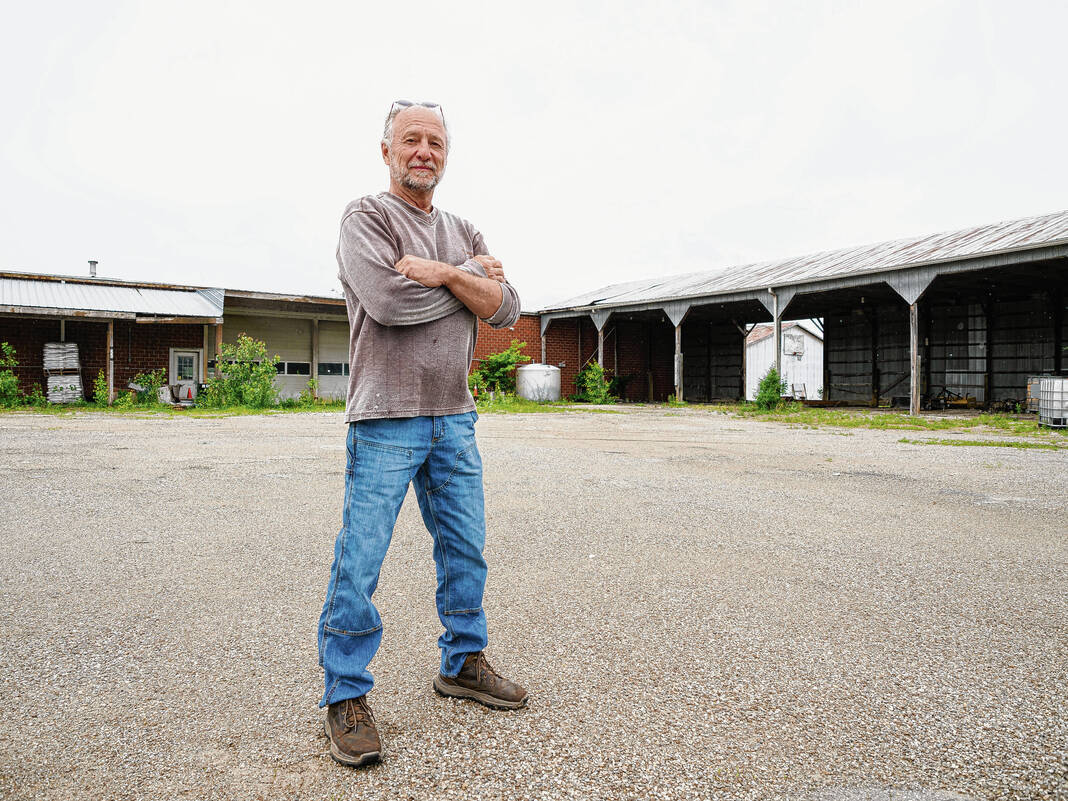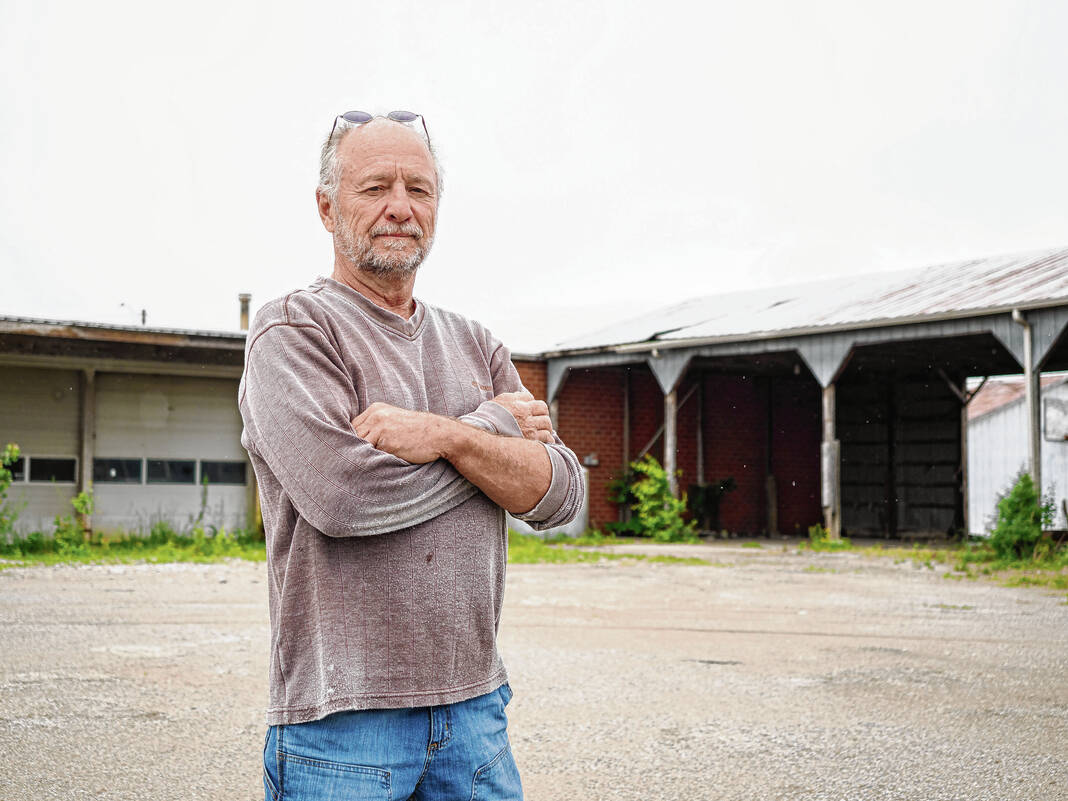
Mike Wolanin | The Republic Jim Elkins poses for a photo in the lot behind the old county highway garage in Columbus, Ind., Thursday, May 22, 2025. Elkins is helping with efforts to manufacture pallet homes in Columbus.
Rain pattered down on the gravel at the former county highway garage on the city’s east side as Jim Elkins peered around, assessing the site.
Elkins, now retired, spent more than 50 years doing electronics work for local car dealerships, mainly in Columbus and Bloomington.
These days, he volunteers a lot of time helping the city’s unhoused population, feeding and providing them resources. And recently, he’s been making efforts to do what he can to bring some sort of tiny home village to Columbus, a place where people experiencing homelessness could stay and get connected with services.
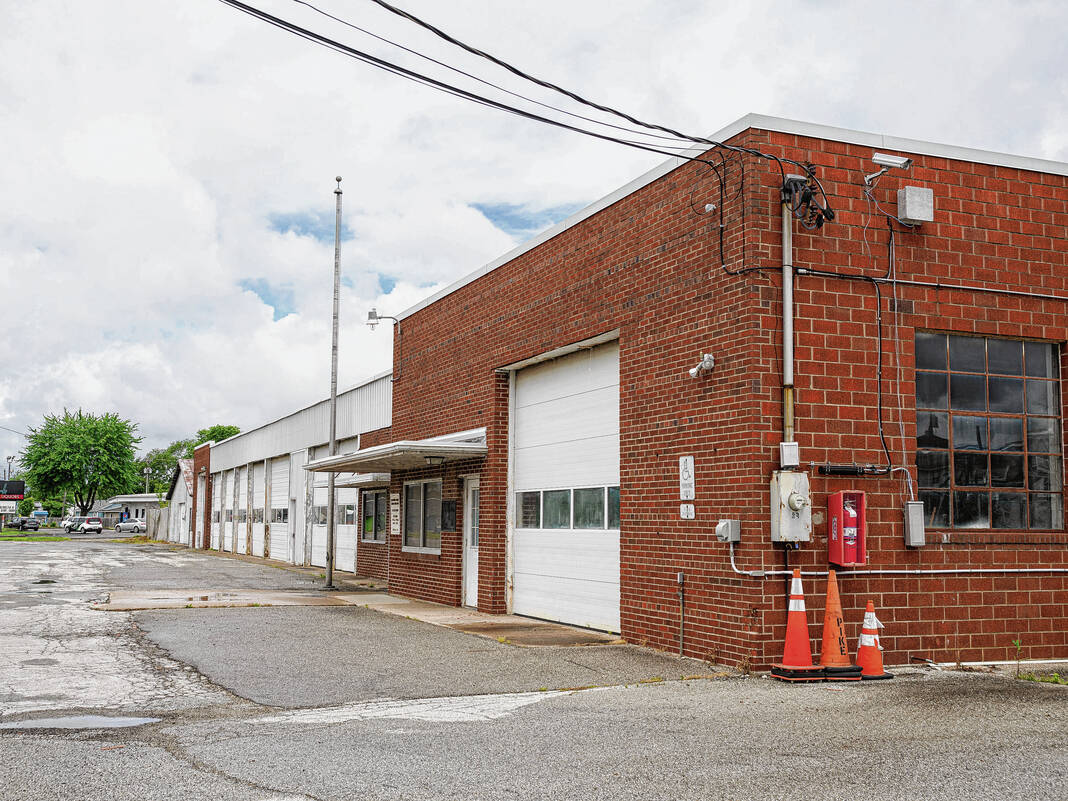
“You could put 100 in if you want to. You could put 50 here, easy,” Elkins said, speaking while standing inside the fence at 2452 State St., where the county highway department had operated a garage until 2022. “That could be the church, you could put a kitchen, community room, bathroom, shower, laundry— all that could be in there.”
The property was purchased from the county by the Columbus Redevelopment Commission last year. It’s mostly unused right now— county highway is still using the salt barn there until the fall.
During a Columbus City Council meeting on May 20, Elkins told the council he thought 2452 State St. or a city-owned property at 625 Water St. would be possible locations for a tiny home village.
However, if a tiny home village does come to fruition, it is unlikely it would be at either of the two spots for a variety of reasons, city officials said. The State Street property has environmental remediation challenges, and redevelopment previously indicated it could be the site of some sort of affordable housing project.
Even if there was a settled-upon site, several hurdles remain including zoning restrictions and perhaps most of all, funding.
However, Elkins is doing what he can to bring attention to what he says is a dire need.
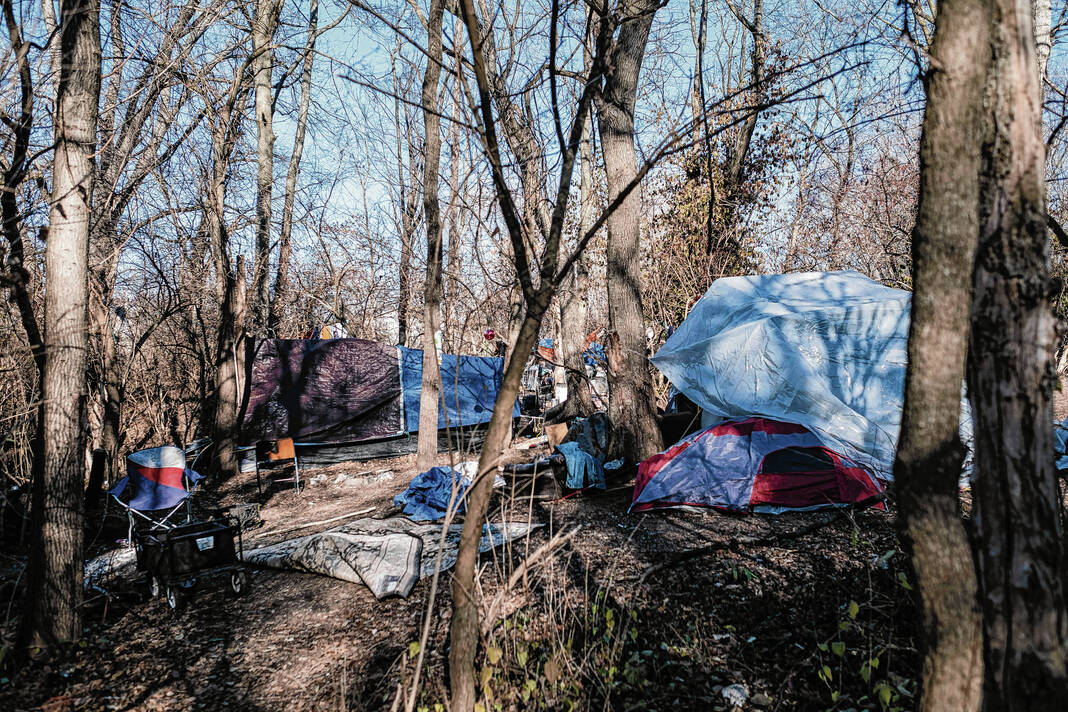
Last year, he wanted to put himself in the shoes of the city’s unhoused population and spent five nights camping with them in Noblitt Park. It’s something he says he plans to do again soon.
On the Water Street property, a tent sits in the near distance. Elkins knows the person staying in there by name.
“If they’re worried about getting run out of their tent campsite because they’re not legal, then how can they go and worry about getting a job and the services they need? They’re looking over their shoulder. I said, ‘this ain’t right.’ They need a place to call home,” he said.
Homelessness initiative
Mayor Mary Ferdon’s administration, with support from city council members, launched a homelessness initiative in 2024 led by United Way of Bartholomew County. Supplied with $500,000 of federal American Rescue Plan (ARP) funding, the initiative aims for homelessness in the community reach a state of “functional zero,” meaning more people will be escaping homelessness each month than those who become homeless. Another key component is that homelessness is rare, brief and non-recurring, United Way officials have said.
The $500,000 was directed towards funding four homelessness-specific initiatives, including a rental assistance and homeless response team, supportive housing, eviction prevention and a street social worker program.
The largest portion of the funding — $300,000 — is earmarked for supportive housing that could be used by United Way in the manner they chose. It could be used as matching grant funds for a larger supportive housing project, or a more scaled down version, according to Eric Frey, the city’s executive director of administration.
The idea of a tiny home village was far-and-away the most popular idea during a community input session regarding the homelessness initiative last year. Attendees were given tokens to vote on potential solutions for homelessness the group found interesting.
“I think they’re kinda cool,” said Mark Stewart, president of United Way of Bartholomew County, on the popularity of tiny home villages. “… It’s just kind of a compelling concept. I think it also is appealing because it gives people a manageable, affordable space that is their own.”
“It’s also private,” Stewart continued. “If you are camping in the woods in a tent, you don’t really have that privacy and you are vulnerable to all sorts of different things. Whereas when you have an established residence of a tiny home, it’s manageable.”
A tiny home village is a community made up of small, typically standalone housing units— often between 400 and 500 square feet— that increasingly are being used as transitional housing for people experiencing homelessness.
A United Way report on homelessness locally, released in November of last year, found that about 140 people are unhoused on any given night in Columbus. Of those, about 80 spend the night at local shelters. However, officials have said those figures are “likely an undercount.”
The report found that several factors are contributing to homelessness and housing insecurity in Columbus, including a significant lack of rental housing available for less than $700 a month, and an even greater shortage of rental housing below $500 a month.
Reflective of that, the report stated that more than 2,500 families in Columbus pay more than half of their monthly income toward housing.
“It is very difficult—very difficult— to find an affordable place in Columbus that will rent $400 to $500,” Stewart said. “… But if we don’t find affordable options for people, there’s a good chance that people are going to be homeless again. At the end of the day, homelessness is an issue of a lack of affordable housing. It’s not just that, but that’s the biggest piece of it.”
Since the homelessness initiative began, 51 people who were formerly unhoused have been rehoused. Another 40 have been prevented from becoming unhoused in the first place, Stewart said.
Many of the people who were formerly unhoused had been for quite a while— at least a year in some cases.
“The longer someone is homeless, the more difficult it is, and the more resources it takes and the more challenges there are, to get them rehoused,” Stewart said.
In turn, the longer someone is unhoused, the more short-term their decision making gets, making the path back even more challenging.
“It’s not even: ‘What good for me next week,’ not even ‘What’s good for me tomorrow,’ it’s ‘What’s good for me right now,’ ” Stewart said. “And sometimes that get exacerbated by mental health concerns and also sometimes with substance misuse. Those three all exacerbate each other.”
“If you are living in a tent, your desire to use substances is going to be increased just to cope with the situation. And the longer that goes on, the more difficult it becomes,” Stewart said.
Another solution?
The type of tiny homes Elkins had mentioned to the city council are Pallet Shelters, a product from a Washington-based public benefit corporation, that come as small as 70 square-feet.
“Our temporary shelter model provides dignity, safety and offers respite to unsheltered people as they transition from the streets into permanent housing,” a description on the Pallet website says.
The shelters require limited site infrastructure, have no permanent foundation and are said to last 15 to 20 years.
There are 116 such Pallet villages across the country— providing those living there the privacy, security and dignity of their own personal space. It allows them to leave their personal items and pets to pursue employment or treatment programs, and gives them a mailing address, enabling them to apply for benefits.
In terms of a site, it would need to be located near essential services such as grocery stores and employment opportunities, and have required physical characteristics. The site would need to be flat, come equipped with appropriate spacing and fire code approvals and have access driveways for emergency services.
The Pallet Shelter website notes that five key groups need to be involved in making their shelter model possible: government staff, elected leaders, local service providers, the fire marshal and building and safety officials.
That’s in part what brought Elkins to the council meeting in May. He had met individually with Columbus City Council President Frank Miller, R-District 4, who said he’s tried to connect Elkins with the right people to help his effort including Stewart.
“I was wanting to create a village for everyone that all the homeless could come to and be in one place and be able to receive all of the services that they can get,” Elkins said.
He found the former county highway garage suitable because its access to nearby services and a bus line, along with the structures on the site that could serve as protection from the elements.
“We just need some land. It doesn’t have to be 2452 State St., it doesn’t have to be 625 Water St., but it needs to be something before this winter is what I feel,” Elkins said. “… I’d volunteer to run it and I’ve devoted my life to this, and I’m retired now so I’ve got the time to do it.”
Elkins already has envisioned some details for what a potential Pallet community would look like. Those staying there would have to earn it, he said, and have some type of job to do.
“I thought about even doing like a chicken farm and getting eggs and then selling them,” Elkins said, also mentioning some sort of cleaning crew he thinks would be a good idea, that would assist in cleaning out old encampments and helping keep the People Trail tidy.
“That would save the city a lot of money,” he said.
The Pallet Shelter units Elkins is looking at— the S2 Sleeper shelter, which is 70 square feet, are not cheap. They’re about $16,000 a piece, and 50 of them would cost around $800,000.
“I’m hoping to find somebody with deep pockets,” he said with a knowing laugh.
Elkins said he felt a calling during Easter 2023, which compelled him to begin volunteering at Brighter Days. He said his church, Blessed Life Fellowship, has encouraged him to do more, and he’s looking at going into the ministry.
“I’m going to give back a little bit, the Lord’s been pretty good to me,” he said.
Stewart, for his part, “certainly appreciates Jim’s passion for this. As much as anyone else in our community, he really wants to make a difference for folks.”
A tiny home village on a permanent foundation would be more viable long-term, and is something that Stewart said may be a better fit.
“Can it be a viable solution? Maybe,” Stewart said of the Pallet shelters. “But there’s a lot of obstacles to overcome to get there. My personal preference is, if we were to go forward and were evaluating it, would be tiny homes on a permanent foundation, which is basically just a traditional house that just happens to be small.”
Stewart mentioned Emerald Village in Eugene, Oregon as an example of what he said could be a useful solution.
“It’s actually styled in kind of a co-op, so people are building a little bit of equity into a co-op model that gives them some money to move forward. But conceptually, the tiny house village is definitely in the mix and we continue to look for an appropriate site where we might be able to bring a concrete proposal of something that our community would feel really good about and be proud of.”
When one think of an unhoused person, a lot of people get a very similar image in their mind of what that looks like, Stewart said.
“There is absolutely a segment of the population who are homeless who look like that. But that’s maybe 20% of the entire population that is homeless.”
Of the people that have been rehoused through the initiative, Stewart said 58% have had jobs, but were still unhoused.
“There are people all across the spectrum— people that work in our local businesses, in professional offices, who are homeless. People who work in restaurants who are homeless. People who work in our factories who are homeless.”
As part of the initiative, United Way is also working proactively with CPD, code enforcement and public works to address some encampments and particular areas around the People Trail and in public parks. Stewart said they also work closely with a group of landlords to accommodate people as they move into housing, and with the Community Engagement Center for case management purposes.