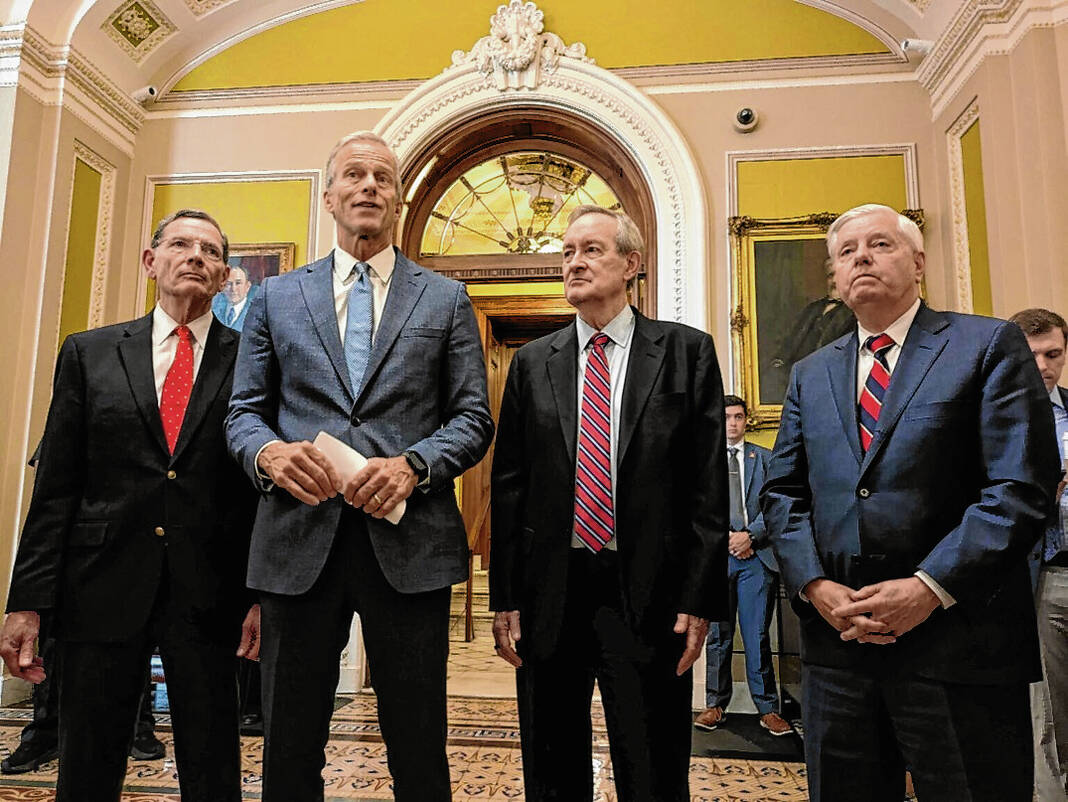
Photo by Ashley Murray/States Newsroom Republican Sens. John Barrasso of Wyoming, John Thune of South Dakota, Mike Crapo of Idaho and Lindsey Graham of South Dakota speak to reporters after passage of their sweeping tax break and spending cut bill on Tuesday, July 1, 2025.
WASHINGTON — U.S. Senate Republicans approved their signature tax break and spending cuts package Tuesday with a tie-breaking vote cast by Vice President JD Vance, following days of tense, closed-door negotiations that went until the few last minutes of a marathon amendment voting session.
The 51-50 mostly party-line vote sends the legislation back to the House, where GOP leaders hope to clear the bill for President Donald Trump’s signature this week. But frustrations throughout the conference over changes made in the Senate could delay or even block final approval.
Republican Sens. Susan Collins of Maine, Rand Paul of Kentucky and Thom Tillis of North Carolina voted against approving the legislation over concerns it would not benefit the country’s finances or Republican voters.
Changes made in final negotiations were not immediately clear or publicly available.
Majority Leader John Thune said the passage marked “a historic day.”
“We’re very excited to be a part of something that is going to make America stronger, safer and more prosperous, and it really starts with the agenda that President Trump laid out when he was running last year.
“He talked about modernizing our military, securing our borders, restoring energy dominance in this country, bringing tax relief to working families and low income taxpayers in this country, and doing something about the runaway, spiraling spending and debt,” the South Dakota Republican said minutes after the vote.
“So this was an incredible victory for the American people, and we as a team are delighted to be a part of it.”
The bill now heads back to the House. The chamber’s Committee on Rules is expected to meet Tuesday afternoon, which will be the final stop for the bill before it reaches the House floor.
Thune said he believes Senate Republicans have given the House “a really strong product.”
“I think we took what they sent us and strengthened and improved upon it. And so I’m hopeful that now, when it gets sent over there, as they deliberate about how they want to handle it, we’ll find the votes that are necessary to pass it and want to put it on the president’s desk,” he said.
House Speaker Mike Johnson issued a joint statement with House Republican leaders saying the chamber “will work quickly to pass the One Big Beautiful Bill that enacts President Trump’s full America First agenda by the Fourth of July. The American people gave us a clear mandate, and after four years of Democrat failure, we intend to deliver without delay.”
“Republicans were elected to do exactly what this bill achieves: secure the border, make tax cuts permanent, unleash American energy dominance, restore peace through strength, cut wasteful spending, and return to a government that puts Americans first,” the Louisiana Republican said in the statement that included House Majority Leader Steve Scalise of Louisiana, Majority Whip Tom Emmer of Minnesota and conference chair Lisa McClain of Michigan.
Trump did not immediately release a statement, but the White House posted a message on social media reading “MAGA VICTORY.”
Alaska Sen. Lisa Murkowski , whose support had been unclear until the vote, and Majority Whip John Barrasso, of Wyoming, left the chamber to catch an elevator together just after 9:30 a.m. Eastern.
Asked if the bill was in the hands of the parliamentarian, Murkowski quipped, “I think it’s in the hands of the people that operate the coffee machine.”
Flooded by reporters after the vote, Murkowski said “we do not have a perfect bill by any stretch of the imagination.”
“My hope is that the House is gonna look at this and recognize that we’re not there yet, and I would hope that we would be able to actually do what we used to do around here, which is work back and forth in the two bodies to get a measure that’s gonna be better for the people in this country and more particularly, for the people in Alaska,” she said.
“This is probably the most difficult and agonizing legislative 24-hour period that I have encountered, and I’ve been here quite a while, and you all know I’ve got a few battle scars underneath me,” Murkowski added. “But I think I held my head up and made sure that the people of Alaska are not forgotten in this, but I think that there is more that needs to be done, and I’m not done.”
“I am gonna take a nap, though,” she said.
When asked about Murkowski’s decision to vote for the bill, Thune said, “She, as you know, is a very independent thinker and somebody who studies the issues really, really hard and well. And I’m just grateful that at the end of the day, she included what the rest of us did, or at least most of the rest of us did, and that is that this was the right direction for the future of our country.”
Democrats react
Senate Democrats walking off the floor seemed somber, a sentiment that Senate Leader Chuck Schumer said also extended to Republicans after the bill’s passage.
“On the Republican side, when the bill passed, there was a bit of somberness that I don’t think was expected, and that’s because they knew deep in their hearts how bad this bill is for them, their states and the Republican Party,” Schumer said.
“When people start losing their Medicaid, when they start losing their jobs, when their electric bills go up, when their premiums go up, when kids and parents lose SNAP funding, the people of America will remember this vote,” the New York Democrat continued.
Criticism poured in from others as well, including the nonpartisan Committee for a Responsible Federal Budget, which likened the Senate’s bill passage to jumping “off a budget cliff.”
“The level of blatant disregard we just witnessed for our nation’s fiscal condition and budget process is a failure of responsible governing. These are the very same lawmakers who for years have bemoaned the nation’s massive debt, voting to put another $4 trillion on the credit card,” the organization’s president Maya MacGuineas said in a statement.
CRFB estimates the Senate version of the bill would add $600 billion to the national deficit just in 2027.
The nonpartisan Congressional Budget Office released a calculation Sunday showing the bill would add $3.25 trillion to deficits over 10 years.
Trump told reporters on Tuesday morning before leaving for a Florida visit to the “Alligator Alcatraz” immigrant detention site that “it’s very complicated stuff” when asked about Senate Republicans’ debate over spending cuts.
“We’re going to have to see the final version. I don’t want to go too crazy with cuts. I don’t like cuts. There are certain things that have been cut, which is good. I think we’re doing well,” Trump said. “We’re going to have to see, it’s some very complicated stuff. Great enthusiasm as you know. And I think in the end we’re going to have it.”
The heart of the nearly 1,000-page legislation extends and expands the 2017 tax law to keep individual income tax rates at the same level and makes permanent some tax breaks on business investments and research and development costs.
The bill would also put in motion some of Trump’s campaign promises, including no tax on qualifying tips, overtime or car loan interest, but only for a few years.
And it slashes spending on the Medicaid program for low-income people and some people with disabilities as well as shifting significant costs of the federal Supplemental Nutrition Assistance Program, or SNAP, to states for the first time. It also overhauls federal education aid.
It would also bolster spending on border security and defense by hundreds of billions of dollars, including line items for the “golden dome” missile defense system and additional barriers along the southern border.
The measure would provide a substantial funding increase for federal immigration enforcement for detention and removal of people without permanent legal status, aiding the president in carrying out his campaign promise of mass deportations.
The bill would raise the debt limit by $5 trillion, a figure designed to get Congress past next year’s midterm elections before the country would once again bump up against the borrowing limit.
House approval is far from guaranteed.
Johnson can only lose four Republicans if all lawmakers in that chamber attend the vote. Several GOP members have voiced frustration with how the Senate has reworked the legislation, signaling an uphill climb for the bill.
House Ways and Means Chair Jason Smith said as he left the Senate cloakroom just after 9:20 a.m. Eastern that lawmakers are “getting closer to a bill signing on July Fourth.”
“If you followed this journey over the last six months, over and over, people said that we could not accomplish a budget (reconciliation bill). We did. They said we would never pass it out of the House. We did. The Senate is going to pass it. The House is going to pass it, and the president’s going to sign it into law,” the Missouri Republican said.