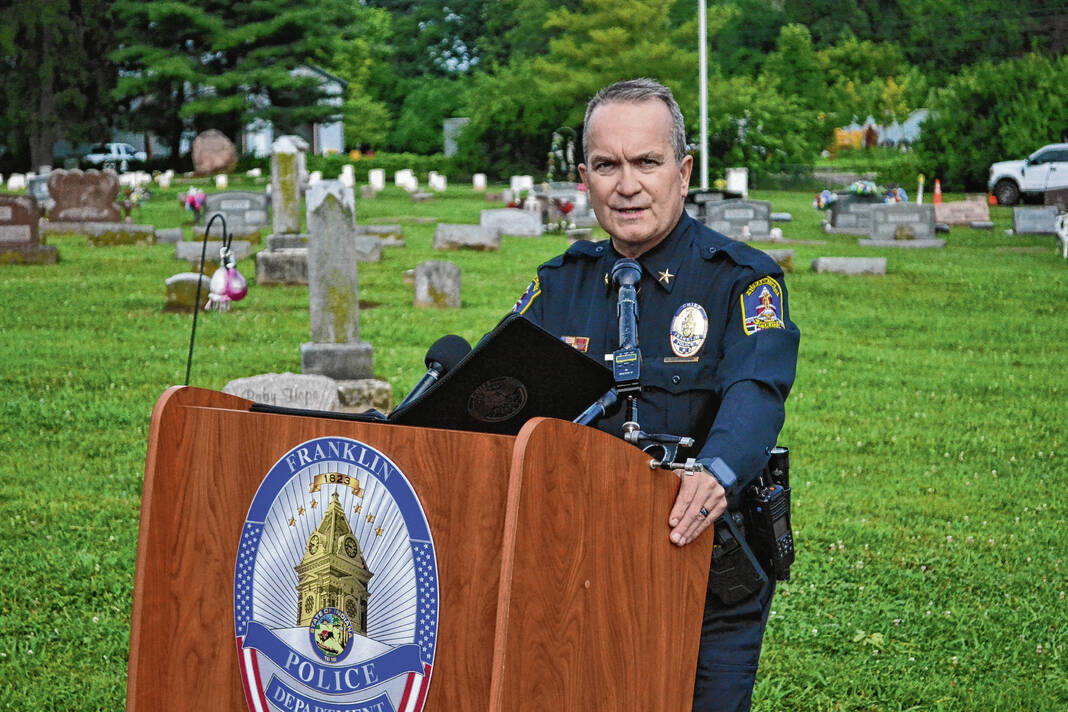
Franklin Police Chief Kirby Cochran gives an update on the Baby Hope investigation Monday at Greenlawn Cemetery. A cold case for more than 30 years, police have finally identified the parents of the newborn child found stabbed to death in a Temple Park trash can.
Noah Crenshaw | Daily Journal
By Noah Crenshaw | Daily Journal
ncrenshaw@dailyjournal.net
For The Republic
FRANKLIN, Ind. — The parents of the baby girl whose murdered body was found inside a trash can at a Franklin park in 1994 have finally been identified.
Franklin Police, joined by the Johnson County Coroner’s Office and Franklin Mayor Steve Barnett, held a press conference at Baby Hope’s gravesite in Greenlawn Cemetery on Monday to update the public on the investigation into her death. Two boys were searching through a trash can in Temple Park for aluminum cans to recycle on April 13, 1994, when they discovered the body of a newborn infant who had been stabbed to death shortly after her non-clinical birth.
The murder of Baby Hope — the name police gave to the unidentified girl — shook the Franklin community. Franklin residents were horrified by the death and donated funds so Baby Hope would have a proper funeral and burial. She was buried in Greenlawn Cemetery in Franklin.
The identity of Hope’s parents — and the motive for killing her — have remained unknown since. But part of the mystery was recently solved, officials said at Monday’s press conference.
Franklin Police’s investigation was reopened in 2019, putting new eyes, staff and detectives on the case. With the advanced support of DNA technology, investigators were able to use genealogy to identify Baby Hope’s mother, said Kirby Cochran, police chief.
With assistance from the Indiana State Police Crime lab and the dedicated work of detectives, Baby Hope’s biological mother has been identified as Cheryl Dawn Larson, who would’ve been around 31 years old at the time of Hope’s death. Cheryl Larson and her then-husband Richard N. Larson lived near Temple Park in 1994, Cochran said.
Certain things about the case may never be known — including why Hope was killed — as Cheryl Larson died in 2018, a year before the investigation reopened, Cochran said.
After identifying Baby Hope’s mother, the investigation gained momentum. Investigators soon discovered that Richard Larson was not Baby Hope’s father, said Lt. Chris Tennell, who was speaking on behalf of the investigative team.
Detectives interviewed Cheryl Larson’s friends and neighbors from 1994, along with members of her family. Through additional interviews and DNA testing, Baby Hope’s father was positively identified as Paul R. Shepherd, who has been cooperative with investigators, Tennell said.
Paul Shepherd was given the opportunity to name the infant. He named her Hope Shepard, in honor of the name given to her by the Franklin community, Tennell said.
Paul Shepherd was not present at Monday’s press conference, but he did provide a written statement that was shared with the media. He voluntarily gave his DNA to police, and was “shocked and grieved” when he learned he was Hope’s father, the statement says.
He was “completely unaware” that Larson, with whom he had a brief relationship, was pregnant with his or anyone else’s child.
“Mr. Shepherd continues to struggle with the grief which has exacerbated his health conditions and from which he can find no relief,” the statement says. “The very thought that a child fathered by him was subjected to such evil is one he cannot escape from.
“Please understand the anguish this causes him and his family and the pain any discussion of the matter brings. He has no answers which shed any light on the murder of his child and no relief from the grief he endures from the unknown. Please respect the privacy of he and his family, it only brings them more suffering,” the statement continues.
With Cheryl Larson’s death, Franklin Police are unable to get further information on her involvement in Hope’s death. There are no formal charges that can be filed at this time, Tennell said.
“Circumstances are beyond the control of investigators, preventing further advancement in this case,” he said. “Following a thorough review of known facts and circumstances, formal charges will not be filed at this time. If new information emerges, the matter may be reconsidered.
“This is not a closed case. We needed to share this information with the community,” Tennell continued.
While police remained “deeply saddened by the tragic and unjust loss of Baby Hope,” they are grateful to finally achieve some degree of closure after 31 years, he said. Investigators thanked the ISP crime lab and Parabon NanoLabs, a Virginia-based DNA technology company, which assisted with the case.
For the Baby Hope investigation, Parabon submitted a genetic data profile created from the unknown crime scene DNA sample to a genetic genealogy database for comparison in hopes of finding individuals who shared significant amounts of DNA with the unknown subject. These genetic matches served as clues to inform traditional genealogy research, like creating family trees, before going into descendancy research to enumerate the possible identities of the unknown subject, according to Parabon.
Other information, like age, location, triangulation between matches, and ancestry and phenotype predications were used to narrow down the possibilities before a final list of leads was produced, according to Parabond. Franklin Police then used traditional police work to continue the investigation, eventually discovering that Shepard was Hope’s father.
Parabon uses information from publicly available genetic genealogy databases, like GEDmatch and Family Tree DNA, for its analysis. No private DNA databases were used, Tennell said.
With the identification of Baby Hope’s parents and her remains, there are no remaining unidentified remains at the Johnson County Coroner’s Office.
“That DNA process that that we use today is is magnificent, but in this case, it’s only a partial answer, because we still have open questions to where we need to get and DNA is not going to answer those questions for us, necessarily — it’s the public,” said Mike Pruitt, Johnson County coroner. “If this stimulates any information, any thoughts that you can bring forward to law enforcement to help us bring complete closure to this case.”
Franklin Mayor Steve Barnett said he appreciates the work and dedication Franklin Police has had for 31 years on the Baby Hope investigation.
“Now we have a baby, that’s over here, that has a name. I think that’s pretty remarkable for our team, and says a lot for the city of Franklin,” Barnett said.
The answers police were able to provide Monday are not what they hoped, but they bring a little more closure for the community, Cochran said. He expressed gratitude to his department and the “many others” who worked relentlessly on the case.
“This breakthrough underscores the Franklin Police Police Department’s unwavering commitment to seek justice for all victims, regardless of the time that’s passed,” Cochran said. “As we continue to seek answers, just know we will not stop. I thank you all for coming today, and we appreciate our community support.”