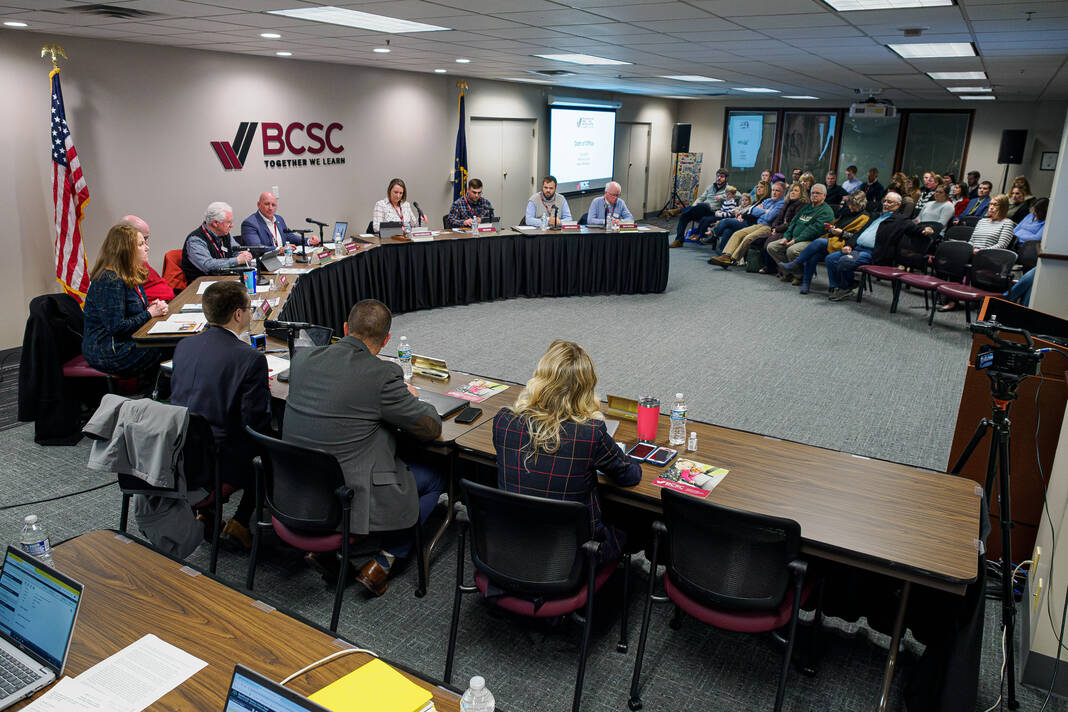
Mike Wolanin | The Republic The Bartholomew Consolidated School Corporation School Board holds their first meeting of the year at the BCSC building in Columbus, Ind., Monday, Jan. 14, 2025.
Bartholomew Consolidated School Corp. school board members gave initial approval to a fifth batch of policy changes as part of an ongoing consolidation process. The policy changes touch on topics including non-discrimination, school visitors and employee benefits. The batch also included two new policies: one related to distracted driving and another outlining guidelines for the amount of cash the district should have on-hand at a given time.
The policy packet replaces or consolidates all or part of 44 current policies, Superintendent Chad Phillips said.
The board gave unanimous approval 6-0— school board member Dale Nowlin, District 4, was absent because he was on the Appalachian Trail raising money for Bartholomew Consolidated School Foundation (BCSF).
The policies need to be approved twice over to be finalized. The second reading for the policies will be during the next school board meeting on Aug. 11.
The batch was posted on BCSC’s BoardDocs page on July 4 and were available for review longer than the typical two-week time frame before board consideration, Phillips noted.
But since that time, Indianapolis-based firm Church Church Hittle and Antrim, who the district hired to update polices based on state and federal legislative changes, updated a couple of them to align with recent state legislation.
Those included changes to B150: Organization to increase the number of days after the start of a new year when the school board elects officers and to A100: Non-Discrimination & Anti-Harassment, to remove references to “gender,” while leaving “sex,” among other language changes.
The district’s amount of cash reserves have been the subject of much conversation, particularly on behalf of members Jason Major, District 1, and Logan Schulz, District 6.
Phillips said the new policy “gives the public parameters for what we’re going to follow when it comes to budgeting and cash management.”
The policy would help the district’s business office know the expectation of the board ahead of budget time, maintain stability in the event of unexpected expenditures, while also providing for sufficient liquidity to pay the district’s bills. Phillips also said it signals to credit agencies and bond investors that the district has strong financial controls in place.
The policy states that the district’s operating funds— made up of BCSC’s education fund, operations fund, and operating referendum fund— will have a minimum balance of 13.5% of a given year’s budgeted expenditures to a maximum of 19%.
That amounts to between two months and two months and three weeks of payroll for district employees.
The district’s rainy day fund, which is untouched without action of the school board, will be between 4% and 6% of annual operating fund expenditures, meaning a total between 17.5% and 25% of annual budgeted expenditures on reserves across the two buckets.
The ranges don’t deviate from how BCSC has already been operating, Phillips said.
The amount of cash the district has in reserves fluctuates throughout the year, depending on when property taxes are dispersed and when BCSC’s 26 pay periods take place.
School board member Whittney Loyd, District 3, asked why BCSC has higher target balances than recommended by the state.
“The state brings in revenue on an ongoing basis, every day, every week, from sales taxes, property taxes— all of that revenue is flowing all of the time,” Phillips said. “For us, we receive distribution once a month in the education fund, and then in the other two funds (operations fund and operating referendum fund), once every six months.”
Phillips said if there’s a three-pay period month that comes before the district gets their property tax distribution, for example, that “that cash can get pretty low.”
Another notable policy given initial approval was H100: School Visitors and Parent-Family Engagement. The policy itself didn’t change from what it replaced, according to BCSC officials.
What has changed were student handbooks that, before this past school year, stated parents were asked to not attend lunch in elementary schools.
Schulz said that the handbooks were previously in conflict with standing policy.
The following are all the policies included in the batch:
A100: Non-Discrimination & Anti-Harassment
A285: No Distracted Driving
B150: Organization
C400: Use of Restraint & Seclusion with Students
C475: School Sponsored Publications and Productions
D425: Employee Benefits
E125: Promotion, Placement and Retention
F350: Cash Balance Policy
G275: Animals on Corporation Property
G375: Use of School Facilities
H100: School Visitors and Parent-Family Engagement