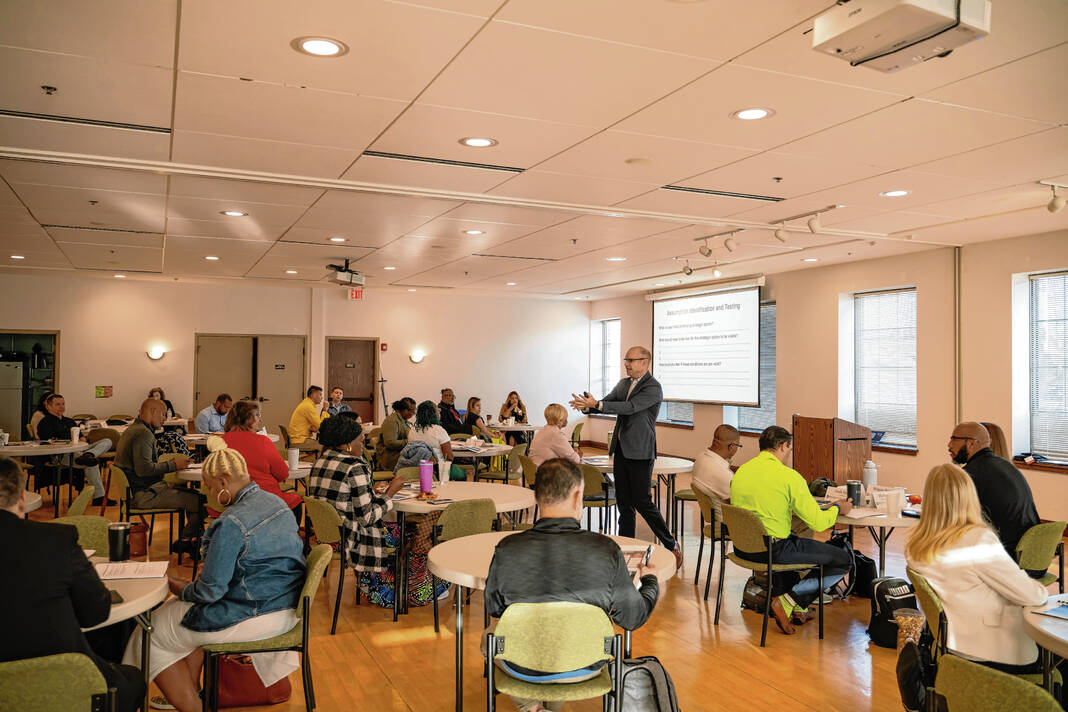
Greg Fisher, the Larry and Barbara Sharpf Professor of Entrepreneurship at IU Kelley School of Business, center, teaches business strategy, one of four short courses taught by Kelley faculty through Enterprise Corps.
Submitted photo by Antonio Chapital
By Noah Crenshaw
Daily Journal
For The Republic
Indiana University officials are seeking applicants for its Enterprise Corps, a business accelerator program that helps established small businesses thrive.
The Kelley School of Business launched the Enterprise Corps in 2021 in partnership with the Indy Chamber with the goal of helping small businesses in the greater Indianapolis area navigate the challenges resulting from the coronavirus pandemic in 2020. The idea sprouted from a series of webinars the Kelley School of Business held to help businesses as they figured out how to reopen, said Phil Powell, executive director of the Indiana Business Research Center and a clinical professor of business economics at the Kelley School.
“We realized we were delivering a lot of value,” Powell said. “So from that experience during COVID, we wanted to institutionalize a program that brought the Kelley School directly to small business owners, and that’s how Enterprise Corps started.”
To date, the Enterprise Corps has aided 191 companies in the state, primarily in central Indiana, adding tens of millions of dollars of revenue to the companies, Kelley School officials say.
One of these companies is L&K Salazar Cleaning, a family- and women-owned cleaning business based out of Greenwood. Owners Gloria and Leslie Salazar took part in the program last year. They gained skills to help their business grow and become more profitable.
“Everything changed after we started with that program,” Gloria Salazar said.
Starting with a question
The Enterprise Corps started with a pilot asking questions such as “Can faculty work with businesses to advance their growth and profitability?” Kelley School faculty knew they worked well with students, so they proposed working with business owners directly. The idea was to match 10 faculty with 10 small businesses in Indianapolis, with the challenge being to come up with an idea that would successfully increase the businesses’ operational cash flow in the first quarter of 2021, Powell said.
“We got through the project and about half of them were successful, half of them were not,” he said. “Well, a 50% success rate in business startups is pretty good, so we knew we were on to something.”
With this knowledge in hand, the program as it is today began to take shape later in the summer of 2021. Kelly School faculty matched small business owners with masters of business administration, or MBA, consulting teams, Powell said.
For this, 20 to 22 teams of four to five MBA students from the school’s evening program at IU Indianapolis were matched with small business owners for 10 weeks. These teams helped each business owner identify a barrier to growth or engage with an opportunity for growth, he said.
It was very successful, Powell said.
“We realized that not only could we help the businesses with MBA consulting teams, but we can help the businesses with courses — short courses, not long courses where they have to come for a semester — but for a few days, they come to campus and we give them our best faculty; we designed the curriculum to be very practical so that they could immediately apply it when they left the classroom,” he said.
Kelley School faculty decided to add this to the MBA consulting program. They received grant money to pay for it, testing it out with two versions of the same business strategy class in the fall of 2022. Faculty tracked the businesses that came out of these two classes, and the businesses saw revenue growth of over $20 million in the first 18 months since — growth the businesses attributed to the courses, Powell said.
Companies have “generously funded” the program too, allowing the school to deliver most, if not all, of the program with full scholarships, Powell said. Supporters of the program include the Indy Chamber and Cummins.
Now, the school is adding a business coaching practice that formally expands the role faculty play in helping businesses, Powell said.
‘Business has essentially doubled’
The courses Gloria and Leslie Salazar took as part of the Enterprise Corps have had an impact on their business, they said.
Gloria Salazar started her cleaning business in 2008 after being laid off from another job, with daughter Leslie helping out as well. Leslie had been helping her mother transition the business’s bookkeeping to digital software when they learned about the Enterprise Corps from Marcela Montero, director of the Hispanic Business Council at the Indy Chamber.
Leslie Salazar had her own small business, but knew she wouldn’t be eligible for the program based on the income requirements. But she knew her mother would be, so she got her connected with Marcela and Gloria got enrolled. Leslie took the classes with her mother as well, learning about business finances and connecting with other business leaders, she said.
“Since we started like nine months ago, my mom’s business has essentially doubled, which has been insane, just from just implementing some tips that they had, and moving it digitally and just connecting with other business owners. It really has helped us grow,” Leslie Salazar said.
Gloria Salazar was initially concerned that the language barrier would hinder the learned experience, Leslie Salazar said. But there were other Latino-owned businesses there, and the program felt very inclusive, she said.
Her mother learned a lot from the program, and Leslie Salazar has seen her mindset shift as she’s become more comfortable with being a business owner, she said.
The importance of small businesses
The Enterprise Corps program is also inspired by a priority of IU President Pamela Whitten; service to the state. One of the best ways to contribute to the state and to regional economic development is to ensure the success of small businesses, Powell said.
“Small businesses are the fuel of economic growth in any community, and so this is an intentional investment by Indiana University and the Kelley School of Business to contribute to probably the most important part of any industry in any region of the state,” Powell said.
For small businesses to be successful, they need three things — capital, knowledge and a network. The Kelley School delivers knowledge that allows business owners to make better decisions, which in turn, can keep costs down and make them more attractive to customers, he said.
At the end of the day, the Kelley School is focused on helping these businesses grow. They don’t consider themselves successful unless the business can go out on its own and apply the knowledge learned to do so, Powell said.
“When you grow revenue, all sorts of stuff follow, right?” he said. “The business owner makes more money. They can employ more people in the community. They can pay their workers more, they can better serve customers, and they can enhance the competitiveness of Indiana industries.”
The program is beneficial for MBA students as well as they can apply their knowledge to a real business in real time, Powell said.
“It’s one thing to solve a problem in classroom where everything is well-defined and clean, but it’s another to be to have to deliver it in a course where the problem is messy,” he said.
The Enterprise Corps also serves as part of the capstone for the evening MBA program, serving as the last experience the students have before they graduate. The students are working professionals who live in the greater Indianapolis area who want to give back, Powell said.
Seeking applicants
For the 2025-26 cohort of small to mid-size businesses, the Kelley School has 50 scholarships available, which will be awarded over the next three weeks. These pay the program fee for businesses, leaving the businesses to only pay an $89 hospitality fee per course, Powell said.
This gives them access to four courses, and then they become part of Enterprise Corps, which also makes them eligible for the MBA consulting projects and coaching, Powell said. Each course is two nights online and two days in-person.
Business owners who meet income requirements and have been operating for at least two years are eligible to apply. It’s a business accelerator program, not a business incubator program, Powell said.
“There’s a lot of incubators around that specialize in startups,” he said. “This exists to help established small- and medium-sized companies that have a lot of potential figure out how to meet their potential because they might be stuck, or they might be scratching their head, figuring out, ‘We know we can grow, but we just don’t know how.’ Well, Enterprise Corps. exists to help them figure that out.”
Businesses must also have an annual revenue between $250,000 and $10 million, be registered with the state of Indiana, and have a minimum of two employees — not including the business owners.
The working application deadline is Aug. 20, though the Kelley School is admitting applicants on a rolling basis. Earlier applications thus have a higher chance of acceptance than later ones, Powell said. The first course begins in September.
To learn more about the program and to apply, go to iu.co1.qualtrics.com/jfe/form/SV_1za54AwZb4Ps0iq.