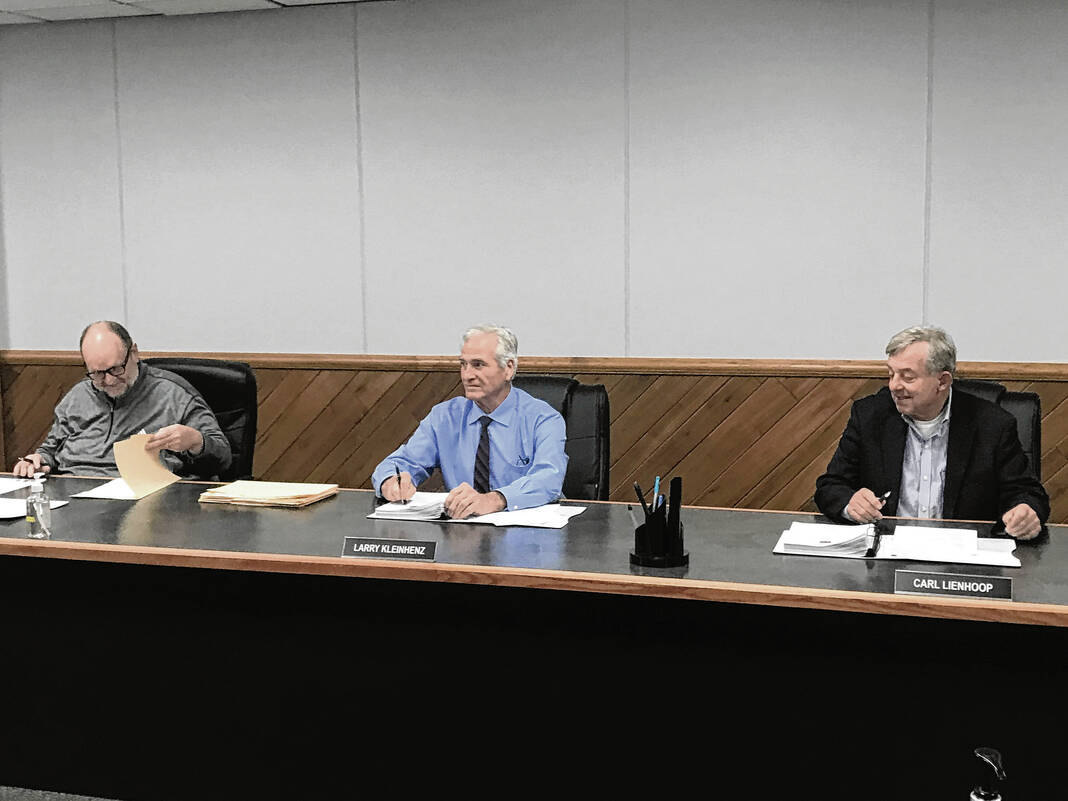
Bartholomew County officials on Monday approved an agreement with a financial advisory firm that will do an analysis to inform budgetary decisions the Bartholomew County Council will have to make as a result of changes enacted by Senate Enrolled Act (SEA) 1.
The Bartholomew County commissioners signed an agreement with Reedy Financial Group for an amount not to exceed $20,000.
According to the commissioners, $15,000 of the agreement is going towards a county-specific analysis, and there’s an optional $5,000 that would go towards an analysis for the city of Columbus.
The vote on the agreement was 2-1, with Commissioner Larry Kleinhenz, R-District 1 voting against.
Kleinhenz said he was in favor of the council getting additional data, but was voting against due to his and other county officials’ well-chronicled opposition to a potential wheel tax.
Reedy has developed a parcel-level analysis by county and an accompanying model to see the impact of the new legislation on things such as assessed values and property tax revenue, and will model out how decisions the council will make regarding a potential wheel tax and local income taxes will impact their funding for road repairs through 2032. The firm presented to the council during their meeting in July.
“With Senate Bill 1 and the ping-pong match we’re doing with the wheel tax and everything else, we need an analysis done,” Councilor Mark Gorbett, R-District 3, told commissioners. “Basically what the proposal is there: through the year 2032, giving us proper data, how it’s going to affect tax rates and everything else before the council.”
SEA 1— a sweeping local government finance reform package passed by the statehouse’s Republican super majority last legislative session— includes changes to assessed value and levy collections, the expansion of local income taxes (LIT) and provisions related to the enactment of a wheel tax.
Changes to local option income taxes are what “impacts our counties in the state the most,” RFG’s Branden Robbins told council members in July. The local option income tax changes authorize new tax rates the council can enact to fund county revenue and emergency services.
“Right now you have the certified shares that go to your general fund, public safety, economic development, you have a jail tax— all that’s gone,” Robbins said. “It’s a whole new system.”
The council in 2027 will have to vote on which local option income tax rates they want and in what area, Robbins told them. The new rates, if enacted, would be effective for 2028.
One of the more-talked about aspects regarding the legislation are provisions included from a House bill related to establishing a legal framework for local government units to enact a wheel tax, which Bartholomew County does not have. Although it’s optional, not enacting one would significantly impact the county’s access to crucial Community Crossings Matching Grant (CCMG) funding. The county has through 2027 to decide whether or not to do so.
The Indiana Department of Transportation (INDOT) has awarded Community Crossing Matching Grant (CCMG) funding to local communities since 2016, the funding for which is primarily from the sales tax on gas.
INDOT has awarded an annual average of $260 million of CCMG-funding statewide since the program began. Bartholomew County has been awarded $10.4 million since 2016, and been required to provide dollar-for-dollar local matching funds for the award amount, which they’ve done with the use of County Economic Development Income Tax (CEDIT) funds.
CCMG funding had been given out over two rounds, with a maximum award of $1 million for the first eight years, which increased to $1.5 million in the past two, meaning that county engineering has had access to up to $3 million in funding annually for road projects.
But House Enrolled Act (HEA) 1461 tweaked CCMG, significantly decreasing the amount of funds local governments have at their disposal and separating out how the funds will be distributed via matching grants, as well as a direct distribution component.
Rather than $260 million in matching grant funds, just $100 million will be awarded. And half of the funding must go to counties and towns with a population less than 50,000, which excludes Bartholomew County.
Essentially, the county will be competing for $50 million in CCMG funds, whereas they were previously doing so for part of $260 million.
“We’re needing this going into budget to get some good numbers,” Gorbett said Monday. “As you guys know, with the wheel tax, that we’re looking at roads that need fixed and they’re going to be asking for money that’s probably going to be short from the state, and we need to know where our funds are going.”
The bill allocated $20 million toward financing a railroad crossing upgrade project from 2026 to 2030. In addition, starting in 2027 and each following year, $50 million would be transferred to Indianapolis for use on secondary streets if Indianapolis matches the funds.
Money that is leftover would be allocated to a new, separate, direct distribution fund, that in turn is directed to counties and cities with populations over 5,000 depending on lane mileage. But that funding is only available to units that have adopted a wheel and excise surtax.
In addition, the legislation allows the possibility that individuals could be taxed twice if both the city and county implement their own wheel taxes, which is in part why the city is being included in the scope of the agreement with RFG.
“There’s no question that the amount of money, the way it comes into the county is going to change drastically,” said Commissioner Tony London, R-District 3. “It’s going to change for the city of Columbus. It’s going to change with the other incorporated towns in Bartholomew County. Everybody is going to have changes. And honestly, I don’t think a lot of the people who voted for this at the state level quite understand the impact it’s going to have.”
“If y’all can’t tell we’re pretty frustrated about some of this stuff,” London continued.
“I feel your pain,” Gorbett said in response.
The county council will begin budget deliberations on Monday.