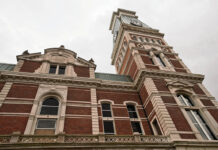
Mike Wolanin | The Republic An exterior view of the building that will become the new Columbus Department of Public Works facility off Arcadia Drive in Columbus, Ind., Monday, April 14, 2025.
City officials on Monday approved funding up to $2 million for a number of building improvements to the future home of the Department of Public Works, including a roof replacement and IT infrastructure improvements.
The Columbus Redevelopment Commission approved a resolution to give initial approval to the release of up to $2,005,781 in Central Tax-Increment financing (TIF) funds, which would go towards the removal and replacement of rooftop units, the installation of commercial fans, a complete rewiring of the IT infrastructure and the replacement of the roof at 1350 Arcadia Drive.
The new department of public works building is expected to be complete in April or May of 2026, according to city officials.
Columbus City Council members will have final say on the additional funds because it’s a city expenditure greater than $500,000.
The council is being presented two separate options for the new roof — one that would be a single-ply roof, and another, more expensive one from The Garland Company, that a representative said provides more sustainability and longevity, and encompasses less maintenance cost.
The difference in price between the base single-ply roof and two-ply flood and gravel system option presented by Garland is roughly $800,000.
Dylan Thornton, territorial manager for Garland, didn’t come with an precise analysis showing things like annual maintenance cost of their roofing system and how much the city would save in theory in the long-term, so redevelopment will hold a special meeting in a couple of weeks so Garland can provide that information in advance of when the matter is presented to council.
Pope said the council will consider finalization of the improvements as early as a meeting on Sept. 16.
Director of Public Works Bryan Burton has illustrated in city meetings over the course of last year how his department has significantly outgrown capacity at the current city facility at 2250 Kreutzer Drive. He has stated the facility is maxed out on electrical capacity, lacks enough parking and office space for employees and has insufficient storage.
The new location is twice the size and will include a 15,000 square-foot building addition for maintenance, a 10,000 square-foot covered storage building addition and a nearly 2,000 square-foot addition for a wash building. It’s set to have a maintenance area with 10 service bays, two underground fuel tanks and would be able to house significantly more vehicles.
The council in September 2024 backed redevelopment’s expenditure of about $8.7 million to buy and retrofit the former data center building. The agreement for the property itself was for $2.6 million. The cost to retrofit it was estimated by Force Design to cost about $6.1 million.
In November, the council approved additional funding to go towards a new salt barn on the property for an amount not to exceed $3.7 million. All in all with the latest additions, the cost of the new building could land upwards of $14.4 million once construction is finished, assuming no other change orders.
The following are the proposed change orders with quotes brought forward by Force Construction, who was chosen to design and renovate the building:
- Removal of existing rooftop units (not to exceed $53,027)
- Replacement of rooftop units (not to exceed $154,184)
- Installation of commercial fans in garage (not to exceed $98,570)
- IT infrastructure improvements (not to exceed $300,000)
- Rooftop replacement (not to exceed $1.4 million)
When the building was purchased it was known the roof would have to be replaced within three to five years, Burton said, but increasing leaks led to the commissioning of a thermal imaging scan last month that Thornton said showed “an abundance” of wet insulation.
Regarding the IT infrastructure, city officials said they didn’t know the extent of what would need to be installed until they began working on the building in earnest. Burton said the previous owners of the building had cut data cables within the walls.
Jim Hartsook, the city’s director of IT, said “there’s no low-voltage cabling in the building any longer,” calling the IT work “a complete rewire.” He also pointed out that the $300,000 figure is more of a “spitball, worst case scenario” and that it’s likely the IT infrastructure work will cost less.
Pope said one option is to leave the roof as is, although she said the roof “has some damage.” Or they could choose the single-ply roof, which Force said would cost at base $602,532. The roof Garland proposed, which is used on all of the Cummins buildings, The Commons and former Sears Building, would cost anywhere between $1 million and $1.4 million depending on the procurement method the city were to choose.
Garland has at least a couple of local contractors certified to install their product, Thornton said.
The Garland roof would also come with a 25-year no-dollar limit warranty, where the company would do an annual inspection to replace anything that needs to be fixed.
When Commissioner Jim Lienhoop asked if that warranty would cover any damage to the contents of the building as a result of a leak, Thornton said he would need to refer to corporate legal counsel.
Burton said the rooftop units and roof replacement were items they knew would need to be replaced in the near-term, while he said the commercial fans and IT infrastructure needs were discovered following the purchase when contractors began to get into the walls.
Council Vice President Grace Kestler, D-at-large, the council’s liaison to redevelopment, noted how the resolution the commission was considering had a couple of blank lines on the section regarding the roof replacement.
“This is a million dollar difference in price —up to $800,000 roughly. I know if I was making this decision right now, I wouldn’t feel comfortable just filling in or choosing one without maybe some internal city reflection and recommendation, maybe from engineering or something,” Kestler said.
In response to Pope asking what his recommendation would be on the options for the roof, Clayton Force, president and CEO of Force Construction, said doing the work now is more practical than waiting until something absolutely needed to be done. He also said it made more sense to do the improvements at this time while the building is empty, as opposed to waiting until it’s occupied.
“But I would defer to the group as to what the costing is, or how it might reflect in your budget,” Force said. “(I) can’t opine on those, but I think the pricing here is competitive and fair and the sequences you’ve taken to get to this point is not unusual. It’s very typical.”
The difference in the estimated useful life for both roofing options is between five and seven years, Force said, although he added he would defer to the manufacturers.
Lienhoop said later that he would feel more comfortable once more information is provided about the difference between the single-ply roof and the Garland product.
“I’d like to see your total cost analysis,” Lienhoop said. “I mean, I feel like I’m being asked to spend $800,000 and promised it’s going to be cheaper in the long-run, but I haven’t seen anything.”
Thornton said he would compile a total cost of ownership analysis “based on what the city has spent over the previous years with its existing single-ply systems and maintenance costs versus what a Garland system is.”