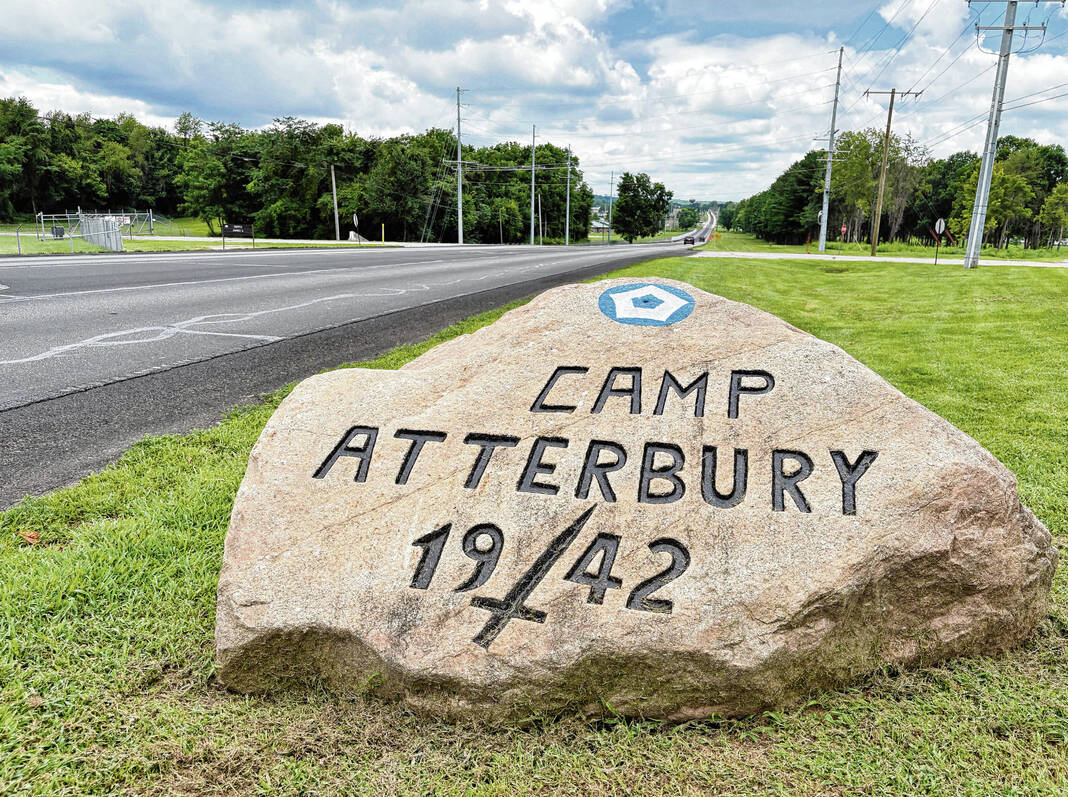
The Camp Atterbury Rock situated as people approach the military base from the east on Hospital Road. The rock was carved by an Italian prisoner of war housed at Camp Atterbury, and the rock still sits in the same spot today, welcoming soldiers and civilians to the post and reminding them of the camp’s origins.
RYAN TRARES | DAILY JOURNAL
By Ryan Trares | Daily Journal
rtrares@dailyjournal.net
For The Republic
CAMP ATTERBURY — The news sent ripples of shock, confusion and anger through southern Johnson County.
Nobody seemed to know what was going on. The federal government had plans for the area, but details were vague.
People wanted to know what was happening in their backyard.
The scene describes feelings of many people since the announcement in July that Camp Atterbury in the southern part of the county could be selected as one of two military sites to be used to house detained illegal immigrants.
But just as revelation has sent ripples through the local community, the creation of the military base in the first place was met with controversy.
“There definitely was anger and frustration. Rumors were coming, Is this base going to be built here?” said David Pfeiffer, director of the Johnson County Museum of History. “You have to think, in 1940 and 1941, before Pearl Harbor, we were still fairly isolationist. It was hard to think of this big military base coming here in the middle of Indiana, all of this farm land.”
For more than 80 years, Camp Atterbury has been an integral part of the Johnson County community. From its start as a training base for U.S. Army soldiers as they headed to World War II to its current role being operated by the Indiana National Guard, the base has made an impact across the country and around the world.
Camp Atterbury has held Italian and German prisoners of war captive, and in 2021, housed 7,000 Afghan refugees.
“It’s been a huge part of our history, and has ended up being a point of pride,” Pfeiffer said. “It’s something that’s always been there for so many people. Like a lot of military bases throughout the country, they have a deep connection to the community, because they’ve been there for decades and decades.”
Preparing for war
The story of Camp Atterbury stretches back to the late 1930s. With World War II raging, federal officials examined what would happen if the United States was pulled into the conflict.
Going to war would require a massive expansion of the existing peacetime Army — and places to train them. Surveys were taken in the late 1930s in Indiana, and the farmland of southern Johnson County was chosen as a potential site for such a base.
In 1941, the War Department (as the Department of Defense was then known) announced plans to build an installation on about 55,000 acres in Johnson, Bartholomew and Brown counties.
The planned military base uprooted about 550 farm families and wiped the towns of Kansas and Pisgah off the map. Cemeteries throughout the area had to be relocated, including moving 674 graves.
“There was that anger and frustration at first; they were coming in, taking away their land. But there was a realization, especially after Pearl Harbor, that this was something that was necessary,” Pfeiffer said.
Construction started in February 1942. Officials decided to name the base Camp Atterbury, after Brigadier General William Wallace Atterbury, an Indiana native, president of the Pennsylvania Railroad and World War I veteran who served as a staff member to General John G. Pershing.
Over the course of six months, 780 buildings were erected. Eventually, the camp would feature 1,780 buildings providing housing to 44,159 officers and troops.
Construction brought a flurry of economic activity in the county, as workers flooded into the area.
“When we’re looking at major events in the eyes of Johnson County, for World War II, Atterbury was the main focus for the county,” Pfeiffer said. “That base was huge and important.”
In June 1942, the first of over 275,000 troops who would pass through Camp Atterbury arrived, and on Aug. 15, the 83rd Infantry Division was activated at the camp in a ceremony witnessed by more than 25,000 people.
The main purpose of the base was training, Pfeiffer said, and throughout World War II, four complete infantry divisions were instructed there — the 83rd, the 30th, the 106th and the all-Black 92nd divisions. All four would serve in Europe during the war.
Camp Atterbury also was home to Wakeman Hospital, which at the time was one of the largest hospitals in the country. The medical center specialized in the treatment of burns and brain injuries — offering cutting-edge treatment and surgeries to soldiers injured in battle.
“They were working on treatments for military personnel who were surviving wounds they typically would not have before,” Pfeiffer said. “Blood transfusions and pencilling saved so many lives, but now, how do we treat those soldiers?”
But one of the most unique aspects of the base was its use as a prisoner-of-war camp. The United States Army was embroiled in battle in Northern Africa at the start of the war, and Army officials wanted to find a place to put captured soldiers where they could not escape and return to fighting the war.
The first Italian POWs arrived at the camp on April 30, 1943. During their time as captives, they were given permission to build a Roman Catholic chapel on the grounds, which has been restored and is still standing near Nineveh.
Once Italy surrendered in World War II, German POWs started to arrive at the camp.
Even these enemy combatants found themselves ingrained in the Johnson County community.
“Those POWs, they were allowed the work, so they were in the fields helping with the crops, in the canning factories and things like that,” Pfeiffer said.
A time of transition
Following the end of World War II, Camp Atterbury was deactivated and activated again during the Korean War and Vietnam War. The base was discontinued as a Department of the Army installation on Dec. 31, 1968, and the Military Department of Indiana assumed control of the area on Jan. 1, 1969 — marking the beginning of Camp Atterbury’s oversight by the Indiana National Guard.
In 1976, about 500 acres of the camp were determined to be surplus by the U.S. Army. The Johnson County Soil & Water Conservation District learned about the surplus and pursued the acquisition of that property through a program called Federal Lands to Parks, which allowed surplus federal property to be donated to local government entities for park and recreation purposes.
Roger Young, a Franklin-based attorney, was associate supervisor on the district’s board at the time.
“We found out about it, and the district supervisors were talking about, saying, ‘heck yeah.’ It was about 400 acres of land that was open, and would be a great asset to the soil and water conservation district,” Young said. “So we put our application in.”
Though the soil and water conservation district applied to the Federal Lands to Parks program, the Bureau of Outdoor Recreation determined the district didn’t have the budget to fund a park. So the county commissioners and county council agreed to submit an application along with the conservation district. Their request was approved in November of 1976, and the property that is now Johnson County Park was conveyed to the county and the conservation district.
The park has been going strong ever since, though stipulations are in the deed that the property must be used for park and recreation purposes.
“There’s a reversion on that: if it ever stops being used for parks and recreation purposes, it reverts back to the federal government,” Young said.
Other surplus land was acquired by the Department of Natural Resources to create the Atterbury Fish & Wildlife Area.
Through the 1990s, Camp Atterbury supported the Indiana National Guard through its various missions, including during Operation Desert Shield and Operation Desert Storm in 1990 and 1991.
When the United States mobilized to fight terror in Afghanistan and Iraq in the early 2000s, thousands of troops came through the base to prepare for deployment.
The camp’s usage has evolved over the years while still maintaining its mission of supporting the National Guard in its training and activities. But in 2021, it also became a center of humanitarian aid and hope.
After withdrawing from Afghanistan, U.S. officials launched Operation Allies Welcome, a coordinated effort across the federal government to support and resettle vulnerable Afghans, including those who worked on behalf of the United States during their time in the country. The work of processing and vetting those refugees took place at eight military bases throughout the country, including Camp Atterbury.
About 7,200 Afghan refugees came through Atterbury, where they were provided shelter, food, medical care and resources as they went through the refugee resettlement process. Community groups and churches collected money, clothing, furniture and more to help the new residents start life in their new home.
“The people of the United States have a heart of gold. Thank you so much for everything,” said Nahid Sharifi, one of the refugees, in November 2021. “In a difficult situation, they never left Afghan people alone.”