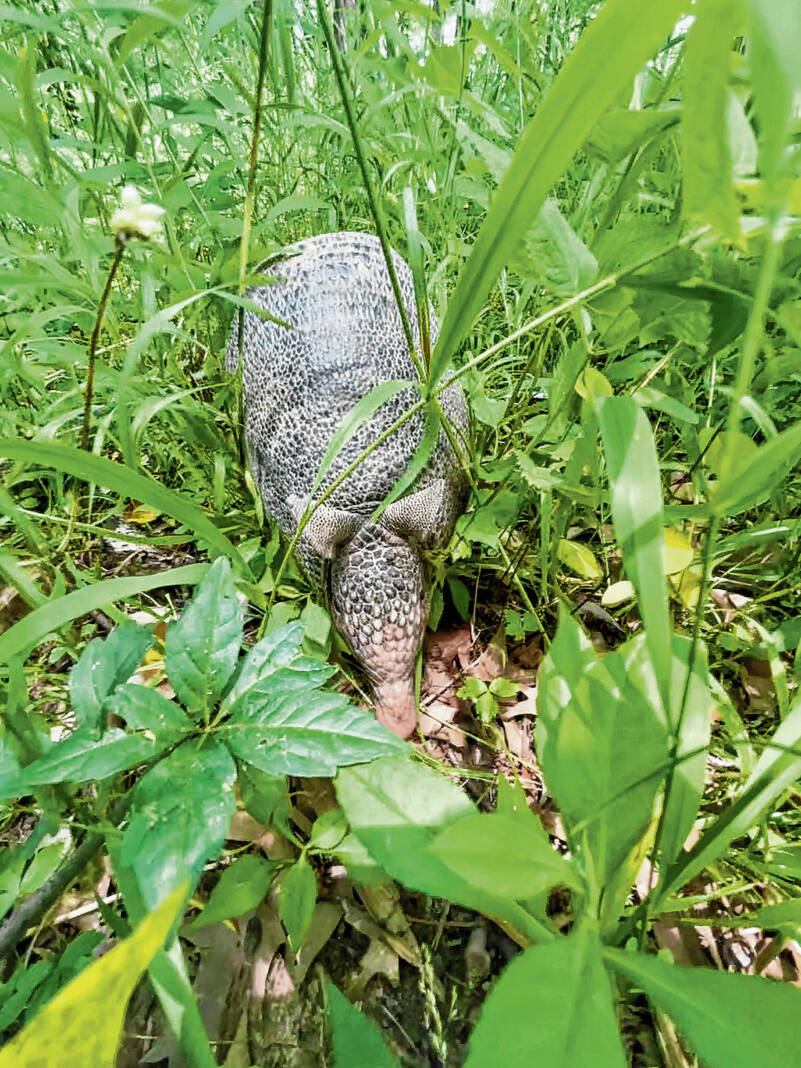
Armadillos have been spotted in the area as this species’ population in Indiana continues to grow.
The nine-banded armadillos, the only armadillo species found in the United States, were first observed in Indiana in 2003. There are three reports of armadillos having been spotted in Jackson County, two along Interstate 65 near Crothersville and one southwest of Medora.
The number of armadillos spotted in counties surrounding Jackson County includes two in Washington, five in Lawence, four in Bartholomew, five in Jennings and one in Brown. Scott County has not had any reported sightings.
Thirty nine out of the 92 Indiana counties have not had any reported sightings of the armor-like skinned mammal.
According to a recent study by the U.S. Geological Survey, armadillos are colonizing much of southeastern Indiana and are spreading north and west. With climate change and the unpredictable weather, the state is now a suitable home for these hard-shell creatures.
Between 2003 and 2018, there weren’t many reports on the species in the area, said Brad Westrich, state mammalogist for the Indiana Department of Natural Resources.
“After 2018, we were able to get a webpage and create some online reporting tools,” he said. “That really helped awareness for people to not only see that they were here, but to report them.”
Since then, the state has received hundreds of reports throughout the state with more than 230 confirmed reports just this month.
These house cat-sized animals live and die within their home ranges, but young ones have been on the move, dispersing to new areas, Westrich said. Indiana has always had a suitable habitat, but not always the right climate.
“Now we have a suitable climate for this warm-adapted species where our winters are more mild and they’re actually able to hang on through our winter months and survive until the next spring,” he said. “Then they get out there, breed and spread even further.”
Armadillos are known as powerful diggers and can quickly excavate burrows to seek shelter from predators or weather.
This burrowing species could have a positive impact on Indiana’s ecosystem, Westrich said.
As they burrow tunnels and chambers underground, not only are armadillos moving soil, but they are contributing to nutrient cycling, disturbing plants and seeds and creating habitat for other species that use burrows, he said.
On the downside, there are some potential negative impacts the state is investigating such as competition for resources with other species and becoming a nuisance to backyards.
“They do burrow underneath sheds or barns and can be a nuisance for sure by some folks,” Westrich said.
If armadillos have created burrows under structures, residents can illuminate the burrow or they can place a radio near the entrance to help drive them away. Fumigants, poisons or traps are not advised for armadillo control, according to the DNR website.
Nine-banded armadillos are protected under Indiana Administrative Code and they cannot be trapped or killed unless the armadillo is destroying or causing substantial damage to property. If property damage is occurring, landowners and tenants can remove an armadillo without a permit or contact a permitted wildlife control operator.
Currently, the DNR is not aware of any pathogens that have been associated with armadillo populations farther south, but a pathogen surveillance program is in the works.
“As we collect specimens, we can get samples submitted to see if the pathogen that causes leprosy, for example, reaches here and how prevalent it becomes,” he said.
It is important to wear gloves and limit exposure if residents are disposing of an accidentally trapped armadillo and to wash your hands afterwards, Westrich said.
Westrich said most of his reports are from the daytime as armadillos are observed as roadkill from state travelers, but overall they are nocturnal animals.
“They’re going to come out around sunset and do some foraging throughout the night and you might see them in the morning too,” he said. “As seasons change and it gets cooler out, you are more likely to see them during the day because they are not going to want to be out at night when it’s colder.”
Residents can report sightings by submitting a report a mammal form on the Indiana DNR website and may be accessed via phone, tablet or computer. Sightings can be reported by dropping a pin on the map and photos and video can be added as well along with an email address. The website to report is in.gov/dnr/fish-and-wildlife/wildlife-resources/animals/report-a-mammal/.
Westrich advises those who see an armadillo to give it space as it’s a wild animal and do not corner it.
“They have terrible vision, but can hear and smell very well, so they might bumble past you as they’re looking for insects,” he said. “They might not perceive you as a threat until you move towards them. So, just give them their space, enjoy the observation and take plenty of photos and video.
Reporter Erika Malone with AIM Media Indiana contributed to the story.