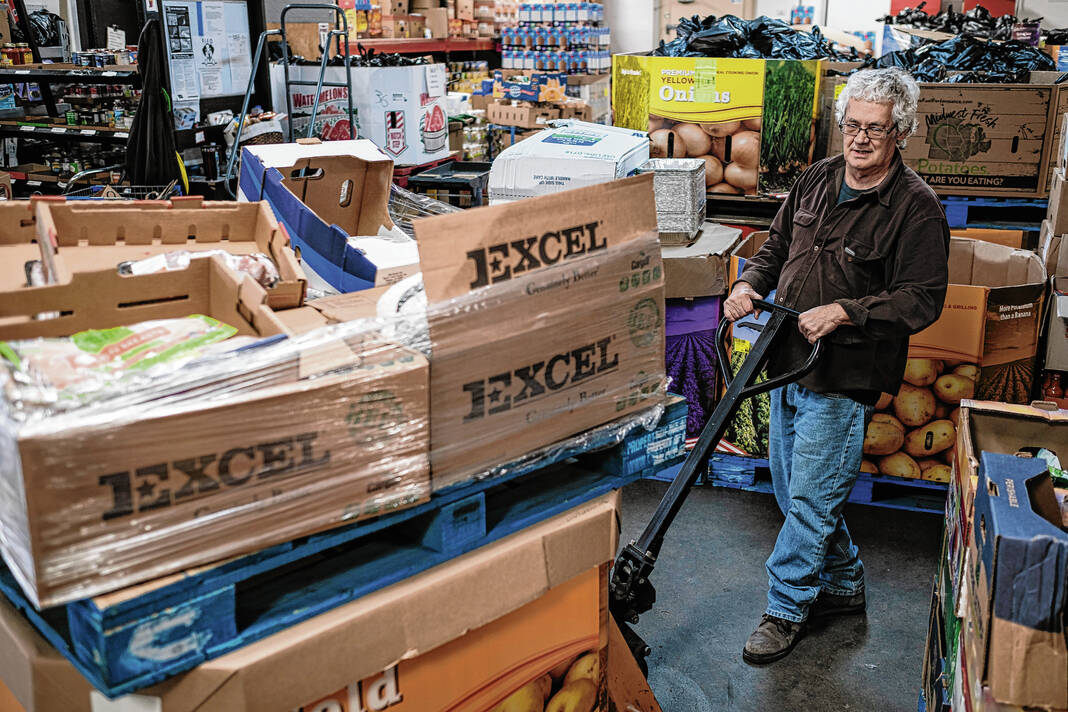
Mike Wolanin | The Republic Pat Rafferty moves a pallet of food at the Love Chapel food pantry in Columbus, Ind., Monday, Nov. 20, 2023.
A coalition of local organizations is working to develop county-wide metrics on hunger and food insecurity in Bartholomew County, aiming to raise public awareness and guide strategies to combat the issue as demand for help with food grows.
The coalition, which meets monthly, is currently in the process of narrowing down the statistics it seeks to track and expects to settle on a set of 10 metrics to research retroactively over the past five years and update quarterly, said Love Chapel Executive Director Kelly Daugherty, who co-chairs the coalition.
The coalition includes representatives from Love Chapel, Healthy Communities, Purdue Extension, Thrive Alliance, Salvation Army, Head Start, the Bartholomew County Health Department, among others.
Food insecurity is described as a lack of access to enough food for an active, healthy life, according to the U.S. Department of Agriculture.
“We’re going to narrow it down to 10 statistics that we’re going to track,” Daugherty said. “…We really want to be able to raise awareness about food insecurity in our community.”
The metrics that the coalition is considering range from the average cost of feeding a family of four in Bartholomew County for a month— which Daugherty said is currently estimated at around $980 — to the number of adults and children experiencing food insecurity and the number of food stamp recipients, among others.
Daugherty said the coalition expects to decide on the 10 statistics during its monthly meeting in October and hopes to have compiled the five years of data by the end of this year.
“The next step is we want to try and really get before the movers and shakers in the community, whether it be the city, the county, and really present them the information of what food in our county,” Daugherty said. “That’s where we want to go with this, so that we can raise awareness and then build strategies to try and combat that going forward, rather than each of us trying to do it individually.”
Rising food insecurity
The new effort to track hunger in Bartholomew County comes after data released this year by Feeding America shows food insecurity in Bartholomew County reached its highest level on record in 2023.
An estimated 12,250 local residents experienced food insecurity in 2023 — 3,730 more people than in 2021 and the highest total since the organization began using its current methodology in 2018. That comes out to 14.8% of the county’s population — roughly 1 in 7 people — and an increase from 10.4% in 2021.
The data also shows an increasing number of Bartholomew County children were food insecure in 2023. A total of 3,240 local children experienced food insecurity in 2023 — 290 more than in 2022 and 1,210 more than in 2021.
Black and Hispanic residents in Bartholomew County were much more likely to be food insecure than white residents, the data shows.
A total of 24% of Black residents, 23% of Hispanic residents and 13% of white residents were food insecure in 2023. By comparison, 13% of Black residents, 16% of Hispanic residents and 10% of white residents experienced food insecurity in 2021.
Food insecurity also rose in Indiana, reaching 15.1% in 2023 and eclipsing 1 million Hoosiers for the first since at least 2018. A total of 13.2% of Indiana residents — 883,260 people — were food insecure in 2018.
Love Chapel has seen an increase in demand for help with food so far this year.
Daugherty said that Love Chapel served 1,445 families in August, an increase of around 100 families from August 2024. Demand at Love Chapel generally increases as the year progresses.
Daugherty said previously that he would not be surprised if Love Chapel was serving 1,700 people per month by the end of the year, which would be a 13% increase in average monthly demand from last year and more than double the monthly average of 750 families in 2022.
So far this month, Love Chapel has been busy, Daugherty said.
“Last week, we were closed for the Labor Day weekend, and on Tuesday, we did 97 families in one pantry session,” Daugherty said. “That evening, we had a mobile outreach in Elizabethtown and did 81 families and then followed it up with 83 families and 87 families during the next two. So, in three days, four sessions, we serve over 360 families. That’s unbelievable numbers. Now that could just be that everybody came early this month. So, I can’t say that that’s a trend, but it’s just been really, really busy.”