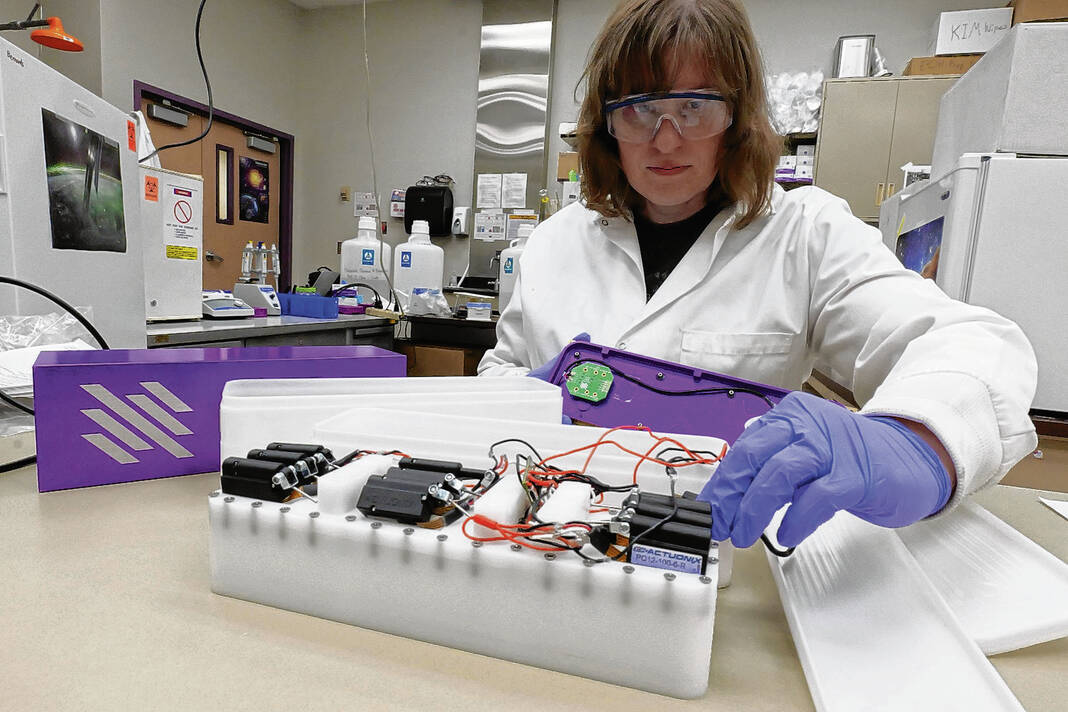
Photo provided by the University of Idaho University of Idaho student-led research is headed to NASA’s International Space Station (ISS) to help astronauts stay healthy in space, extend mission success and deepen our understanding of the galaxy we live in. Research led by U of I College of Engineering Professor Matthew Bernards and Chemical Engineering Graduate Student Adrienne Shea, is focused on developing a bacteria adhesion resistant coating for use in space vehicles to protect astronauts from sickness and disease.
A Columbus-native had an experiment she worked on sent to the stars, with hopes that it will help astronauts stay healthy in space and ultimately deepen our understanding of the galaxy.
Adrienne Shea, a chemical engineering graduate student at the University of Idaho, saw the experiment launch to NASA’s International Space Station (ISS) on Aug. 24.
As she watched it soar into space at the Kennedy Space Center alongside her two kids, Shea thought about how far she had come.
“From going back to IUPUC because I couldn’t pay my bills to standing there watching a rocket with my science on it— was very surreal,” Shea told The Republic.
Shea’s experiment seeks to prevent bacteria from adhering to the walls within systems that move water for people to drink, whether that’s metal pipes or holding tanks.
Essentially, through the research she conducted in coordination with University of Idaho Professor Matthew Bernards and other students, they sought to develop a bacteria adhesion-resistant coating for use in space vehicles to protect astronauts from sickness and disease. The nonfouling polymers resist the adhesion of proteins and bacteria, keeping surfaces germ-free longer and lowering the potential spread of infection.
Astronauts are more likely to get sick in space, in part because they have a depressed immune system when up there, but also because the ISS has its own water system that Shea said routinely operates with more bacteria than what is typically safe on Earth.
“We still have over 6,600 deaths in the United States now from people who have gotten sick from waterborne illnesses, and that’s in public water sources,” she said. “There’s a lot of day-to-day bacteria in water and then that is something that’s exacerbated in space.”
With NASA plans to send humans to Mars sometime during the 2030s in mind, now it’s more crucial than ever to make astronauts as healthy as possible in space, and in turn increase the amount of time missions can last, according to Shea.
Housed in a protective containment chamber designed and built by Shea, two strains of bacteria most commonly found in wastewater on the ISS will be automatically introduced onto stainless steel samples coated in the nonfouling polymers known to resist the adhesion of proteins and bacteria.
The experiment will stay on the ISS for 30 days before it will return to Earth for evaluation.
“There’s samples in there that have three different polymer coatings and one of them we like the most,” Shea explained. “… When it comes back, I will expose it all to a fluorescent dye that only adheres to the bacteria, and then I’ll look at it under the microscope and see which of the samples has the most bacteria.”
The research has applications for humans on Earth too: from developing the coating for larger surfaces such as drinking water piping to using the coatings for biomedical procedures like organ transplants and joint replacements.
Shea said she may have become “a little bit too passionate about drinking water” but the idea that there are still people who get sick from their drinking water drove her to continue on.
A graduate of Columbus East in 2002, Shea returned to school at then-IUPUC in her mid-30s to pursue mechanical engineering, with two kids to support.
Shea credited J.D. Mendez, chemistry professor at IU Columbus, for encouraging her to pursue a PhD while he was undergraduate research mentor to Shea at then-IUPUC.
When looking at graduate schools, Shea was able to receive full-ride offers from four different colleges. The program at the University of Kentucky was working on waterproof fabrics. The University of Idaho, on the other hand, had graduate research students working on projects involving the great beyond.
“In Idaho, I tease my professor here all the time because he pulled out the big guns in the interview. He’s like, ‘Well, we’re working on NASA projects.’ How am I supposed to go anywhere else now?”