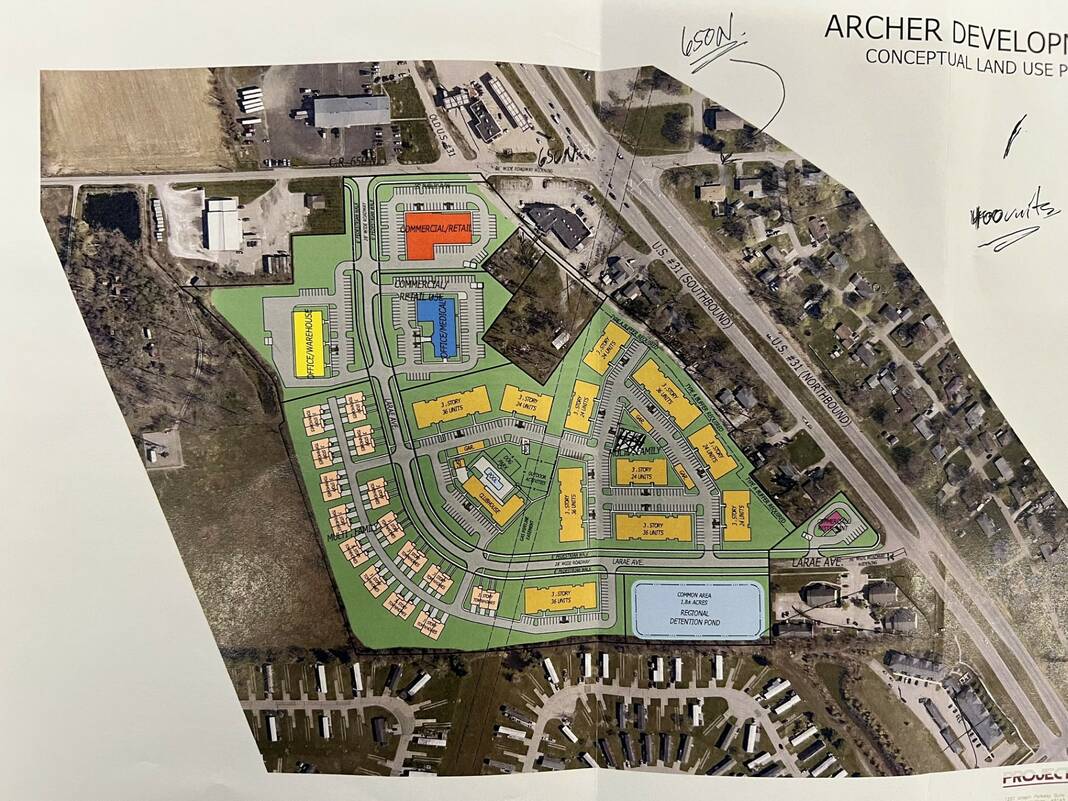
Photo provided A conceptual land use plan for a proposed apartment development on the south side of Tannehill Road and County Road 650N.
County officials on Monday gave initial approval to a rezoning request on property in German Township where an applicant is planning a combination multi-family residential and commercial development.
The Bartholomew County commissioners passed the first reading of an ordinance to establish zoning changes on three parcels totaling just under 32 acres on the south side of Tannehill Road and County Road 650N, about 400 feet west of U.S. 31 in German Township.
Ordinances must be passed twice to be finalized. The second reading is expected to be considered during the commissioners meeting on Oct. 20.
The applicant, Tulsidas Narsinghani, is seeking to rezone .59 acres from Residential: Multi-Family (RM) to Commercial: Regional (CR); 22.5 acres from Agriculture: General (AG) to RM; and 8.5 acres from AG to CR.
Narsinghani indicated that he plans to develop the southern two-thirds of the property for between 370 to 400 market-rate units. The northern third will be for commercial development, such as offices and retail spaces.
Narsinghani has been involved in developing general retail-type strip centers locally, particularly along 25th Street in Columbus, Jeff Colvin, president of Colvin Builders, said in March.
Narsinghani owns Tony’s Plaza, located near the intersection of 25th and California streets, and the property one block to the east at 1024 25th St., which used to be the site of A&W Root Beer and later Becker’s Drive-In.
The Bartholomew County Plan Commission during its meeting on Sept. 10 put forward a unanimously favorable recommendation to the commissioners on the request after it was continued in March and June.
The favorable recommendation came with four commitments, including that the future development include a pedestrian system, that public right-of-way be dedicated along County Road 650N and that a Type A buffer, the most robust type of buffer, be instituted along the entire eastern property line. The last commitment was regarding four traffic changes that came out of a traffic study the applicant conducted, including the widening of Tannehill Road and new a left turn lane at U.S. 31 and Larae Avenue.
An early-stages conceptual land use plan for the site shows a combination of town homes and three-story apartment buildings, with three buildings for commercial use to the north. The multi-family portion shows a clubhouse and pool, dog park, and a couple of pickleball courts.
North of the project site are commercially zoned properties including Waffle House and Circle K.
Larae Apartments are to the east, single-family residential to the west and Heritage Height mobile home park spans the entire southern boundary. The comprehensive plan identifies the area as a development district because of its availability to public sewer and water and easy access to high capacity roads.
Commissioner Larry Kleinhenz, R-District 1, said he supported the project, but wanted assurances that some type of resolution would be reached to address drainage problems in the area, which was the subject of discussion at the plan commission level.
“Our highway department has worked on that for many years, trying to improve the outflow of water to that little catch point, and we’ve yet to get it fixed,” Kleinhenz said. “And we always thought, well, when it’s developed, that’s the time to fix it. So I want to see the fix.”
Colvin, who was enlisted by Narsinghani for the project, said they had hired a civil engineer that is looking into a design to address drainage issues but “we’re not at the point where we can definitively, exactly say where and at what rate the water will be detained.”
The concept plan does show a 1.8 acre common area with a detention pond south of the site. Colvin also added that Narsinghani is planning to invest anywhere between $20 and $30 million into the project.
After Kleinhenz suggested putting the request on ice until the civil engineer had designed the mechanism to address drainage issues, Colvin reiterated that their preference would be to complete the rezoning first.
Details regarding the design of the drainage mechanism, which are guided the county’s drainage ordinances, would still require approval from the county plan commission if and when the rezoning is finalized.
“That way we know that we have the zoning in place to spend the capital to do the actual engineering component because that’s quite expensive,” Colvin said. “We wouldn’t be able to build anything until we satisfy all of the ordinance requirements concerning drainage anyway.”
Kleinhenz said he “heard the same speech when we put the (Larae Apartments) in there” and that “the problem has not improved, if anything, it’s gotten worse.”
If the rezoning is finalized after the second reading, the applicant will then be required to submit a subdivision plat to the planning department laying out lot specifications and details about drainage.