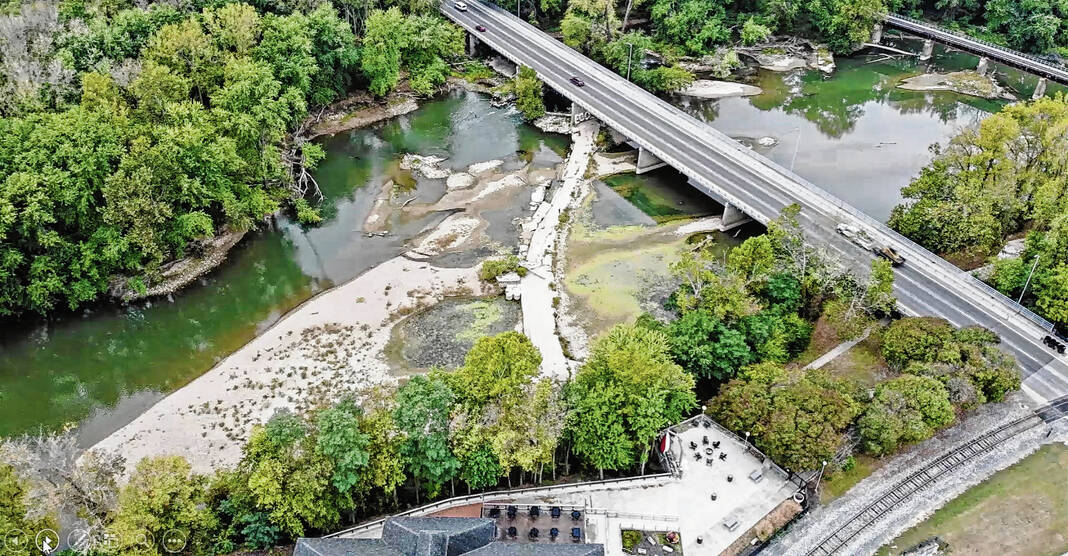
A significant portion of the “Our River…Our Riverfront” project began Tuesday.
The project, which has been in the works since 2016, seeks to address safety concerns on the riverfront. In particular, it will involve the removal of the failing low head dam in the East Fork White River, make way for a pedestrian connection to the 1821 Trail and Mill Race Park, while also providing safe access to the river for emergency personnel.
It also plays into other ongoing city projects including the Second Street Thoroughfare Project and remake of the downtown entrance into the city.
Milestone Contractors was chosen in July to do construction primarily on the east side of the bank, and city officials in a press release said that work has just begun.
Milestone will stabilize and re-landscape the east side of the bank, institute a connection to the People Trail from Mill Race Park to Water Street and construct a plaza that will provide access to the river. The contractor will also fix a wash out on the west bank.
Milestone is starting site clearing and initial erosion control measures this week, city officials said. That will mean people will begin seeing temporary fencing, tree removal, material delivery and surveying between the Second and Third Street bridges.
Throughout the remainder of the year, site clearing and prep will continue, along with excavation and sheet piling efforts to prepare for the trail’s retaining walls. The project construction timeline will extend through 2026, with the anticipated dam removal during the summer of 2026.
The “Our River…Our Riverfront” project has seen several iterations in its design, with the most recent involving the removal in-river recreation component that included a recreation channel, rock riffle ramp and fish habitat structures.
After bids on the project came in higher than expected at the start of 2024, redevelopment officials said they went back to do some value engineering and broke down the project into seven separate bid packages in hopes it would attract different contractors and bring down the cost. But bids came in higher than expected yet another time in fall of 2024, so a guiding team including city council members was put together to re-evaluate the project. Out of that it was determined to seek a project without in-river features.
The project is divided up into three parts — work to the west side and east side of the riverfront and then the removal of the deteriorating lowhead dam in the East Fork White River.
Redevelopment officials in January hired EDCO Contractors for $454,318 to provide west bank access for the eventual removal of the lowhead dam and bank stabilization, which involved the removal of trees, implementation of a construction access road and filling in a scour area, at the location of the former landfill. That portion is already finished.
Milestone’s part of the project is being done for an amount not to exceed $11.8 million.
Jerry Sweeten of Ecosystems Connections Institute will take out the lowhead dam in 2026 as grant funding from the Indiana Department of Natural Resources and U.S. Fish and Wildlife Service becomes available. Jason Larrison of consulting firm J.S. Held told the redevelopment commission in July that “the anticipation is that the majority of that (removal of the lowhead dam) cost will be covered by state dollars.”
The project wouldn’t have been eligible for the type of grants Sweeten is seeking with the in-river features originally included in the scope, redevelopment officials said. The grants will also likely require some sort of local match.
Sweeten came highly recommended by the Indiana Department of Natural Resources, according Larrison, who called Sweeten “the expert in Indiana when it comes to lowhead dam removal.”
Sweeten has helped remove “dozens and dozens” of dams throughout the state, Larrison said, including Edinburgh’s Thompson Mill Dam in 2024.
Overall, the project has access to about $18.9 million in approved funds, made up of $11.5 million in tax-increment-financing (TIF) funding, $5.6 million in Regional Economic Acceleration and Development Initiative (READI) funds and $1.8 million from various funding sources including a $1.72 million Next Level Trails Grant from the Indiana Department of Natural Resources, along with contributions from Duke Energy and the Columbus Park Foundation.
The portion Milestone is doing will use up READI and grant funding first, followed by just over $4 million in TIF funding.