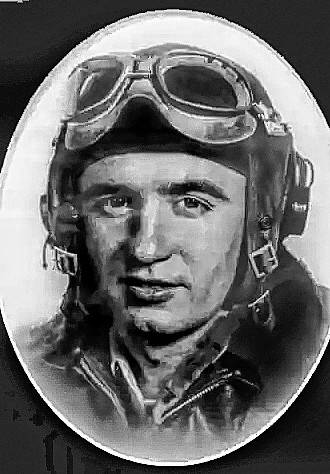
Ensign Delbert LaRue Martin
SHELBY COUNTY — The POW/MIA branch of the Navy Casualty Office recently announced that Indiana native Delbert Martin, who died in aerial combat in the battle to secure Yap (modern-day Federated States of Micronesia), will be buried with full military honors in Shelby County at 11 a.m. Oct. 15.
The ceremony will be at Fairland Cemetery, 4378 N. County Road 400W, Fairland.
Martin was previously buried as an Unknown at the National Memorial Cemetery of the Pacific in Hawaii before his identification.
The Navy partnered with the Defense POW/MIA Accounting Agency, without whom recoveries and identifications would not be possible, officials said.
The family declined to comment directly to the media. However, Martin’s niece, Barbara Martin, has made the following statement:
“Several years ago, my brother Scott Martin was approached by Patrick Ranfranz of the Missing Air-Crew Project. This worthy organization makes it their job to identify missing in action soldiers, no matter how many years ago they disappeared. My brother sent in his DNA to help with the identification. Many years later, I got a call from the Navy saying they had positively identified the remains as those of my uncle, Delbert LaRue Martin.
“In the time between finding out that LaRue’s remains would finally return to lie next to his parents, I’ve learned about him. Looking at photos of him, I see that he was a handsome young man with an eager look in his eyes. He was born Feb. 13, 1922, in Shelby County. Delbert grew up on his family’s farm. He enlisted in 1942 and trained to be a pilot. Delbert’s nickname during his time as a Hellcat Ace pilot in World War II was “Snuffy.” He was described by his first cousin Maurice Eugene Boring as “a little guy, but a ball of fire.” He was part of his squadron’s aerial victory during the first strike at Tokyo.
“He was killed in action flying over Yap Island in Micronesia on March 21, 1945, at the age of 23. His remains were recovered after 70 years, and he will be buried next to his parents in Fairland Cemetery. He is survived by his nieces, Kathryn Brown, Natalie Shepard and Barbara Martin, and his nephew, Scott Martin. After his death, his parents, J. Franklin and Anna Marie Martin, his sister, Scytha Mae Brown, and his brother, Robert Martin, died.
“I am grateful that LaRue’s remains have returned to his home. I know my grandparents would have been especially happy to have LaRue back and buried next to them.
“Many thanks to the Navy for their persistence over 70 years in returning LaRue’s remains to his native soil and helping LaRue’s remaining family to attend this burial. The Navy has also been very helpful in making it possible for us to be at the burial and guiding us through the many details involved in bringing LaRue home.”
The public affairs office explained that naval aviators flew from aircraft carriers during World War II, participating in multiple battles that were crucial turning points in the war.
Martin was reported missing March 21, 1945 and presumed dead on March 22, 1946.
He was awarded the Distinguished Flying Cross, the Purple Heart, Air Medal, American Campaign Medal, Asiatic-Pacific Campaign Medal with Bronze Star, and the World War II Victory Medal.
According to the Navy POW/MIA Public Affairs office, Martin’s final mission occurred when he was assigned to Fighter Squadron (VF12) in January 1945 to the USS Randolph (CV 15).
Aviators on the Randolph flew the Grumman F6F-5 Hellcat, the U.S. Navy’s primary carrier-borne fighter during World War II.
In the latter part of 1944, the squadron supported the invasion of Iwo Jima and raids on the Japanese home islands, including fighter sweeps and photographic missions over Yap, (modern-day Federated States of Micronesia) and Ulithi Atoll in September 1944.
Martin’s aircraft, an F6F Hellcat, was last seen failing to pull up from a dive and crashing into the ground in Gagil-Tomil, Yap Island, about a half mile from his intended targeted. He was listed as missing on the same day and presumed dead a year later. Ensign Martin’s remains were not identified in postwar accounting efforts, according to the Navy.
During recovery and identification efforts on the Yap Islands after the war, the American Graves Registration Service disinterred one set of unidentified remains at a location designated “173-Jig” on the Yap Air Gunnery Target Map. The graves registration service designated the remains as Unknown X-397 Manila Mausoleum (X-397) and buried them at the Manila American Cemetery and Memorial.
With their research, historians at the Defense POW/MIA Accounting Agency concluded Martin was the historical candidate for the remains recovered from Gagil-Tomil. After lab analysis, it was determined that the skeletal remains share a DNA profile with Martin’s relatives and align in expected biological profile based on skeletal analysis.
Martin was accounted for on June 18.