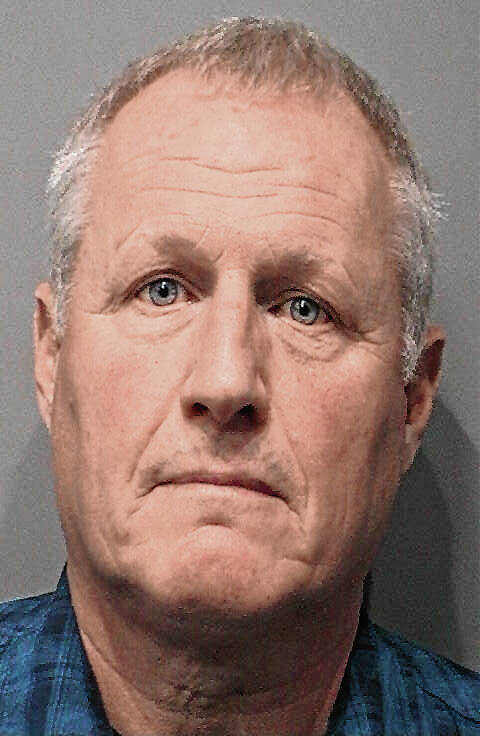
Pruitt
FRANKLIN — The Johnson County coroner is now incarcerated after his arrest on Tuesday.
Michael D. Pruitt, 60, of Bargersville, turned himself in at the county jail in Franklin at around 11:40 a.m. Tuesday. He was taken into custody without incident and booked in under a no-bond warrant issued, said Chief Deputy Andrew Barnhart of the Johnson County Sheriff’s Office.
While Pruitt has been booked into jail, he is being transferred to the Brown County jail for “safety and security,” Barnhart told the Daily Journal. Pruitt showed up as “released” on the county’s inmate data web page as a result of the transfer between counties, he said.
”This is standard procedure for inmates where there members of the jail staff may be family or close acquaintances, to ensure complete transparency with regards to treatment and procedures,” Barnhart said.
Pruitt’s attorney, Russell Johnson of Franklin-based Johnson Gray & Johnson, did not immediately return a request for comment on the developments.
Pruitt, the county’s elected coroner since 2021, is accused of buying alcohol for a 17-year-old girl and offering her cannabis gummies. The situation was revealed following the filing of a protective order against him by the mother of the teen, who accuses Pruitt of having “inappropriate” contact with her and of harassment, court documents show.
The protective order details 30 incidents of contact between Pruitt, the girl and her mother over the last year or so. The incidents include in-person contact, text messages, emails and phone calls; the messages cover a range of topics and many do not involve providing substances. The protective order also includes comments that suggest Pruitt was having a mental health crisis, which likely contributed to this situation.
The probable cause affidavit filed in the criminal case details seven occasions when Pruitt provided alcohol to the teen girl. The affidavit says he did this several times at a farm, at a Bargersville fire station, a hotel room in Illinois when the two were there for a swine show, and twice at the Johnson County Fairgrounds during the fair earlier this year. These incidents were also referenced in the protective order.
The Johnson County Sheriff’s Office requested that the Indiana State Police investigate the incident to avoid a conflict of interest. Fourteen misdemeanor criminal charges — seven charges of contributing to the delinquency of a minor and seven charges of furnishing alcohol to a minor — were filed in Johnson Superior Court 3 on Friday. The charges were filed by Brown County Prosecutor Theodore Adams, who has been appointed as a special prosecutor for the case.
Since news of the allegations against Pruitt first surfaced, protesters have called for Pruitt’s resignation, along with the Johnson County Democratic Party. A petition asking for Gov. Mike Braun to remove him from office has garnered at least 354 signatures as of Tuesday afternoon.
Pruitt is a Republican. Johnson County Republican Party Chair Beth Boyce said the allegations against Pruitt were “concerning and disturbing.”
“As a mother, I find them particularly so,” Boyce said in a statement. “The law does not empower a county Republican Party or its chair to remove a county office holder elected through the democratic process. We will monitor the progress of any criminal proceedings along with the rest of the public and we do not have further comment until that time.”
There are only three ways for a coroner to be removed. Those are removal by the governor, automatic removal in the event of a felony conviction, or if the coroner decides to resign.
The felony route is not applicable in this case.
The same day charges were filed against Pruitt, Johnson Superior Court 3 Judge Douglas Cummins recused himself because of a conflict of interest. On Monday, Judge Dan Marshall of Hancock County Superior Court 2 was appointed as a special judge.
Later on Monday afternoon, Hancock County Magistrate Cody Coombs found there was probable cause to issue a warrant with a no-bond hold. No-bond holds are standard in Hancock County, as judges decide what the bond amount will be at the initial hearing. An unopposed motion for bond was filed by Pruitt on Tuesday following his booking to the Johnson County jail.
Warrants or summons, both of which are used to hold a defendant, can be issued for misdemeanor offenses. While typically most defendants charged with a misdemeanors receive a summons to appear in court, it is not required. Summons, however, can only be issued for misdemeanors, per Indiana law.
Brown County Prosecutor Ted Adams told the Daily Journal that his office did request an arrest warrant, however, his office left the bond amount blank and open to the discretion of the court — which is normal.
“On special prosecutor cases, we leave the bond amount blank on our warrant request so that the court can assign an appropriate bond consistent with the bond schedule specific to the county,” Adams said.
His office did not request a no-bond warrant specifically for Pruitt. Adams said “such a request would be highly irregular involving misdemeanor allegations.”
“I did notify Mr. Pruitt’s attorney when we filed charges, a common courtesy,” Adams said.
In Indiana, bond amounts are set by judges during an initial hearing after a person is arrested and charged with a crime. The judge considers various factors to determine if a bond is appropriate and what the amount should be — including the nature of the alleged crime, the criminal history of the suspect and whether the person is a danger to the community. The primary goal of a bond is ensuring the defendant’s appearance in court and the safety of the community.
Many counties in Indiana have a “bond schedule” — a reference, sometimes in the form of a table, that a judge can look at for bond recommendations when a criminal case is entered into the system — like Johnson County.
However, Hancock County does not. That means county judges there have full discretion to determine what the bond should be after a judge reads a probable cause affidavit and hears preliminary evidence from the state, and a sometimes a defense attorney, during an initial appearance.
Under Indiana law, prosecutors or the defendant may be granted an alteration or revocation of bail by application to the court “upon a showing of good cause.” In reviewing a motion for alteration or revocation of bail, credible hearsay evidence is admissible to establish good cause.
Bail “may not be set higher than that amount reasonably required to assure the defendant’s appearance in court or to assure the physical safety of another person or the community if the court finds by clear and convincing evidence that the defendant poses a risk to the physical safety of another person or the community,” according to Indiana law.
In setting and accepting an amount of bail, the judicial officer shall consider the bail guidelines described as part of the Indiana pretrial risk assessment system — which can determine whether a defendant does not present a substantial risk of flight or danger to the arrestee or others — if available, and take into account all facts relevant to the risk of nonappearance, including the defendant’s length of time in the community, their employment status and ability to make bail, their character, criminal history, and the nature of offense, according to Indiana law.